


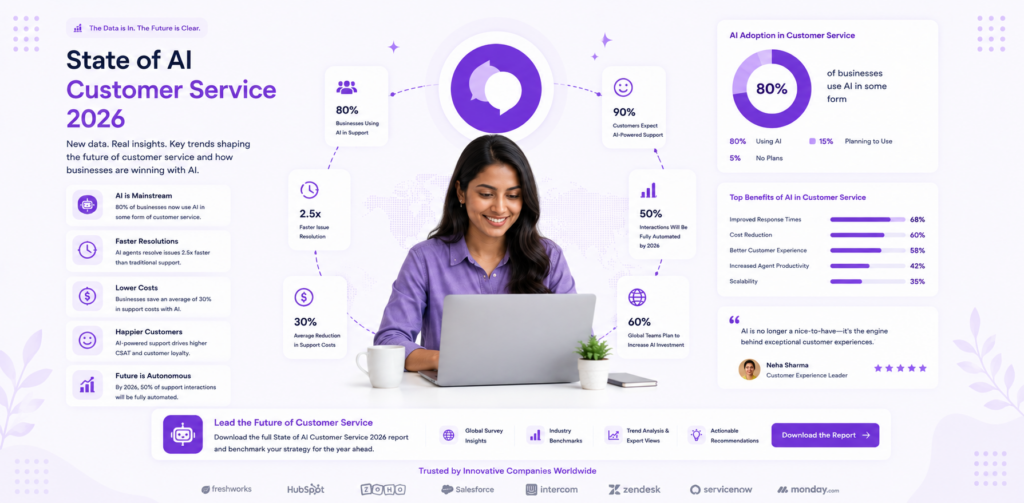
AI customer service has moved from an emerging technology category to a mainstream business practice. The businesses deploying AI in their customer support operations in 2026 are not early adopters — they are the majority. The question is no longer whether AI belongs in customer service, but how to deploy it effectively and what comes next.
This report synthesises the most important data, benchmarks, and trends defining AI customer service in 2026, with practical implications for businesses at every stage of AI adoption.
The Market in Numbers
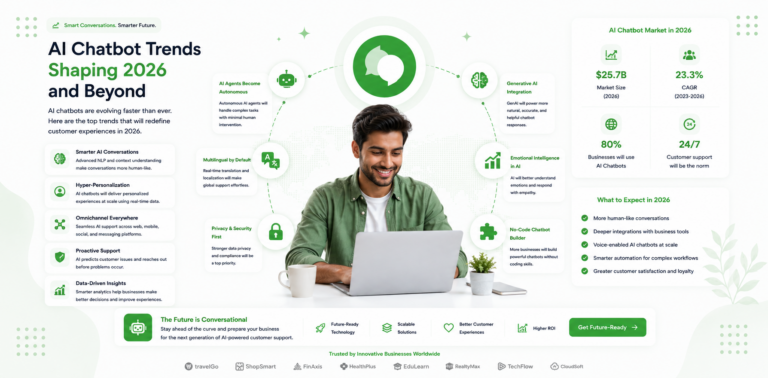
The global conversational AI market has grown dramatically and shows no signs of slowing. The market for AI-powered customer service tools is valued at over $15 billion globally in 2026, having roughly quadrupled since 2022. Adoption among SMBs specifically has accelerated sharply in the past 18 months as no-code platforms brought enterprise-grade capability within reach of smaller businesses.
In the UK, an estimated 42% of businesses with more than five employees now use some form of AI in their customer support operations, up from 18% in 2023. The growth rate is particularly pronounced among e-commerce, SaaS, hospitality, and professional services businesses.
Customer acceptance of AI service has kept pace with deployment. In 2022, surveys showed approximately 60% of consumers were comfortable with AI handling routine queries. In 2026, that figure is consistently above 80% — driven largely by improvements in response quality and speed.
Adoption Patterns: Who Is Deploying and Why
By business size. Enterprise adoption has been sustained and growing since 2020. The significant 2025–2026 shift has been in the SMB segment, where adoption has more than doubled. The driver is overwhelmingly the emergence of no-code platforms with SMB-accessible pricing.
By industry. E-commerce leads adoption at approximately 67% penetration, driven by the high volume of repetitive post-purchase queries that AI handles well. SaaS follows at around 58%, where AI is increasingly used to qualify leads and triage support across multi-product portfolios. Hospitality, retail, and healthcare have all seen rapid adoption growth in 2025–2026.
By deployment channel. Website chat remains the most common first deployment channel, used by approximately 78% of AI chatbot adopters, with many businesses then unifying it with their other channels into a single inbox. WhatsApp deployment has grown fastest over the past 18 months, now at approximately 31% of adopters.
Primary deployment motivation. Cost reduction is still the most cited primary motivation (64% of deployers), but revenue enhancement has grown rapidly as a stated goal — from 22% of deployers citing it as primary in 2022 to 41% in 2026.
Performance Benchmarks: What Good Looks Like in 2026
Understanding what typical and excellent deployments look like is essential for setting realistic expectations. For businesses that want to see how these numbers play out in practice, real-world case studies with measurable results are the most reliable benchmark.
Automation rate:
- Median across SMB deployments: 52%
- Top quartile (75th percentile): 67%
- Bottom quartile (25th percentile): 34%
Businesses in the top quartile share common characteristics: large, well-maintained knowledge bases (60+ entries), weekly review of failed conversations, and active use of CRM integration for personalisation.
First response time:
- Median AI response time: 3.2 seconds
- Median human-only response time: 2 hours 44 minutes
The gap here is stark and explains why response time improvement is the most universally cited benefit of AI deployment — and why the true cost of slow customer response times is so often underestimated.
Customer satisfaction (CSAT) scores:
- Pre-deployment median CSAT: 3.9/5
- Post-deployment median CSAT (6 months in): 4.4/5
- Key driver: Speed improvement and 24/7 availability
Sustaining these gains depends on measuring the right support metrics rather than tracking volume alone.
Cost per resolved ticket:
- Human-only resolution: £1.80–3.20 average
- AI-resolved tickets: £0.12–0.28 average (platform cost amortised across ticket volume)
At a typical SMB automation rate of 52%, the blended cost per ticket drops by approximately 45%. To model the impact for your own operation, it helps to calculate your AI chatbot ROI with real numbers.
The Quality Gap: Why Some Deployments Fail
Not all AI customer service deployments deliver positive outcomes. Understanding where failures occur is as important as understanding where success comes from.
Underdeveloped knowledge bases. The most common failure mode: an AI deployed with 15–20 FAQ responses attempting to handle a query mix that includes 80+ distinct question types. The result is high escalation rates, frustrated customers, and leadership concluding that "AI does not work for us" — when the real problem is insufficient knowledge base investment. The fix is to scale a proper FAQ and smart-response layer before judging performance.
Poor escalation configuration. Deployments that trap customers in AI loops — where the bot cannot resolve a query but also does not offer a clear path to a human — generate significantly worse outcomes than both pure human support and well-configured hybrid support. Getting this right is the core of helpdesk automation best practices for complex ticket queues.
Misaligned success metrics. Businesses that measure only ticket deflection rate miss negative signals in CSAT, repeat contact rate, and churn contribution. A chatbot that deflects 70% of tickets but drives a 15% CSAT decline is a failure, not a success.
Static deployments. AI chatbots that are configured once and never updated perform progressively worse as products evolve and customer query patterns shift. The businesses sustaining high performance 12 months after deployment treat the knowledge base as a living document, not a one-time setup task — supported by quality assurance processes that maintain excellence at scale.
What Customers Actually Think About AI Service in 2026
Speed beats humanness. When customers describe their most satisfying support interactions, the most commonly cited factor is speed — cited by 71%. Human involvement is cited by 31%. Accuracy is cited by 68%. This reflects a deeper shift in how conversational AI is changing customer expectations.
Frustration triggers are specific. Customers who report negative AI support experiences consistently cite three triggers: being unable to get a human when genuinely needed, receiving incorrect information, and being asked the same question multiple times within one interaction. None of these are inherent to AI — they are configuration failures, and systematically automating customer feedback is one of the fastest ways to surface and fix them.
Generational patterns are shifting. While older demographics retain stronger preferences for human service, the gap has narrowed substantially in 2025–2026. Across all age groups, instant AI response for routine queries is now broadly accepted when response quality is high.
What's Next: The 2026–2027 Horizon
Predictive engagement. The next evolution is proactive rather than reactive. Instead of waiting for a customer to ask a question, AI agents will anticipate needs based on behavioural signals — a customer on the cancellation page receiving a proactive retention offer; a customer whose delivery is delayed receiving a message before they ask. This predictive approach to customer support is in early deployment in 2026 and will become mainstream within 24 months.
Fully agentic customer service. As agentic AI matures, the range of actions a chatbot can take autonomously — processing returns, adjusting subscriptions, issuing credits, booking replacements — will expand significantly.
Deeper personalisation. AI customer service will increasingly behave more like a knowledgeable account manager than an automated FAQ responder. Persistent memory, purchase history integration, and behavioural context will enable genuinely personalised service at scale.
Voice and multimodal normalisation. Voice-enabled AI support and the ability to process images, documents, and video will move from differentiators to baseline expectations over the next 18–24 months — alongside multilingual support workflows for global customer service.
Implications for Your Business
The data and trends paint a clear picture: AI customer service is no longer an optional competitive advantage — it is becoming table stakes. Businesses that deploy well, maintain their deployments, and stay ahead of the shifting chatbot trends will hold a structural advantage over those that delay.
The businesses best positioned for 2026–2027 are deploying now, building operational fluency with the tools — including training their teams to work alongside AI — and accumulating the knowledge base depth and conversation data that will fuel increasingly sophisticated AI capabilities as the technology continues to evolve. For a longer view of where this is heading, see our analysis of the 10 ways AI will transform small business customer service by 2027.
FAQ
Is the UK AI customer service adoption rate above average globally? UK adoption among SMBs is broadly in line with the Western European average. However, WhatsApp deployment rates in the UK are above the US average, reflecting the platform's greater market penetration.
How does the benchmarked 52% median automation rate compare to claims of 80%+? Claims of 80%+ automation rates typically reflect best-in-class deployments with mature, comprehensive knowledge bases. The median is 52% and the realistic expectation for most SMBs in the first 90 days is 45–60%.
Are CSAT improvements always consistent after AI deployment? Not always. CSAT improves when automation quality is high and escalation is easy. Deployments with poor knowledge base coverage or difficult human escalation paths can show CSAT declines.
What is the biggest risk in delaying AI adoption? The primary risk is competitive: as AI deployment becomes universal, the advantage shifts from deployers versus non-deployers to excellent deployers versus average deployers.
How should I interpret the cost-per-ticket benchmark for my business? Use your current average handling time and blended hourly rate to calculate your actual cost per ticket, then apply the 45% blended cost reduction as a conservative projection for AI deployment impact. Our Chatloop case study on AI automation ROI for SMBs shows how this calculation plays out in a real deployment.
See where your business stands. Start your Chatloop free trial and benchmark your automation rate against the 2026 median.


3 Responses on this post
Comments are closed.