


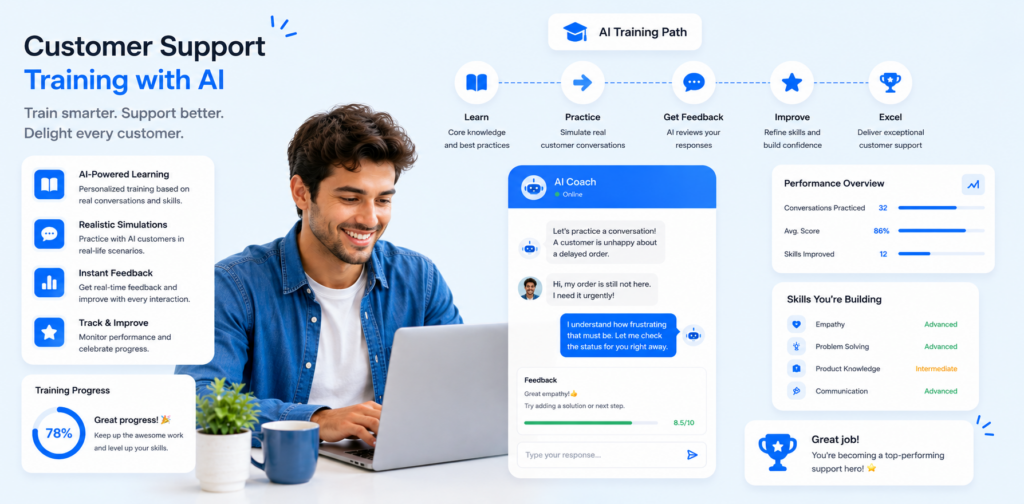
Traditional support training is inefficient. New agents spend 2-4 weeks in training, during which they're not productive. They then spend months ramping to full productivity. Senior agents spend 10-15% of their time mentoring juniors. When agents leave, institutional knowledge walks out the door.
Customer support training with AI solves these challenges. By providing personalized, on-demand training tailored to each agent's needs, AI helps new team members become productive faster while continuously improving the skills of all agents.
The Training Problem
Current Model Costs
New hire training costs: $3,000-5,000 per agent in trainer time and lost productivity. Ramp time: 3-6 months to reach full productivity. Inconsistency: Training quality depends on trainer. Knowledge loss: When experienced agent leaves, their knowledge leaves too.
For a company with 20 agents and 30% annual turnover: 6 new hires/year × $4,000 = $24,000 in direct training costs, plus opportunity cost of lost productivity.
The Learning Curve Reality
Most support training follows a predictable pattern:
- Weeks 1-2: Intensive classroom training
- Weeks 3-4: Shadowing and supervised calls
- Weeks 5-12: Gradual independence with coaching
- Months 3-6: Ramp to full productivity
Even then, new agents often don't reach veteran-level performance for 12+ months in some areas.
How AI-Powered Training Works
Continuous Learning
Unlike traditional training that happens upfront, AI-powered training provides continuous, just-in-time learning. As agents work, they encounter situations they might not fully understand. AI provides real-time guidance, suggestions, and learning content exactly when they need it.
Personalized Learning Paths
AI analyzes each agent's performance. If Agent A struggles with billing questions, the system recommends targeted training. If Agent B consistently gets positive feedback on empathy, the system suggests advanced coaching. Each agent gets training matched to their specific needs.
Knowledge Capture
When senior agents handle complex tickets, AI captures their approach, reasoning, and language. This institutional knowledge is codified and made available to all agents. New agent learns from senior's expertise without requiring one-on-one time.
Intelligent Simulation
AI creates realistic practice scenarios tailored to agent's development stage. New agent practices handling angry customers in a safe environment. As they improve, scenarios become more complex. This mirrors best practices in other industries (pilots use flight simulators before flying real planes).
Implementation Roadmap
Phase 1: Knowledge Capture (Weeks 1-2)
Record top performers handling various scenarios. Capture written knowledge (best practices, policies, scripts). Transcribe and analyze interactions to identify patterns. Document decision trees for common issues.
Phase 2: Platform Setup (Weeks 3-4)
Choose AI training platform (options: Lessonly, Absorb, custom solutions). Build learning paths for each role. Create simulations for common scenarios. Configure competency assessments.
Phase 3: Pilot Program (Weeks 5-6)
Train 3-5 new agents using AI-powered platform. Compare to traditional training baseline. Measure time-to-productivity, quality metrics, satisfaction. Refine based on results.
Phase 4: Ongoing Training (Week 7+)
Integrate into hiring and development process. Use for new agent onboarding. Use for continuous improvement of existing agents. Measure impact against baseline.
Real-World Results
Case Study 1: 25-Agent Support Team
Traditional Training: 4-week program, 12-week ramp to productivity, 15% trainer time dedicated to onboarding.
AI Training: 2-week program, 6-week ramp to productivity, 5% trainer time.
Results:
- Time to productivity: 12 weeks → 6 weeks (-50%)
- Training cost per agent: $4,000 → $1,500 (-62%)
- Trainer time freed: -10% (allows trainer to handle more tickets)
- New agent quality: Improved by 15-20%
- Annual cost savings: $48,000
Case Study 2: High-Turnover Support Center (100 agents)
Turnover: 40% annually = 40 new hires/year. Traditional training: Each hire requires 2-week commitment of trainer (80 person-weeks/year).
AI Training: New hire completes self-paced AI training + 1-week human supervision. Trainer time reduced to 20 person-weeks/year.
Results:
- Trainer capacity freed: 60 person-weeks/year
- Equivalent to hiring 1.2 new agents
- Cost savings: $120,000/year
- Quality consistency: Significantly improved
- Turnover reduced: 40% → 32% (better experience reduces churn)
Case Study 3: 60-Agent Multilingual Team
Challenge: Training across multiple languages and cultural contexts. Variation in quality due to inconsistent trainer backgrounds.
AI Training: Standardized training across all teams in local languages. Role-specific modules. Continuous performance monitoring.
Results:
- Quality consistency: Improved significantly
- Language fluency: New hires achieve target 95% understanding faster
- Trainer coordination: Easier across time zones
- Overall team performance: +25% improvement in first quarter
Key Features of Effective AI Training
1. Real-Time Performance Analysis
The system watches agents work and provides immediate feedback. "You handled that billing issue well, but next time mention the late payment fee upfront to set expectations."
2. Personalized Learning Recommendations
Based on performance data, the system recommends specific training. "You've taken 47 product questions. Recommend module: Advanced Product Features."
3. Competency Assessment
AI assesses mastery of key competencies: Product Knowledge, Customer Empathy, Technical Troubleshooting, Policy Compliance, etc. Shows strengths and improvement areas.
4. Simulation-Based Practice
Rather than practicing on real customers, agents practice in realistic simulations. They can make mistakes, learn, and improve before handling real tickets.
5. Knowledge Management
Captures best practices and institutional knowledge. Codifies how senior agents handle complex situations. Makes this available to all agents.
6. Team Analytics
Managers see team-wide performance by skill, topic, quality metric. Identify skill gaps and training needs at scale.
Best Practices
Start with High-Leverage Areas
Don't train on everything. Focus on areas where training drives highest business impact: new employee onboarding, handling difficult customers, product knowledge, upselling/cross-selling.
Use Real Scenarios
Train on real customer questions and situations. Avoid generic roleplay scenarios that don't match your actual customer base.
Measure Performance Impact
Track key metrics: time-to-productivity, quality scores, customer satisfaction, first-contact resolution. Show ROI clearly.
Combine with Human Coaching
AI is a supplement to human coaching, not replacement. Senior agents should spend less time on basic training and more on advanced mentoring.
Continuous Improvement
Regularly update training content based on: new products/features, customer feedback, top performer techniques, emerging issues.
Metrics That Matter
| Metric | Baseline | After AI | Impact |
|---|---|---|---|
| Week to 80% productivity | 12 weeks | 6 weeks | -50% faster |
| First-week performance | 40-50% | 60-70% | +20-30 points |
| Training cost per agent | $4,000 | $1,500 | -62% |
| Quality consistency | 60-80% | 85-95% | +25 points |
| Agent satisfaction | 7/10 | 8.5/10 | +1.5 points |
Tools and Platforms
Popular AI-enabled training platforms:
- Lessonly: LMS with AI recommendations
- Absorb Learning: Personalized learning paths
- Duolingo for Work: Language + support skills
- Custom platforms: Built on your specific needs
Addressing Concerns
Concern: Will AI training replace human trainers? Reality: It augments their time, freeing them for higher-value mentoring and advanced coaching.
Concern: Agents won't prefer AI to human training. Reality: Most agents prefer AI for routine training (flexible timing, self-paced) and human coaching for advanced skills.
Concern: Is it expensive to set up? Reality: Upfront cost ($20-50k) is recovered in first 6-12 months through productivity gains and reduced turnover.
Conclusion
AI-powered customer support training builds skilled teams dramatically faster than traditional methods. By combining standardized, personalized learning with real-time coaching and institutional knowledge capture, organizations can:
- Get new agents productive 50%+ faster
- Reduce training costs 40-60%
- Improve team consistency and quality
- Reduce costly turnover
- Create career development paths that retain talent
The companies winning in support aren't those with the most agents—they're those with the most skilled agents. AI training is how you build that competitive advantage.
Next Steps
- Audit your current training program - identify inefficiencies
- Calculate training ROI - what's faster ramp time worth?
- Document best practices - capture your top performers' techniques
- Request platform demos - see options
- Plan pilot - train next cohort with AI
Ready to transform training? Most platforms offer trials with your own training content. Start today and see productivity improvements within weeks.


2 Responses on this post
Comments are closed.