


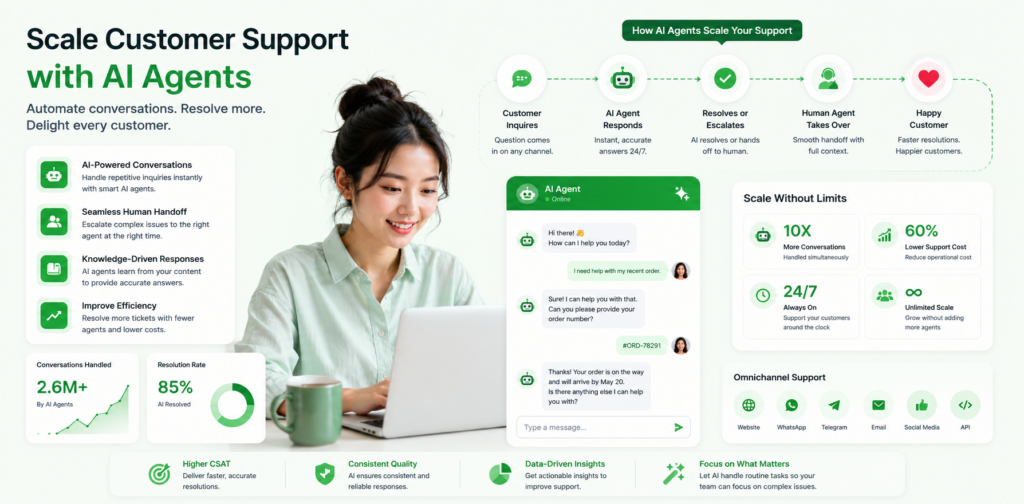
As your business grows, customer support becomes exponentially more challenging. What worked for 100 customers breaks at 10,000. AI agents offer the scalability you need without proportional cost increases. This guide covers scaling strategies for every growth stage.
What You'll Learn
- Scaling challenges at each stage
- Stage-specific support strategies
- AI implementation timing
- Cost optimization techniques
- Performance metrics by scale
- Enterprise best practices
The Support Scaling Problem
Why Support Gets Harder as You Grow
The Paradox: As your business grows, support costs grow even faster.
Typical Cost Growth Pattern:
- At 100 customers: Support ratio = 1:100
- At 1,000 customers: Support ratio = 1:200
- At 10,000 customers: Support ratio = 1:500
- At 100,000 customers: Support ratio = 1:1000
Why?
- Increased product complexity
- More diverse customer needs
- Higher customer expectations
- Multiple channels
- Compliance requirements
The AI Solution
AI agents level the playing field by:
- Handling routine queries (60-80% of volume)
- Operating 24/7 without human fatigue
- Scaling linearly with volume
- Learning and improving over time
- Reducing human agent burnout
Stage 1: Startup Phase (0-1,000 Customers)
Support Model
Team size: 1-2 people Tickets/month: 50-300 Tools: Basic ticketing or email
Challenges
- Bootstrapped budget
- Founder's time stretched thin
- Limited tooling
- No AI investment ROI yet
AI Strategy for Startups
When to implement: Immediately if budget allows Why: Even 1 person doing 50% AI-assisted support is 1.5 FTE
Recommended approach:
- Start with WhatsApp AI (highest ROI)
- Use AI for FAQ automation
- Simple knowledge base
- Founder reviews escalations
Cost Model
| Item | Cost |
|---|---|
| Founder time (partial) | $20k/month |
| Basic ticketing | $50/month |
| AI chatbot (simple) | $99/month |
| Total: | ~$20k/month |
Metrics to Track
- Response time (target: <4 hours)
- Resolution rate (target: >60%)
- CSAT (target: >4/5)
- AI automation rate (track: % automated)
Scaling Action
- Document processes
- Build knowledge base
- Monitor what questions repeat
- Plan for next stage
Stage 2: Growth Phase (1,000-10,000 Customers)
Support Model
Team size: 2-5 people Tickets/month: 300-2,000 Tools: Ticketing system + AI + basic CRM
Challenges
- Manual processes breaking down
- Quality control issues
- Inconsistent responses
- High staff turnover risk
- Rising costs
AI Strategy for Growth Phase
When to implement: Upgrade to enterprise AI Why: 70% automation becomes possible with proper infrastructure
Recommended approach:
- Multi-channel platform (WhatsApp + Email + Chat)
- Advanced knowledge base
- AI handles 60-70% of tickets
- 2-3 humans handle escalations
- Manager oversees quality
Cost Model
| Item | Cost |
|---|---|
| 3 support agents | $120k/year |
| Unified platform | $500/month |
| Advanced AI | $500/month |
| CRM integration | $200/month |
| Total: | ~$130k/year |
Cost per ticket: $5-8 Savings vs manual: 40-50%
Metrics to Track
| Metric | Target |
|---|---|
| Response time | <2 hours |
| First contact resolution | >75% |
| CSAT | >4.2/5 |
| AI automation rate | >70% |
| Human escalation rate | <30% |
| Cost per ticket | <$8 |
Scaling Action
- Implement ticketing + AI stack
- Document standard procedures
- Train team on AI tools
- Build competitive hiring advantage
Stage 3: Mid-Market Phase (10,000-100,000 Customers)
Support Model
Team size: 5-20 people Tickets/month: 2,000-15,000 Tools: Full-stack: Ticketing + AI + CRM + Analytics
Challenges
- Need for specialization (tiers/topics)
- Consistency across team
- Performance management
- Team scaling and hiring
- Regional/timezone coverage
AI Strategy for Mid-Market
When to implement: Mature AI infrastructure Why: Complex escalations still need humans; AI handles routine
Recommended approach:
- Tier 1: 80% AI-handled (FAQ, password resets, billing)
- Tier 2: 30% AI-assisted (technical issues, configuration)
- Tier 3: 0% AI (complex problems, escalations)
- Regional teams in major timezones
- Full analytics and reporting
Cost Model
| Item | Annual Cost |
|---|---|
| 15 support agents | $600k |
| Manager (1 FTE) | $80k |
| Platform/AI stack | $60k |
| Training/tools | $30k |
| Total: | ~$770k |
Cost per ticket: $3-5 Savings vs manual: 50-60%
Metrics to Track
| Metric | Target |
|---|---|
| Response time | <1 hour |
| First contact resolution | >80% |
| CSAT | >4.3/5 |
| AI automation rate (Tier 1) | >80% |
| Cost per ticket | <$5 |
| Average handle time | <5 minutes |
| Ticket volume growth | Linear |
Scaling Action
- Implement specialized routing
- Hire team leads
- Implement performance reviews
- Build knowledge base culture
- Invest in training
Stage 4: Enterprise Phase (100,000+ Customers)
Support Model
Team size: 20-100+ people Tickets/month: 15,000+ Tools: Full enterprise stack with advanced AI
Challenges
- Enterprise SLAs and compliance
- Multi-region operations
- Multiple product lines
- Consistency at scale
- Premium support tiers
- Advanced analytics
AI Strategy for Enterprise
When to implement: Fully mature, integrated system Why: At this scale, cost per ticket is critical
Recommended approach:
- Tier 1: 85-90% automation (standard queries)
- Tier 2: 50% AI-assisted (technical support)
- Tier 3: 0% AI (strategic issues)
- 24/7 coverage across regions
- Premium tier: Humans from start
- Advanced analytics and AI model training
- Machine learning from ticket patterns
Cost Model
| Item | Annual Cost |
|---|---|
| Support staff (50 FTE) | $2,000k |
| Managers/leads (5 FTE) | $400k |
| Enterprise AI platform | $500k |
| Analytics/reporting | $100k |
| Training/development | $100k |
| Total: | ~$3.1M |
Cost per ticket: $1.50-2.50 Savings vs manual: 60-70% Cost per customer per year: $0.25-0.50
Metrics to Track
| Metric | Target |
|---|---|
| Response time | <30 minutes |
| First contact resolution | >85% |
| CSAT | >4.4/5 |
| NPS | >50 |
| AI automation rate | >85% |
| Cost per ticket | <$2.50 |
| Ticket volume: Linear to growth | ~1:20 ratio |
Scaling Action
- Invest in AI model training
- Build proprietary systems
- Implement advanced analytics
- Optimize workflows continuously
- Consider 24/7 global operations
Comparing Support Costs Across Stages
Cost Per Customer Per Year
| Stage | Customers | Cost/Customer/Year |
|---|---|---|
| Startup | 500 | $40 |
| Growth | 5,000 | $26 |
| Mid-Market | 50,000 | $15 |
| Enterprise | 500,000 | $6 |
Key insight: Better efficiency at every stage
Timeline to Profitability
| Stage | Time to ROI | Notes |
|---|---|---|
| Startup | Immediate | Even simple AI helps |
| Growth | 3-4 weeks | 60% automation reduces costs |
| Mid-Market | 2-3 weeks | Scale efficiency kicks in |
| Enterprise | 1-2 weeks | Volume discounts apply |
Technical Infrastructure by Stage
Startup Architecture

Growth Architecture

Mid-Market Architecture

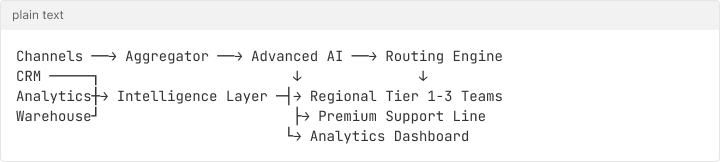
Enterprise Architecture
Common Scaling Mistakes
| Mistake | Impact | Solution |
|---|---|---|
| Scaling manually first | Costs explode | Use AI from beginning |
| No process documentation | Chaos | Document as you grow |
| Wrong tool selection | Hidden costs | Evaluate enterprise needs early |
| Ignoring automation | Cost explosion | Automate 60%+ early |
| No analytics | Flying blind | Implement monitoring now |
| Poor knowledge base | Lower automation | Invest in KB early |
Key Principles for Successful Scaling
Principle 1: Automate Early, Automate Often
- Start with 30-40% automation in startup phase
- Goal: 70-80% in growth phase
- Target: 85%+ in mid-market and enterprise
Principle 2: Invest in Infrastructure
- Choose platforms that scale
- Plan for 10x growth
- Build automation as you go
- Don't overspend early; don't underspend later
Principle 3: Focus on Knowledge Base
- Your knowledge base is your AI's brain
- Poor KB = poor automation
- Invest continuously
- Keep it updated
Principle 4: Monitor and Measure
- Track metrics at every stage
- Use data to guide decisions
- Iterate quickly
- Learn from patterns
Principle 5: Build Culture of Quality
- Quality over volume
- Empower agents
- Celebrate wins
- Share learnings
Scaling Timeline Example
Year 1: Startup Phase
- Month 1-3: Basic AI support
- Month 4-6: Growing ticket volume
- Month 7-9: Adding chat channel
- Month 10-12: Evaluating next upgrade
End state: 1-2 people, 30% AI automation, $300 budget
Year 2: Growth Phase
- Month 1-3: Implement unified platform
- Month 4-6: Hire first full-time agent
- Month 7-9: Add WhatsApp channel
- Month 10-12: Reach 60% automation
End state: 3-5 people, 60% automation, $5k/month budget
Year 3: Mid-Market Phase
- Month 1-6: Build specialized tiers
- Month 7-9: Hire team lead
- Month 10-12: Implement advanced analytics
End state: 10-15 people, 70% automation, $50k/month cost
Year 4+: Enterprise Phase
- Continuous optimization
- Regional expansion
- Advanced AI implementation
- Premium tier development
End state: 30-50+ people, 85%+ automation, mature operations
FAQ & Troubleshooting
Q: When is the right time to implement AI?
A: Day 1, if possible. Even startups with 10 tickets/month benefit. Scale grows linearly with AI; without it, costs grow exponentially.
Q: How to transition from manual to AI without disrupting service?
A: Gradual rollout. Start with FAQ automation only, expand as system improves. Keep humans in parallel until confident.
Q: What's the right staffing ratio at each stage?
A: Startup: 1 person, Growth: 1 per 2-3k customers, Mid-market: 1 per 5k customers, Enterprise: 1 per 10k+ customers (with AI)
Q: Should I build or buy support tools?
A: Buy. Almost always. Building is expensive and distracts from core product.
Q: How to keep CSAT high while scaling?
A: Focus on automation quality, invest in training, implement quality reviews, maintain knowledge base rigorously.
Conclusion
Scaling customer support without AI forces you into an impossible economics problem: costs grow faster than revenue. AI agents solve this by handling 60-85% of volume while your humans focus on complex, high-value interactions. By implementing AI at every stage and continuously optimizing, you can maintain or improve service quality while reducing per-ticket costs from $40+ (startup) to $1-2 (enterprise).



Comments are closed.