


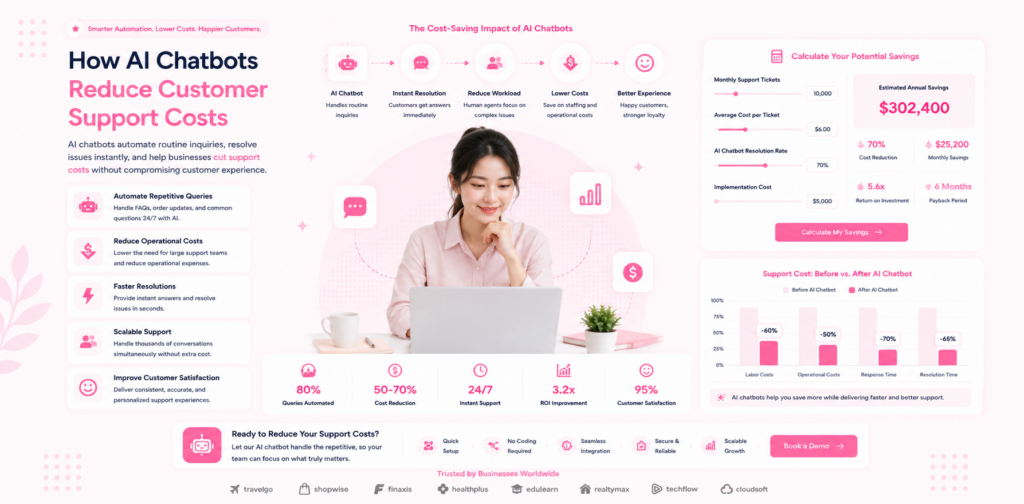
Customer support is one of the most significant operational costs for businesses of any size. For SMBs, where every pound of operational spend competes with growth investment, the pressure to deliver quality support without proportionally growing the support team is constant.
AI chatbots have emerged as the most practical solution to this tension — not because they replace human agents, but because they handle the majority of queries that do not require human judgment, at a cost that is a fraction of manual processing. The headline claim — 40% cost reduction — is not marketing. It is a floor, not a ceiling.
This guide explains exactly where those savings come from, how to calculate them for your business, and how to implement AI support cost reduction without compromising quality.
The Real Cost of Manual Customer Support
Before understanding how AI reduces costs, you need an accurate picture of what your current support actually costs. Most businesses dramatically underestimate this figure.
Direct labour cost per ticket The most obvious cost: the time your team spends reading, processing, and responding to each query. At a blended hourly rate of £15–25 for a support agent or business owner, and an average handling time of five to eight minutes per ticket, you are spending between £1.25 and £3.33 per ticket in labour alone.
Overhead and management cost Support staff require management time, training, systems, and workspace. Industry benchmarks suggest overhead adds 30–40% to direct labour costs. A team spending £3,000/month on direct support labour is actually costing £3,900–4,200/month in total.
After-hours cost Queries that arrive outside business hours create one of three costs: overtime or shift premium to cover them, the cost of a missed opportunity when they go unanswered, or the management burden of handling a backlog at the start of each day.
Error and inconsistency cost Human agents give inconsistent answers. Policy questions answered differently by different team members create customer confusion, complaints, and repeat contacts. The cost of each "I was told something different last time" interaction is at least two tickets where there should be one.
Escalation and re-handling cost When a customer has to contact you more than once about the same issue — because the first response was incomplete or incorrect — the cost multiplies. First-contact resolution rate is a critical but often unmeasured cost driver.
The Five Mechanisms Through Which AI Reduces Costs
Mechanism 1: Automation of high-volume, low-complexity queries This is the primary cost lever. When 55–65% of your incoming queries are handled automatically, your team's time is freed for the queries that genuinely require human involvement. The per-ticket cost for automated queries approaches zero — only the platform subscription applies.
If you receive 800 monthly tickets, automate 60% of them, and each manual ticket costs £2.00 in labour:
- Before: 800 × £2.00 = £1,600/month
- After: 320 × £2.00 = £640/month
- Saving: £960/month on labour alone
Mechanism 2: Elimination of after-hours staffing costs An AI chatbot that operates 24/7 removes the choice between paying shift premiums for after-hours cover or missing after-hours enquiries. The cost of the chatbot is fixed regardless of when queries arrive.
Mechanism 3: Reduction of repeat contacts through consistent answers AI agents give the same answer every time. When customers can trust that the information they receive is accurate and consistent, repeat contacts decline. A 10% reduction in repeat contacts on an 800-ticket volume eliminates 80 tickets/month — around £160/month in additional labour savings.
Mechanism 4: Faster resolution reduces abandonment and churn Customers who wait hours for a response and do not receive one abandon their purchase, dispute their payment, or switch to a competitor. Each prevented abandonment or churn has a value equivalent to the average order value or customer lifetime value.
Mechanism 5: Agent time reallocation, not headcount reduction The most durable cost benefit from AI support is not firing people — it is redeploying them. When support agents spend 60% less time on repetitive queries, they can take on higher-value work: proactive outreach, complex problem solving, product feedback collection, or upsell conversations. The same labour budget generates more business value.
Calculating Your Specific Cost Reduction
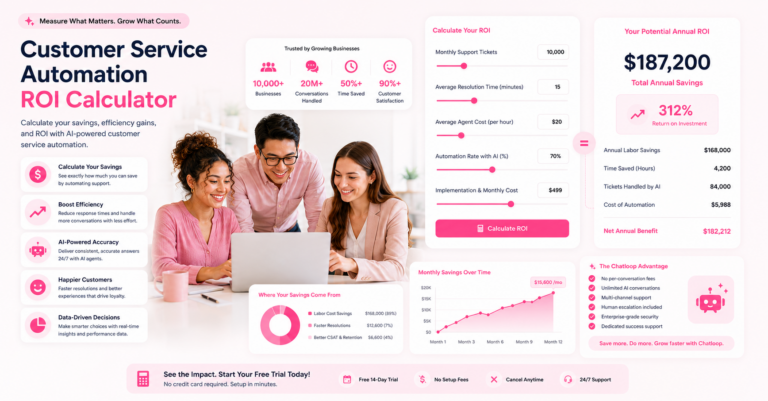
Use this framework to estimate your savings before deployment.
Step 1: Calculate current monthly support cost (Monthly ticket volume) × (Average handling time in minutes ÷ 60) × (Hourly labour rate) × 1.35 (overhead multiplier)
Step 2: Apply automation rate Multiply monthly ticket volume by your expected automation rate (use 55% as a conservative estimate). This is the number of tickets removed from human handling.
Step 3: Calculate labour saving (Automated tickets) × (Average handling time ÷ 60) × (Hourly rate) × 1.35
Step 4: Subtract platform cost Net monthly saving = Labour saving – Platform subscription fee
Example: Online service business with 500 monthly tickets
- Current cost: 500 × (6 ÷ 60) × £20 × 1.35 = £1,350/month
- Automated tickets: 500 × 55% = 275
- Labour saving: 275 × (6 ÷ 60) × £20 × 1.35 = £742.50
- Platform cost: £199/month
- Net monthly saving: £543.50 (40% cost reduction)
Implementation: How to Achieve 40% Cost Reduction in 90 Days
Month 1: Foundation Deploy with a focused knowledge base covering your top 30 FAQ topics. Do not try to automate everything on day one. Cover the queries that account for 70–80% of your volume. A narrow, accurate knowledge base outperforms a broad, patchy one every time.
Configure escalation rules for complexity, frustration signals, and high-value customer flags. Connect to your CRM or helpdesk if you use one. Set up weekly review of failed conversations.
Month 2: Expansion Review the conversations that escalated to human agents. Identify which ones the AI attempted to handle but got wrong — these are your highest priority knowledge base additions. Add ten to fifteen new FAQ topics based on actual query data.
Begin tracking automation rate weekly. The target is to improve by three to five percentage points per month through knowledge base expansion.
Month 3: Optimisation By now you should have real data on which query categories are fully automated, which are partially automated, and which consistently escalate. Focus optimisation effort on the partially automated category. Also review your conversation flows for lead capture and upsell opportunities.
Common Mistakes That Limit Cost Reduction
Launching with too few knowledge base entries. A chatbot with 15 FAQ responses will automate 15–20% of queries at best. The businesses that achieve 55–65% automation rates have 60–100 well-structured knowledge base entries covering not just the question but the follow-up questions that typically follow.
Ignoring failed conversations. Every week without reviewing failed conversations is a week of missed optimisation. This review should be a non-negotiable weekly task.
Measuring only cost, not quality. An AI chatbot that reduces costs by 40% but also reduces CSAT by 15 percentage points is a net negative outcome. Always track customer satisfaction alongside cost metrics.
Not connecting back-end systems. A chatbot without access to order data, account information, or inventory status can only answer general questions. Connecting your CRM and commerce systems doubles the automation potential overnight.
What Chatloop Delivers on Cost Reduction
Chatloop is specifically designed to deliver measurable cost reduction for SMBs without the complexity or enterprise pricing of platforms like Intercom. The no-code setup means there is no implementation cost, the monthly pricing is transparent, and the knowledge base interface is designed for non-technical users to update independently.
Customers consistently report hitting the 40% cost reduction threshold within 90 days, with some businesses achieving 55–65% reductions as automation rates improve over the first six months.
FAQ
Is a 40% cost reduction realistic for a small business? Yes. The 40% figure represents a conservative estimate based on a 55% automation rate. Businesses with higher query volumes or higher labour costs often see larger percentage reductions.
Does cost reduction require reducing headcount? No. Most businesses achieve cost reduction through time reallocation — agents spend less time on repetitive queries and more on higher-value work, without any changes to team size.
How does the cost reduction compare to Intercom or Tidio? Chatloop's pricing model delivers the same automation capability at significantly lower subscription cost, meaning a higher net saving for equivalent automation performance.
What if my query mix changes over time? The knowledge base should be updated as your product and policies evolve. Chatloop's no-code interface makes this straightforward without technical support.
Can I measure cost reduction from day one? You can begin measuring from the moment the chatbot handles its first query. Most businesses have meaningful data within two to three weeks of launch.
Start reducing your support costs today. Deploy Chatloop in under a day and measure your first week of automation.


4 Responses on this post
Comments are closed.