


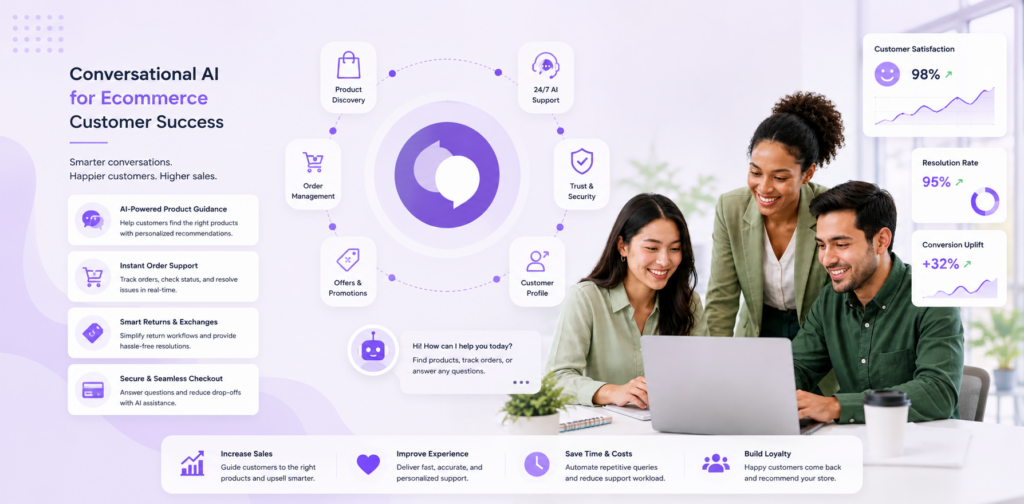
E-commerce businesses face a paradox: success creates complexity. As order volume grows, so do customer inquiries, returns, and support workload. Yet most e-commerce teams lack the bandwidth to provide personalized support at scale—or they hire more agents, watching labor costs consume 40-60% of profit margins.
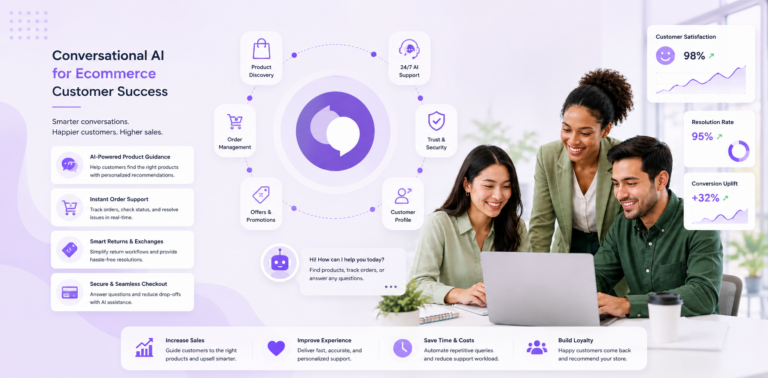
Conversational AI for e-commerce customer success offers a breakthrough solution: deliver personalized, real-time support across all channels while simultaneously increasing order value, reducing returns, and improving customer lifetime value. This comprehensive guide reveals how leading e-commerce brands are implementing conversational AI to scale customer success without scaling headcount.
Why E-commerce Needs Conversational AI
The E-commerce Support Challenge
Modern e-commerce teams face multiple pressures simultaneously. Volume explosion is constant: the average e-commerce business handles 1000+ inquiries per week. Forty percent occur outside business hours. Peak seasons create 3-5x volume spikes. Manual response becomes impossible at scale.
Cost pressure is relentless: support costs $2-5 per interaction. 1000 weekly inquiries equal $10,000-50,000 monthly. One agent handles 100-150 tickets daily. Growing volume requires proportional hiring, straining margins.
Customer experience expectations are higher than ever: 80% expect response within 1 hour. 60% expect 24/7 availability. Social media complaints cause immediate brand damage. Slow responses increase returns and chargebacks.
The Conversational AI Advantage
Conversational AI handles 50-70% of inquiries automatically, generating $5,000-30,000 monthly in cost savings. It responds instantly 24/7 with no time zone limitations. It increases average order value 15-25% through upsell recommendations. It reduces returns 10-20% by improving product clarity before purchase. It improves customer satisfaction with 85%+ rating conversational AI interactions while maintaining personal touch through customer context and purchase history.
The Business Impact: Real Data
Revenue Impact Example
Consider a business with these metrics: $85 average order value, 5,000 monthly orders ($420,000 annual revenue), $3,500/month support cost, 18% return rate, 22% repeat purchase rate.
After implementing conversational AI for 12 months:
- Support cost reduction: -$2,100/month (-60%)
- AOV increase (upsell recommendations): +8% = $36,000/month
- Return rate reduction: -5% = $51,000 saved monthly
- Repeat purchase increase: +6% = $27,000 incremental
- Total annual impact: +$870,000 (211% ROI)
Measurable Improvements Across Channels
| Metric | Before | After | Improvement |
|---|---|---|---|
| Average response time | 4-6 hours | <1 minute | 95% faster |
| Customer satisfaction | 72% | 88% | +16 points |
| First contact resolution | 45% | 78% | +73% |
| After-hours inquiries handled | 0% | 92% | Full coverage |
| Support cost per interaction | $4.50 | $0.75 | -83% |
| Return rate | 18% | 13% | -5 points |
| Repeat purchase rate | 22% | 28% | +27% |
How Conversational AI Works in E-commerce
The Complete Customer Journey
Pre-purchase: AI helps customers choose the right product, reducing returns before they happen. Purchase: Order information is created and AI suggests complementary products. Post-purchase: Shipping updates and returns support are handled automatically. Retention: Loyalty offers and replenishment reminders drive repeat purchases.
Pre-Purchase: Product Discovery
Scenario 1: Size/Fit Uncertainty
- Customer: "What size should I order? I'm usually between M and L"
- AI: Pulls product size guide, recalls past orders, recommends L based on fit data
- Result: Reduced returns, increased customer confidence
Scenario 2: Product Comparison
- Customer: "Is this better than your other backpack? What's the difference?"
- AI: Compares features, price, reviews; identifies which is better for use case
- Result: Faster decision, higher satisfaction with choice
Scenario 3: Availability Questions
- Customer: "When will this come back in stock?"
- AI: Checks inventory, predicts restock date, offers waitlist registration
- Result: Retained customer, captured intent
Purchase: Optimization
Real-time enhancements include cart recovery (AI triggers: "Having issues checking out? We're here to help"), upsell at moment of truth (AI: "Customers who buy this also get [complementary product] - Bundle for 15% off"), and checkout support (AI monitors for issues and proactively offers help).
Post-Purchase: Delivery & Support
Predictable customer inquiries (70% of volume) include order status (Customer: "Where's my order?" → AI pulls tracking), shipping questions (Customer: "Can I change my address?"), and product issues (Customer: "Product arrived damaged").
Retention: Lifetime Value
Post-purchase engagement includes delivery confirmation (AI: "Confirm you received your order. How's it going?"), product care (AI provides usage tips and care instructions), and replenishment reminders (AI: "Your [product] needs refill soon").
Implementation Framework: 6-Week Roadmap
Week 1: Assessment & Planning
Audit top 100 customer inquiries across channels. Identify patterns (40% pre-purchase, 30% shipping, 20% returns, 10% product issues). Determine channels to implement (typically: website chat → email → social). Set success metrics baseline.
Week 2: Data Preparation
Gather 6+ months of historical conversation data. Clean and organize conversations. Label intents and appropriate responses. Prepare product catalog for AI knowledge base. Extract shipping/return policies. Organize: 1000+ conversations labeled by category, complete product database, customer history API integration points, order/shipping system integration setup.
Week 3: Configuration & Training
Configure AI with e-commerce-specific templates. Train on historical conversations. Integrate with order management system. Set up inventory visibility. Configure escalation rules. Quality checks: AI accesses real order information, inventory checks return accurate data, responses match brand voice, escalation triggers appropriately, customer history displays correctly.
Week 4: Channel Integration
Deploy to website chat (highest value). Set up email integration. Configure social media monitoring. Create omnichannel customer profiles. Establish transfer protocols. Testing coverage: 200+ test scenarios, peak load testing, integration testing, human handoff testing.
Week 5: Soft Launch
Launch to 30% of incoming inquiries. Monitor daily accuracy and resolution rate. Survey customer satisfaction. Collect team feedback. Analyze escalation patterns. Make quick adjustments: refine response categories, adjust escalation thresholds, fine-tune tone, expand training data.
Week 6: Full Launch & Optimization
Roll out to 100% of inquiries. Implement continuous improvement loop. Establish weekly review cadence. Plan advanced features.
Channel-Specific Implementation
Website Chat
Best for: Real-time product questions, order tracking, returns, upsell opportunities.
Metrics:
- Target resolution rate: 75%+
- Average response time: <30 seconds
- Customer satisfaction: 85%+
- Chat-to-purchase rate: 5-10%
Configuration: Proactive chat triggers based on behavior, upsell prompts on high-margin products, escalation path for complex issues.
Email Integration
Best for: Non-urgent questions, returns, account/billing inquiries, follow-up nurturing.
Metrics:
- First-response time: <30 minutes
- First-contact resolution: 65%+
- Resolution time: <4 hours
Configuration: Auto-response with human-style templates, smart categorization, conditional routing.
SMS/Text Support
Best for: Order updates, delivery notifications, quick questions, abandoned cart reminders.
Metrics:
- Delivery rate: 98%+
- Response rate to prompts: 30-40%
- Click-through rate: 8-12%
Configuration: Triggered by customer preference, opt-in workflows, mobile-optimized messages.
Real-World Implementation Cases
Case Study 1: Mid-Size Fashion Retailer (750 SKUs)
Pre-AI: Monthly revenue $850,000, support team 12 people, average response time 3.5 hours, support cost $22,000/month.
Challenge: 3000+ inquiries/week mostly repeat questions, 40% before business hours, poor customer satisfaction (64%).
AI Implementation: Website chatbot trained on 2000 conversations, integrated with inventory and order systems, custom training on sizing, email automation for returns.
Results (90 days):
- Support team reduced to 8 people (-33%)
- Monthly cost: $11,000 (-50%)
- Response time: 2 minutes average
- Customer satisfaction: 82%
- Repeat purchase rate: 31%
- Revenue impact: +$142,000/month
Case Study 2: Specialty E-commerce (Direct-to-Consumer)
Pre-AI: Monthly revenue $2.1M, support team 18 people, support cost $48,000/month, return rate 22%.
Challenge: Seasonal volume spikes (holiday: 5x normal), above-average return rate, difficult hiring.
AI Implementation: Multi-channel (chat, email, SMS), product education focus, pre-purchase fit guidance, proactive damage reporting.
Results (180 days):
- Support cost: $22,000/month (-54%)
- Headcount: 12 (-33%)
- Peak season managed without temp hiring
- Return rate: 16% (-6 points)
- Customer satisfaction: 84%
- Annual revenue impact: +$1.8M
Case Study 3: Subscription E-commerce
Pre-AI: Monthly recurring revenue $420,000, subscriber base 8,500, churn rate 14%/month, support cost $18,000/month.
Challenge: High churn from billing questions and account issues, manual refund processing delays, low support satisfaction (68%).
AI Implementation: Smart billing question automation, proactive churn intervention, self-service account management, pause/resume support.
Results (120 days):
- Churn rate: 11.2% (-2.8 points)
- LTV increase: +$28/customer average
- Support cost: $9,500/month (-47%)
- Customer satisfaction: 81%
- Monthly revenue impact: +$47,000
Best Practices for E-commerce AI Success
Prioritize Product Knowledge
Your AI's effectiveness depends on accurate product data: detailed descriptions (300+ words), sizing guides with conversion charts, material composition, known issues, reviews, and policies. Update new products immediately, sync pricing hourly, integrate inventory real-time, and update reviews daily.
Personalization Through Customer History
Integration points: previous purchases (what have they bought?), product preferences (size, color, style?), support history (issues before?), return patterns (frequency?), lifetime value (spend-based prioritization?).
Examples: "Welcome back, Sarah! Ready to reorder [product]?" or "This comes in size L like your last order—add to cart?"
Mobile-First Experience
Most customers shop on mobile. Use short conversational messages, quick-select buttons, one-click actions, fast load times (<3 seconds). Instead of "Please describe your issue in detail..." use "Need help? Choose: [Size], [Shipping], [Returns], [Other]".
Handle Returns Intelligently
Auto-detect return reasons, initiate return label generation if eligible, offer store credit alternative to refund, guide to right product size to reduce future returns. Impact: Average processing 12 hours → <5 minutes, customer satisfaction +40 points.
Smooth Human Handoff
Effective escalation transfers context, includes customer history, prioritizes urgently, provides suggested solution. Escalate for: complex returns, customer distress signals, manager requests, novel issues.
Conclusion
Conversational AI for e-commerce customer success is essential for competitive businesses. The combination of instant response, 24/7 availability, personalization, and cost efficiency creates powerful competitive advantage.
Most e-commerce businesses implementing AI see 40-50% support cost reduction, 10-20% improvement in repeat purchase rate, and 15-25% increase in average order value within 6 months.
The key is starting with core inquiries, monitoring closely, and continuously improving based on real customer interactions.
Next Steps
- Audit your top 50 customer inquiries this week
- Calculate your support cost baseline
- Request demos from 2-3 platforms
- Identify quick wins (what % could AI handle?)
- Plan 6-week implementation with your team
Ready to scale your e-commerce support without scaling headcount? Most platforms offer 14-day free trials with your actual product catalog. Start today.


6 Responses on this post
Comments are closed.