


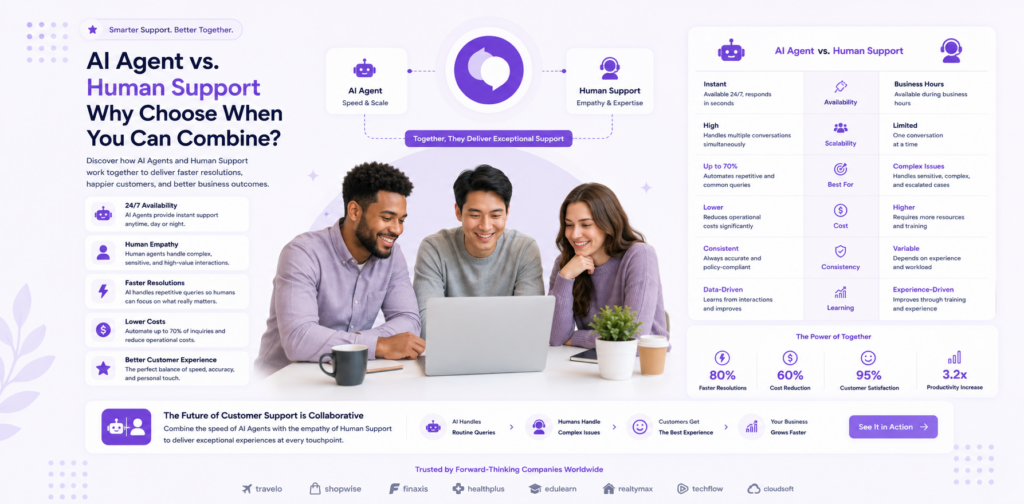
The debate is not "AI or humans" — it is "AI and humans, deployed intelligently." Businesses that achieve the highest customer satisfaction scores and the strongest support ROI are not the ones who automate everything. They are the ones who know precisely which interactions belong to an AI agent and which require a human being.
This guide gives you a clear, practical framework for making that decision across every category of customer interaction your business handles.
The False Choice Most Businesses Make
When companies first consider AI chatbots, they often frame it as a replacement decision. Will the AI replace our support team? Should we reduce headcount once the chatbot is live?
This framing leads to poor outcomes — either over-automating (customers hitting dead ends on complex issues) or under-automating (failing to capture the cost and speed benefits that make AI chatbots valuable in the first place).
The correct frame is augmentation. An AI agent handles the queries it handles better than humans can — instantly, at scale, at any hour. A human agent handles the queries they handle better than AI can — with judgment, empathy, and contextual nuance. The goal is to route every interaction to the right handler.
Where AI Agents Consistently Outperform Humans
Frequently asked questions Any question your team has answered more than ten times is a candidate for automation. FAQs about pricing, hours, return policies, shipping times, and product specifications are resolved faster, more consistently, and at a fraction of the cost by a well-configured AI agent.
Order and account status enquiries Queries like "Where is my order?", "What is my account balance?", or "When does my subscription renew?" are high-volume, low-complexity, and perfectly suited to an AI agent connected to your back-end systems.
After-hours coverage Human agents go home. AI agents do not. Any business that receives enquiries outside standard working hours benefits from AI coverage during those windows. The conversion rate on after-hours leads captured by AI versus those that go unanswered is not comparable.
Appointment booking and scheduling Intake flows, availability checks, and booking confirmations are rule-based processes that AI handles reliably. Removing humans from this workflow reduces scheduling errors and frees agent time for more valuable work.
First response and triage Even when a human agent will ultimately resolve a query, an AI agent can greet the customer, capture context, classify the issue, and route it to the right team member. This dramatically reduces time-to-resolution even when the AI does not resolve the issue itself.
High-volume repetitive queries during peak periods Black Friday, product launches, seasonal spikes — moments when query volume multiplies overnight. AI agents absorb peak volume without requiring emergency staffing, overtime costs, or quality degradation.
Where Human Agents Consistently Outperform AI
Complex, multi-issue complaints When a customer has multiple problems, high frustration, and a history of interactions that need to be understood in context, a human agent navigates nuance that AI cannot reliably handle. Attempting to automate complex complaints risks escalating frustration.
High-value retention conversations When a long-standing customer is considering cancellation or has expressed significant dissatisfaction, the conversation has commercial stakes that justify human attention. The cost of getting it wrong — losing a valuable customer — outweighs the savings from automation.
Sensitive or emotionally charged interactions Bereavement, medical urgency, financial hardship — queries with emotional stakes require human empathy. An AI that responds with clinical efficiency to a sensitive situation does real damage to brand trust.
Novel or unprecedented issues AI agents work from knowledge bases. When a customer raises an issue that genuinely has no precedent — a product defect you were unaware of, a complaint about a specific employee — a human needs to handle it and document it for future policy.
Regulatory or legal queries Questions that have compliance implications should always involve a human. An AI agent that provides inaccurate legal or regulatory information creates liability. The appropriate response is to acknowledge the query and route immediately to the right person.
Account escalations and VIP customers High-value accounts and escalated complaints benefit from the signal that a real person has invested time in their issue. Even if the resolution is the same as what an AI would provide, the act of human engagement has commercial value.
The Hybrid Support Model: A Practical Framework
The best-performing AI-human support operations use a tiered model built around query complexity and commercial stakes.
Tier 1 — Full automation (AI only) Query types: FAQs, order status, account info, booking, standard refund requests. Target automation rate: 100%. When to escalate: When the AI cannot resolve, it acknowledges and routes.
Tier 2 — AI-assisted human support Query types: Moderate complexity, multi-step troubleshooting, partial complaint. AI role: Gather context, classify issue, suggest resolution path, draft response. Human role: Review AI suggestion, personalise, send. Outcome: Faster human resolution with AI doing the groundwork.
Tier 3 — Human-led, AI-informed Query types: Complex complaints, sensitive situations, high-value accounts. AI role: Pull relevant customer history, flag previous interactions, surface policy references. Human role: Full ownership of response and resolution. Outcome: Human context is richer and faster because AI has done the research.
Tier 4 — Human only, no AI involvement Query types: Legal, regulatory, crisis management, board-level escalations. AI role: Route accurately and promptly. Human role: Complete ownership.
How to Configure Your Handoff Triggers
The quality of a hybrid model depends almost entirely on handoff triggers — the conditions under which an AI agent passes a conversation to a human.
Keyword and intent triggers Configure specific phrases or intent classifications that automatically escalate. Words like "cancel", "refund", "lawyer", "complaint", and "urgent" should trigger human routing regardless of query context.
Sentiment detection Modern AI platforms can detect frustrated or negative sentiment in a customer's messages. A conversation that starts neutral but deteriorates should trigger automatic escalation.
Loop detection If a customer asks the same question twice without receiving a satisfying answer, the AI is not resolving the issue. A second attempt at the same query should automatically route to a human agent.
Customer tier detection If your CRM is connected, the AI can identify high-value or at-risk accounts and escalate those to human agents regardless of query complexity.
Explicit request Always make "Talk to a person" instantly available. Customers who want human contact should never be forced through additional AI interactions. Friction at this point damages trust more than slow response times.
Measuring the Right Balance
The target automation rate is not "as high as possible." It is "as high as possible without compromising customer satisfaction on escalated queries."
Track these metrics together to find your optimal balance:
- Automation rate (percentage of queries fully resolved by AI)
- Escalation rate (percentage of AI conversations that route to human)
- First-contact resolution rate (percentage of all queries resolved without follow-up)
- CSAT score by query type (compare AI-resolved vs human-resolved queries)
- Escalation satisfaction score (how satisfied are customers who escalated to a human?)
If your escalation satisfaction score is low, your handoff triggers may be catching cases too late — after the customer is already frustrated. Adjust triggers to escalate earlier on high-stakes query types.
What Chatloop Provides for Hybrid Support
Chatloop is built around the hybrid model. The platform handles tier-1 automation with high accuracy, offers configurable escalation triggers, integrates with human agent inboxes, and passes full conversation context when handing off — so the human agent never has to ask "Can you tell me what you already told the bot?"
The no-code configuration means non-technical teams can adjust escalation rules, update knowledge base content, and refine routing logic without engineering support.
FAQ
Will customers mind talking to an AI agent? Research consistently shows that customers care about speed and resolution accuracy far more than whether the first responder is AI or human. As long as escalation to humans is easy and fast, most customers accept AI handling for tier-1 queries.
How do I know if my escalation rate is too high? If more than 40% of AI conversations escalate to human agents, your knowledge base likely has gaps. Review the most common escalation triggers and add content to address them.
Can the AI learn from resolved human conversations? With Chatloop, human-resolved conversations can inform knowledge base updates, helping the system handle similar queries automatically in future.
Is there a risk of the AI over-automating sensitive queries? Only if triggers are configured poorly. Chatloop allows you to define escalation rules for sensitive keywords and sentiment patterns, ensuring high-stakes queries always reach a human.
What is the ideal first automation rate for a new deployment? Start with 40–50% as a target. A conservative initial scope lets you validate quality before expanding automation to more complex query types.
Build the right balance for your business. Start your Chatloop free trial and configure your first hybrid support model in under a day.


15 Responses on this post
Comments are closed.