How AI Chatbots are Supporting the Healthcare Sector

Discover how AI chatbots for businesses are revolutionizing the healthcare sector by improving patient support, automating tasks, and enhancing efficiency.
The Future of AI Chatbots in Healthcare - Chatloop.io

Healthcare providers are under immense pressure. Patient volumes are growing, staff are stretched thin, and administrative workloads are consuming time that should be spent on care.

Meanwhile, patients expect fast, clear, and empathetic communication — whether they are booking an appointment, chasing a test result, or looking for guidance on a symptom at midnight.

Conversational AI for healthcare is bridging this gap. AI chatbots are increasingly being deployed across hospitals, clinics, dental practices, mental health services, and telehealth platforms to streamline communication, reduce administrative burden, and improve the patient journey.

This article explores how AI chatbots are being used in healthcare today, the tangible benefits they deliver, and what organisations need to consider before implementing them.


The Challenge Facing Healthcare Providers Today

Before looking at solutions, it is worth understanding the scale of the problem.

Healthcare organisations deal with enormous volumes of inbound communication every day. Appointment bookings, prescription queries, insurance questions, test result follow-ups, referral requests — the list goes on. Many of these interactions are repetitive and time-consuming for staff, yet critical for patients.

Phone lines are often overwhelmed. Email response times lag. Patients grow frustrated. Staff burn out.

The result is a system that is under-resourced at the front line of communication, even when clinical care itself is excellent. AI chatbots do not replace the clinical team — they remove the administrative friction so that team can focus on what matters most.


Key Applications of AI Chatbots in Healthcare

1. Appointment Scheduling and Management

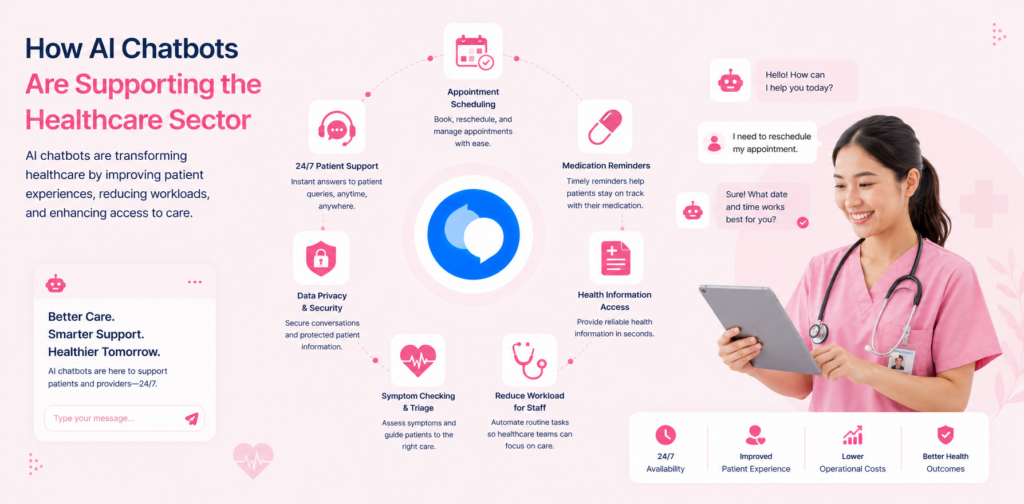
One of the most immediate and impactful uses of an AI chatbot for appointment scheduling is in booking management. An AI agent can handle the full scheduling flow — checking availability, confirming bookings, sending reminders, managing cancellations, and rescheduling — entirely without staff involvement.

Patients can book at any time of day, in natural language, without navigating a clunky online portal or waiting on hold. For providers, this reduces no-show rates, minimises administrative workload, and keeps the appointment calendar optimised.

2. Symptom Triage and Initial Assessment

AI chatbots can guide patients through a structured symptom-checking conversation, helping them understand whether they need emergency care, an urgent appointment, a routine consultation, or simply rest and over-the-counter remedies.

This is not a replacement for clinical diagnosis. It is a first layer of guidance that helps patients make informed decisions and helps providers prioritise their most urgent cases. Done well, it reduces unnecessary A&E visits and keeps appointment slots available for patients who genuinely need them.

3. Patient FAQ and Administrative Support

Healthcare providers answer the same questions thousands of times a year. What are your opening hours? How do I register as a new patient? What should I bring to my appointment? Can I get a repeat prescription?

An automated customer support chatbot handles all of these instantly and consistently, 24 hours a day. Patients get answers immediately. Staff are freed from repetitive queries. And the quality of response is always accurate and on-brand.

4. Mental Health and Wellbeing Support

Several mental health organisations are deploying conversational AI to provide initial support, psychoeducation, and guided self-help tools to people who may not yet be ready or able to access formal clinical care.

AI chatbots in this space do not provide therapy. Instead, they offer a safe, non-judgmental space for people to express how they are feeling, receive evidence-based coping strategies, and be guided toward appropriate professional support when needed.

Availability is key here. Mental health crises do not follow office hours. An AI agent that is available around the clock provides a critical safety net.

5. Post-Discharge Follow-Up and Medication Reminders

After a patient leaves hospital or completes a course of treatment, follow-up is often inconsistent. AI chatbots can automate structured check-ins — asking patients how they are recovering, flagging any concerning responses for clinical review, and sending medication or appointment reminders.

This improves continuity of care, catches complications earlier, and reduces unnecessary readmissions.

6. Multilingual Patient Communication

Healthcare settings increasingly serve diverse communities where English may not be the first language. An AI chatbot with multilingual capabilities allows providers to communicate clearly with patients regardless of language barriers — without needing to source interpreters for every routine interaction.


Benefits for Healthcare Organisations

Reduced Administrative Burden

By automating high-volume, low-complexity interactions, healthcare organisations can redeploy administrative staff to higher-value tasks. The result is better use of resources and improved staff satisfaction.

Improved Patient Experience

Patients who can get answers quickly, book appointments easily, and feel supported throughout their journey report higher satisfaction. This feeds directly into reputation, patient retention, and even clinical outcomes.

Around-the-Clock Availability

Healthcare needs do not stop outside business hours. An AI agent that is always available ensures patients are never left without guidance, regardless of when they reach out.

Scalability Without Proportional Cost

As a practice grows, the volume of patient queries grows too. An AI chatbot scales to handle increasing demand without the proportional increase in staffing costs that traditional support models require.


What to Consider Before Implementing AI in Healthcare

Healthcare is a high-stakes environment and any AI deployment must be approached thoughtfully.

Data privacy and compliance are paramount. Patient data is highly sensitive, and any AI platform used in a healthcare setting must comply with relevant regulations — including GDPR in the UK and EU, and HIPAA in the US. Always verify your provider’s compliance credentials before deploying.

Clear escalation pathways are essential. AI chatbots must be configured to recognise when a conversation requires human clinical involvement and escalate immediately. The handoff must be seamless and the patient must never feel abandoned.

Transparency with patients matters. Patients should always know they are speaking to an AI, not a clinician. Clear labelling and honest communication build trust rather than undermine it.

Clinical validation is important for any symptom-checking functionality. Symptom triage content should be developed in consultation with qualified clinicians and reviewed regularly.


Getting Started With a No-Code AI Chatbot in Healthcare

You do not need to build custom software to deploy an AI chatbot in a healthcare setting. Platforms like Chatloop allow healthcare providers to create and deploy AI agents without writing a single line of code.

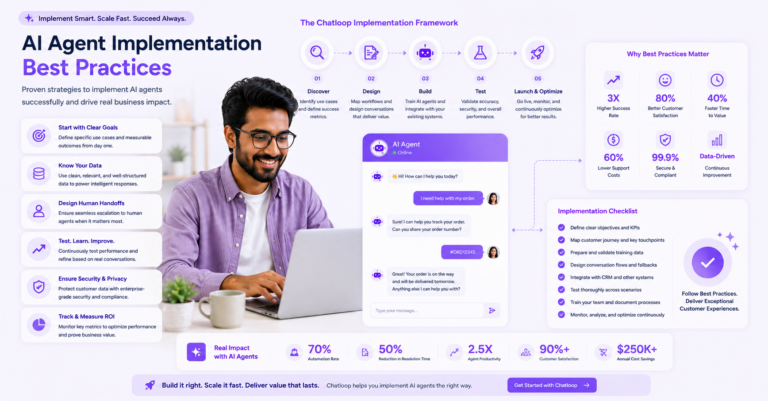
A typical implementation might look like this:

Step 1 — Identify your highest-volume queries. Start with appointment booking, opening hours, and registration FAQs. These offer the fastest return on investment.

Step 2 — Train the AI on your specific content. Upload your patient information leaflets, service descriptions, and FAQs. The AI learns from your materials and responds accordingly.

Step 3 — Define escalation rules. Decide exactly which triggers should escalate to a human — urgency keywords, emotional distress signals, or requests that require clinical judgement.

Step 4 — Pilot with a defined cohort. Before rolling out fully, test with a subset of patients and gather feedback. Refine the experience based on real-world use.

Step 5 — Monitor and iterate. Use analytics to identify gaps in the AI’s knowledge and continuously improve response quality.


Frequently Asked Questions

Can an AI chatbot diagnose medical conditions? No. AI chatbots are not qualified to diagnose. They can provide general health information, guide patients through structured triage questions, and signpost appropriate services — but clinical diagnosis must always involve a qualified healthcare professional.

Is patient data safe with an AI chatbot? Reputable platforms use encrypted data storage and transmission, and comply with relevant healthcare data regulations. Always check your provider’s compliance documentation before deploying.

Will patients be comfortable talking to an AI? Acceptance varies, but many patients — particularly for administrative tasks — are comfortable using AI-powered tools. Clear labelling and a smooth experience are key to building confidence.

Can AI chatbots support mental health services? Yes, in a supportive and informational capacity. They can provide psychoeducation, guided self-help exercises, and signposting to clinical services — but they are not a replacement for professional mental health treatment.

How quickly can a healthcare provider deploy an AI chatbot? With a no-code platform like Chatloop, basic deployments can go live in a matter of days. More complex integrations with existing patient management systems may take longer.


Conclusion

AI chatbots are not here to replace healthcare professionals. They are here to remove the administrative friction that stands between patients and the care they need.

From appointment scheduling and multilingual communication to post-discharge follow-up and mental health signposting, conversational AI for healthcare is already delivering measurable improvements across the sector.

As the technology matures and adoption grows, the organisations that embrace it now will be best positioned to deliver the kind of responsive, patient-centred care that sets them apart.

Ready to explore what an AI agent could do for your healthcare organisation? Book a free demo with Chatloop to see the platform in action.