


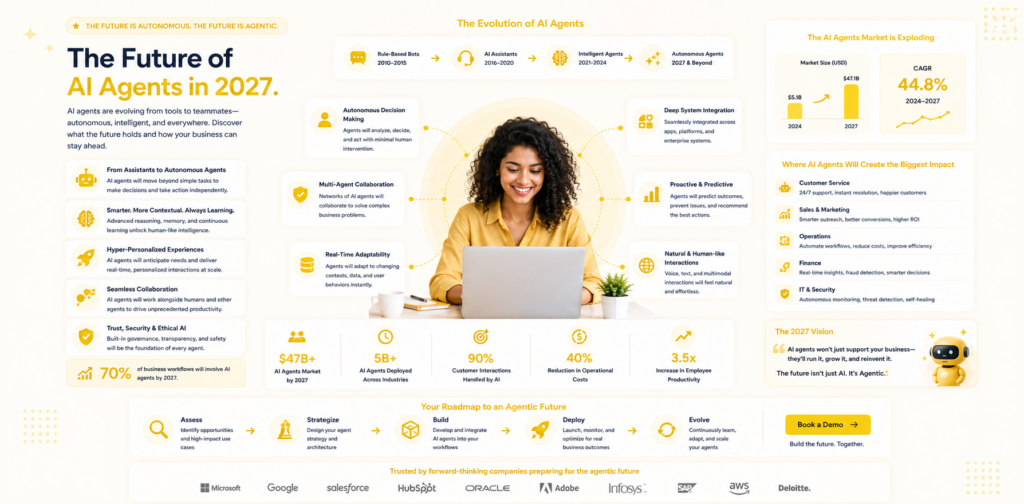
The AI agent landscape is evolving faster than almost any previous technology category. What was state-of-the-art in 2024 is now the baseline. What is emerging in 2026 will be the expectation in 2027. For businesses that are planning their AI strategy over the next 18–24 months, understanding the direction of travel is as important as understanding where the technology is today.
This article maps the most significant developments coming in AI agent technology through 2027, explains the business implications of each, and provides a practical framework for preparing your business to benefit from them — without over-investing in capabilities that are not yet ready.
Where AI Agents Stand Today
Before looking forward, a clear-eyed assessment of where AI agents are in 2026 provides the right baseline.
Today's AI agents are primarily reactive information providers with emerging action capability. They respond to queries, draw from knowledge bases, follow defined conversation flows, and increasingly take actions in connected systems — booking appointments, updating CRM records, routing requests. Automation rates of 55–70% for well-configured deployments represent a meaningful proportion of customer communication handled without human involvement.
This is already transformative for many businesses. The state of AI customer service in 2025 documents the shift from novelty to mainstream: 42% of UK businesses now deploy AI in customer support, customer acceptance is above 80% for routine queries, and cost-per-ticket for AI-resolved interactions is a fraction of human-resolved ones.
What comes next builds on this foundation.
The Five Most Significant AI Agent Developments for 2027
1. Persistent Memory Across All Interactions
Today's AI agents have context within a conversation but limited memory across conversations. A returning customer who spoke to your AI three weeks ago starts fresh — the AI does not remember what they discussed, what they bought, or what issues they had.
By 2027, persistent cross-session memory will be standard in commercial AI agent platforms. The AI will remember every previous interaction, integrate that history with CRM and purchase data, and use it to provide genuinely personalised service at scale.
The practical implication: a returning customer will be greeted by name, have their previous issues acknowledged, and receive recommendations based on their complete history — not just the current session. This shifts AI customer service from transactional to relational.
How to prepare now: Build the CRM integration habit. Businesses that connect their AI agent to their CRM today will have the data infrastructure required for persistent memory when the capability arrives. The companies with the richest customer data histories will extract the most from memory-enabled AI.
2. Full Autonomous Action Capability
Today's agentic AI can take defined actions in connected systems — booking, updating, routing. By 2027, the scope of autonomous action will expand significantly: AI agents will be capable of handling complex, multi-step processes end-to-end with minimal human checkpointing.
A returns process that currently involves: customer request → AI eligibility check → human approval → label generation → refund trigger — will be handled entirely by the AI for standard cases, with human involvement only for exceptions. A complex onboarding sequence that currently involves multiple team handoffs will execute autonomously.
This shift from "AI that assists humans" to "AI that completes processes" is the most commercially significant development on the near horizon. Businesses that have built agentic workflow foundations in 2025–2026 will be positioned to expand autonomous capability rapidly as it becomes available.
How to prepare now: Build your first automated end-to-end workflow today. The AI chatbot workflow automation guide covers the starting point. The businesses building workflow automation habits now will scale autonomous capability in 2027 rather than starting from scratch.
3. Voice-Native AI Interaction
Voice-enabled AI support has been in development for years. By 2027, it will be a mainstream customer communication channel — not as a telephone IVR replacement, but as a genuinely conversational voice interface that understands natural speech, maintains context across a voice conversation, and integrates with the same knowledge base as text-based AI interactions.
For businesses whose customers prefer voice — trades, healthcare, older demographics, and contexts where typing is inconvenient — this development opens AI automation to a significantly wider proportion of their query volume.
How to prepare now: Ensure your AI platform choice has a clear roadmap toward voice capability. Your knowledge base and conversation logic should be designed to work across modalities — an entry written for text interaction should translate to voice without requiring a separate content structure.
4. Multimodal Input Processing
By 2027, AI agents will routinely process images, documents, and video as part of customer support interactions. A customer who photographs a damaged product will receive an instant assessment and return initiation. A customer who uploads a screenshot of an error message will receive specific troubleshooting steps. A prospective customer who shares a competitor's quote will receive a targeted comparison response.
This capability — understanding what the customer is showing, not just what they are saying — dramatically expands the range of queries that AI can resolve without human involvement.
How to prepare now: The knowledge base and integration work you do today is the same foundation that multimodal AI will use. Businesses with comprehensive, well-structured knowledge bases will be able to extend to multimodal inputs faster than those starting from a low base.
5. Self-Optimising AI Agents
Today's AI agent optimisation relies on human review: someone reads failed conversations, identifies gaps, and updates the knowledge base. By 2027, AI agents will increasingly identify their own gaps, flag them for human review, and propose knowledge base additions based on patterns in their own conversation data.
The optimisation routine described in AI chatbot analytics and optimisation will partially automate: the AI will surface "I was asked about X seventeen times this week and could not answer it — here is a suggested knowledge base entry based on the most common phrasing" rather than requiring a human to identify this pattern manually.
How to prepare now: Establish the analytics and optimisation discipline today. The businesses that build a culture of data-driven chatbot improvement will leverage self-optimising capability effectively when it arrives. Those that deploy and ignore will not have the operational habits to use it.
The Competitive Landscape in 2027
Understanding where the technology is going helps clarify the competitive dynamics that will define the market by 2027.
The Expertise Gap Will Replace the Access Gap
In 2024–2025, the competitive advantage in AI was simply having it. By 2027, AI will be broadly deployed — the access gap will be largely closed. The new competitive advantage will be expertise gap: which businesses have the most mature knowledge bases, the most sophisticated workflow automation, and the deepest integration between AI and their operational data.
Businesses deploying and refining AI in 2025–2026 are building the expertise, the data, and the operational fluency that will be the competitive differentiator in 2027. This is the first-mover advantage window that is still open but closing.
SMBs with AI Will Outcompete Enterprises Without It
One of the most significant structural shifts of the 2025–2027 period is that AI removes the enterprise scale advantage in customer service. A ten-person business with a mature AI deployment delivers 24/7 instant, personalised, multilingual customer service — capabilities that previously required enterprise infrastructure and headcount.
By 2027, the distinction will not be "large company vs small company" but "AI-mature company vs AI-immature company." Companies in the latter category will be at a structural disadvantage that is difficult to close quickly.
For a perspective on how AI is already reshaping the competitive landscape, see why no-code AI agents are the future of small business automation.
Regulatory Maturation Will Create Compliance Requirements
The regulatory environment for AI in customer-facing applications is evolving. By 2027, the UK's AI regulation framework will be further developed, and specific requirements around AI disclosure, data processing, and customer rights in AI interactions will be more clearly defined.
Businesses that have already built compliant AI deployments — clear AI disclosure, accessible human escalation, proper data processing — will need minimal adjustment. Those deploying hastily without compliance consideration will face retrofit costs and potential regulatory exposure.
Your 2026–2027 AI Agent Roadmap
Quarters 1–2 of 2026 (now):
- Deploy your first AI agent for customer support — website chat and WhatsApp
- Build a knowledge base covering your top 50 customer queries
- Connect your CRM and core business systems
- Establish the weekly analytics review routine
Quarter 3 of 2026:
- Add your first automated end-to-end workflow (booking, qualification, or returns)
- Expand to a second channel if not already deployed on both website and WhatsApp
- Begin lead qualification automation if not already in place
- Reach 60%+ automation rate through ongoing knowledge base investment
Quarter 4 of 2026:
- Implement predictive support for your top two churn or delivery risk signals
- Expand knowledge base to 80+ entries
- Begin measuring revenue impact (lead conversion, upsell conversion) alongside cost metrics
- Review your AI platform's product roadmap for 2027 capabilities
2027:
- Activate persistent memory capabilities as they become available from your platform
- Expand autonomous action scope as agentic capabilities mature
- Evaluate voice capability for relevant customer segments
- Build multimodal input handling for your highest-value image-based support use cases
Choosing the Right Platform for the 2027 Horizon
The platform you choose today should have a clear, credible roadmap toward the capabilities described above. Evaluate your current or prospective AI agent platform against these criteria:
Integration depth today. A platform with shallow integrations today is unlikely to support the deep operational connections that autonomous AI requires in 2027. Prioritise platforms with pre-built connections to the tools you run on. Review chatloop.io's integrations as a reference point.
Roadmap credibility. Is the platform actively developing agentic, voice, and multimodal capabilities? What is the timeline? What is the evidence of delivery against previous roadmap commitments?
Data portability. In 2027, your conversation history and knowledge base are strategic assets. Ensure you can export and own this data if you change platforms.
Compliance track record. As regulatory requirements evolve, a platform with a strong compliance track record — GDPR compliance, transparent data processing, audit capabilities — is a lower-risk choice than one that treats compliance as an afterthought.
Chatloop.io is built for this trajectory — with active investment in agentic capability, multimodal support, and the integrations depth required for 2027-level autonomous operations. For current capabilities and pricing, see chatloop.io features and plans.
FAQ
Is it too early to prepare for 2027 AI capabilities? No — it is exactly the right time. The foundations required for 2027 AI (integration depth, knowledge base quality, workflow automation) are the same foundations that deliver value today. Building them now generates immediate returns while positioning for future capability.
Will the AI agent platforms available today still be relevant in 2027? Platforms that are actively developing toward agentic, voice, and multimodal capability will remain relevant. Platforms that are static will be displaced. Evaluate your platform's development trajectory as part of your 2026 planning.
How should I think about AI investment relative to other technology spending? AI agent investment has unusually short payback periods — most deployments are cash-positive within 30–60 days from support cost reduction alone. This makes it a different risk profile from most technology investments, which have longer payback periods. See how to calculate AI chatbot ROI for the financial framework.
What is the biggest mistake businesses make when planning for future AI? Waiting. The competitive window for building AI expertise advantage is 2025–2026. Businesses that deploy in 2027 will be catching up to a standard, not setting one. The businesses with the most to gain from acting now are those that have not yet started.
What is chatloop.io's product roadmap toward 2027 capabilities? For the most current information on chatloop.io's development roadmap, contact the team directly through chatloop.io's contact page or start a conversation in the chatloop.io app. Feature development moves quickly and the most accurate information is always direct from the team.
The window to build AI expertise advantage is open now. Start your free chatloop.io trial — and position your business for 2027 while your competitors are still deciding.


Comments are closed.