


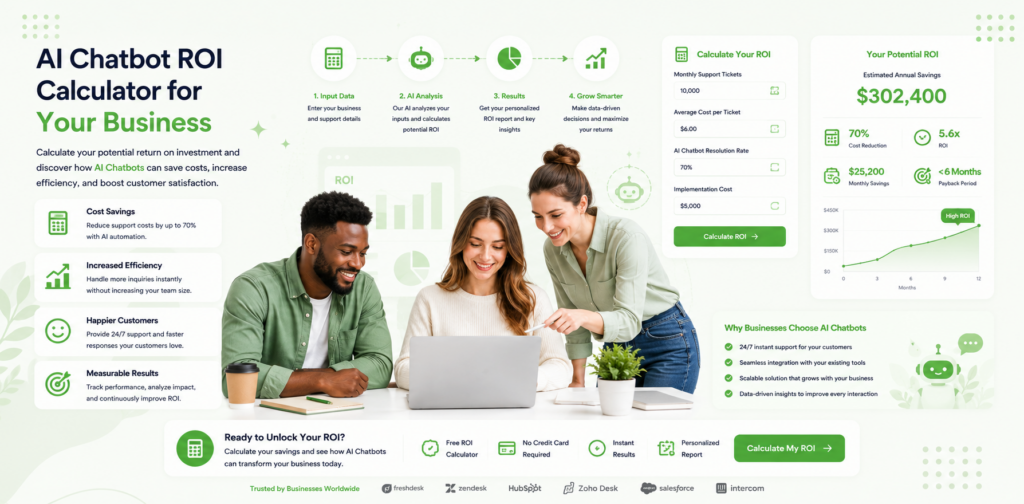
Businesses that deploy AI chatbots often ask one question before signing up: will this actually pay for itself? The answer is almost always yes — but only if you measure it correctly. This guide walks you through every component of AI chatbot ROI, gives you a working formula, and shows you real numbers from businesses using Chatloop to automate customer support.
By the end, you will know exactly how to build a business case for AI chat automation and what return to realistically expect in your first 90 days.
What Is AI Chatbot ROI?
Return on investment for an AI chatbot is the net financial gain from deploying the tool, divided by the total cost of ownership, expressed as a percentage. Unlike vanity metrics such as chat volume or session length, ROI ties directly to revenue saved or generated.
The formula is straightforward:
ROI (%) = ((Total Benefits – Total Costs) ÷ Total Costs) × 100
The challenge is not the maths — it is knowing which costs and benefits to include.
Step 1: Calculate Your Total Costs
Before calculating returns, you need a clear picture of what the chatbot actually costs.
Platform subscription fee Most AI chatbot platforms charge a monthly SaaS fee. Chatloop's pricing starts at a fraction of what enterprise tools like Intercom charge, making it accessible for SMBs and scaling startups alike.
Setup and integration time Even no-code platforms require initial configuration. Budget for the hours your team spends uploading knowledge base content, setting escalation rules, and connecting your CRM or helpdesk. For most Chatloop customers, this is a one-time investment of four to eight hours.
Ongoing maintenance AI chatbots need periodic updates as your product evolves. A realistic estimate is one to two hours per month to refresh knowledge base articles, review failed conversations, and adjust response flows.
Total Monthly Cost Example for a Small Business:
- Platform fee: £149/month
- Amortised setup time (£25/hr × 6 hrs ÷ 12 months): £12.50/month
- Maintenance (1.5 hrs × £25/hr): £37.50/month
- Total: approximately £199/month
Step 2: Quantify Your Support Costs Before Automation
This is where most businesses underestimate the value of a chatbot, because manual support costs are hidden across salary, overhead, and opportunity cost.
Direct labour cost per ticket Calculate the average time your team spends resolving a single customer enquiry. Include reading, typing, looking up information, and any follow-up. For most SMBs this is between four and eight minutes per ticket.
Multiply that by your team's blended hourly rate. If your support agent earns £15/hour and each ticket takes six minutes:
Cost per ticket = £15 ÷ 60 × 6 = £1.50
Monthly ticket volume Pull your monthly incoming query volume from your helpdesk, email inbox, or CRM. If you receive 800 tickets per month:
Total monthly manual support cost = 800 × £1.50 = £1,200/month
After-hours and overflow costs Queries outside business hours either go unanswered (lost revenue) or require shift premiums. If 20% of your enquiries arrive after hours and you either miss them or pay a premium, factor this in separately.
Step 3: Estimate Your Automation Rate
Not every query is suitable for automation. Complex complaints, nuanced negotiations, and sensitive situations require human judgment. However, the majority of incoming queries — FAQs, order status, appointment booking, pricing questions — are ideal candidates.
Industry benchmarks suggest AI chatbots can automate 40–70% of incoming queries. Chatloop customers typically achieve 55–65% automation within the first 60 days, depending on how well the knowledge base is structured at launch.
Applying the automation rate:
If you receive 800 monthly tickets and automate 60% of them:
- Automated tickets: 480
- Cost saving per automated ticket: £1.50
- Monthly saving from automation: £720
Step 4: Include Revenue Impact
Cost savings are only part of the story. AI chatbots also generate revenue by capturing leads outside business hours, reducing churn through faster responses, and upselling at the right moment.
A chatbot that qualifies and logs leads at 11pm converts visitors who would otherwise bounce. If your average customer lifetime value is £500 and you capture ten additional leads per month with a 20% close rate, that is £1,000/month in new revenue attributable to the chatbot.
Customers who get instant answers are significantly less likely to cancel or switch to a competitor. Studies consistently show that response time is the single biggest driver of customer satisfaction in service interactions. Reducing average first response time from hours to seconds materially improves retention.
An AI agent that identifies purchase intent during a conversation can recommend relevant products or plans, converting support interactions into sales opportunities.
Step 5: Build Your Full ROI Calculation
Using the numbers from the examples above:
| Category | Monthly Value |
|---|---|
| Labour saving (automation) | £720 |
| After-hours lead capture revenue | £1,000 |
| Estimated retention improvement value | £300 |
| Total Monthly Benefit | £2,020 |
| Platform + maintenance cost | £199 |
| Net Monthly Gain | £1,821 |
| ROI | 914% |
Even conservative scenarios deliver strong returns. If you halve every benefit estimate and double the cost, you are still looking at an ROI well above 100%.
Real Business Results from Chatloop Customers
E-commerce store (fashion retail) Before Chatloop: 45 daily queries, 3-person team spending 2.5 hours daily on support. After 90 days: 62% of queries automated, average response time dropped from 4 hours to 18 seconds. Net monthly saving: £1,400. Monthly Chatloop cost: £199. ROI: 603%.
B2B SaaS company Before Chatloop: Sales team spending 30% of time answering repetitive product questions. After 90 days: Chatbot handles all tier-1 product FAQs, onboarding steps, and pricing queries. Sales team redirected to closing deals. Estimated revenue uplift: £3,200/month.
Local service business (plumbing) Before Chatloop: Missing 30% of after-hours booking requests — estimated £600/month in lost revenue. After 90 days: 100% of after-hours enquiries captured and routed to booking. Revenue recovered: £580/month. ROI on £149/month investment: 289%.
Common Mistakes When Calculating Chatbot ROI
Only counting direct cost savings. Many businesses focus solely on reduced headcount or ticket volume, missing the revenue impact from faster response, better lead capture, and improved retention.
Ignoring soft ROI. Employee satisfaction improves when repetitive queries are handled automatically. Reduced burnout and higher morale have real business value even if they are difficult to quantify precisely.
Measuring too early. AI chatbots typically improve over the first 60–90 days as the system learns from real conversations and the knowledge base is refined. Measuring ROI at day 14 will understate the long-term return.
Forgetting the cost of not acting. Every month without automation is a month of paying full labour costs and missing after-hours revenue. The opportunity cost of inaction is itself a form of negative ROI.
How to Improve Your Chatbot ROI Over Time
The most direct lever for improving automation rate — and therefore ROI — is adding more content to your knowledge base. Every FAQ you add is a category of queries that no longer needs a human.
Review conversations that escalated to a human agent weekly. These contain the questions your chatbot could not answer and represent your highest-priority content gaps.
Small changes to how your chatbot introduces itself, qualifies a visitor, or presents options can meaningfully affect lead capture rates and customer satisfaction scores.
If you start with website chat, adding WhatsApp or email automation multiplies your automation rate across a wider surface area without proportionally increasing costs.
What Makes Chatloop Different for ROI
Chatloop is built specifically for businesses that want fast deployment, high automation rates, and measurable financial returns. Unlike enterprise platforms that require months of professional services to configure, Chatloop is live in days. The no-code interface means your team can update responses, add knowledge, and adjust flows without engineering support — reducing the hidden maintenance cost that erodes ROI on other platforms.
FAQ
How quickly can I expect ROI from an AI chatbot? Most Chatloop customers see positive ROI within the first 30 days, with automation rates and cost savings compounding over the following 60–90 days.
Does the ROI formula change for B2B vs B2C? The formula is the same, but the weighting shifts. B2B businesses typically see more value from lead qualification and sales acceleration, while B2C businesses benefit more from support cost reduction and after-hours coverage.
What automation rate should I target? A 40–60% automation rate is realistic for a well-configured knowledge base in the first 90 days. Some businesses with highly structured FAQs achieve 70%+ within six months.
Can I calculate ROI before deploying a chatbot? Yes. Use the customer service automation ROI calculator with your current ticket volume, average handling time, hourly labour cost, and an estimated 50% automation rate to build a conservative projection.
Does Chatloop offer a free trial to test ROI? Yes. Chatloop offers a free trial so you can validate automation rates and cost savings with your actual query data before committing.
Ready to calculate your specific ROI? Start a free Chatloop trial and see real automation rates from your first week of conversations.


6 Responses on this post
Comments are closed.