


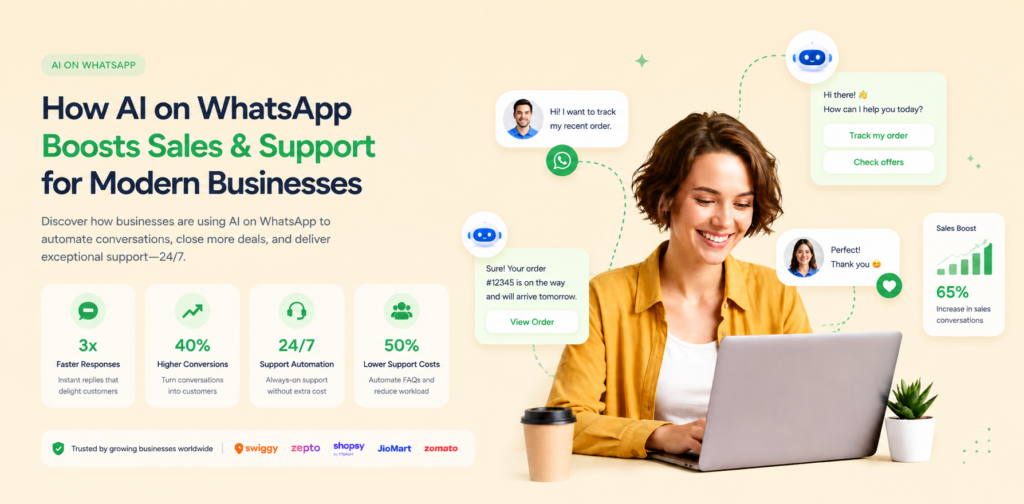
WhatsApp has over 2 billion active users. Your customers are already on it—checking messages, sharing voice notes, ordering from local businesses, and expecting instant replies at 11pm on a Sunday. The question is no longer whether businesses should be on WhatsApp. The question is how to scale meaningful conversations without burning out your team.
The answer is AI-powered conversational messaging.
This article explores how businesses—from lean ecommerce operations to high-volume SaaS platforms—are deploying AI on WhatsApp to drive more sales, deliver faster support, and reduce the customer effort that quietly kills retention. We'll go beyond the surface-level hype and dig into what actually works: the implementation patterns, the metrics that matter, and the architectural decisions that separate a chatbot that frustrates from one that converts.
Why WhatsApp Is the Highest-Intent Channel You're Ignoring
Most businesses think about customer communication in terms of email, live chat, and phone. WhatsApp often gets treated as an afterthought—maybe a customer service number shared reluctantly, checked sporadically. That's a strategic mistake.
The Numbers Are Unambiguous
WhatsApp messages see open rates between 85–98%, compared to email's average of 20–25%. Response rates are 40% or higher. Users check WhatsApp an average of 23–25 times per day. When a customer messages your WhatsApp number, they are actively seeking a resolution—this is not a passive inbox waiting to be managed, it's a live, intent-rich conversation channel.
For sales teams, this means a warm lead on WhatsApp converts at rates that dwarf cold email outreach. For support teams, it means a customer who reaches out on WhatsApp has already made the effort to find you—the only job left is to make resolution effortless.
The Effort Equation
Research on Customer Effort Score (CES)—a metric that measures how easy it was for a customer to resolve an issue—consistently shows that ease of resolution is the strongest predictor of loyalty, outperforming satisfaction and even delight. A customer who had to repeat themselves three times, navigate five IVR menus, or wait 48 hours for an email reply will leave, even if you eventually resolved their issue.
WhatsApp removes several structural friction points:
- No new app to download
- No account to create
- No ticket number to track
- Asynchronous by default, so customers reply when convenient
- Rich media support (images, documents, voice notes) reduces the back-and-forth of "can you describe what you're seeing?"
Now layer AI on top, and you have a channel that is both high-intent and low-effort—the combination that builds durable loyalty.
What "AI on WhatsApp" Actually Means
There's a spectrum here. On one end, you have a basic keyword-triggered chatbot that replies with a menu of options. On the other, you have an LLM-powered assistant with access to your order management system, your CRM, and your knowledge base—capable of handling nuanced queries, qualifying leads, and escalating with full context when a human is needed.
The businesses seeing real results are building toward the latter, but getting there incrementally.
The Three Layers of WhatsApp AI
Layer 1 — Automated Routing and FAQ Deflection
The first and most immediately impactful layer. AI identifies the intent behind a customer message and either resolves it automatically (FAQs, order status, return policies) or routes it to the right human agent with context attached.
This layer alone can deflect 40–60% of inbound volume, freeing your team to handle the complex, high-value interactions they're actually needed for.
Layer 2 — Contextual Support and Sales Assistance
The second layer involves AI that doesn't just respond to individual messages but maintains context across a conversation. It knows what the customer asked five messages ago. It can reference their order history. It can handle multi-step processes like initiating a return, checking stock availability, or walking a user through a technical setup.
At this layer, the AI starts to feel less like a bot and more like a capable first-line colleague.
Layer 3 — Proactive Engagement and Revenue Generation
The third—and often underutilised—layer is outbound. AI on WhatsApp isn't just reactive. Businesses using the WhatsApp Business API can send approved message templates proactively: abandoned cart reminders, back-in-stock alerts, post-purchase follow-ups, renewal nudges, and personalised product recommendations.
This is where WhatsApp AI shifts from a cost centre (support efficiency) to a revenue driver (conversion and retention).
Deploying AI for Sales: Conversations That Convert
Qualifying Leads Without Human Bottlenecks
The traditional lead qualification funnel has a fundamental problem: it relies on humans to be available, consistent, and fast. A prospect who fills out a contact form at 7am on a Tuesday and gets a callback on Thursday afternoon has already moved on—emotionally and practically.
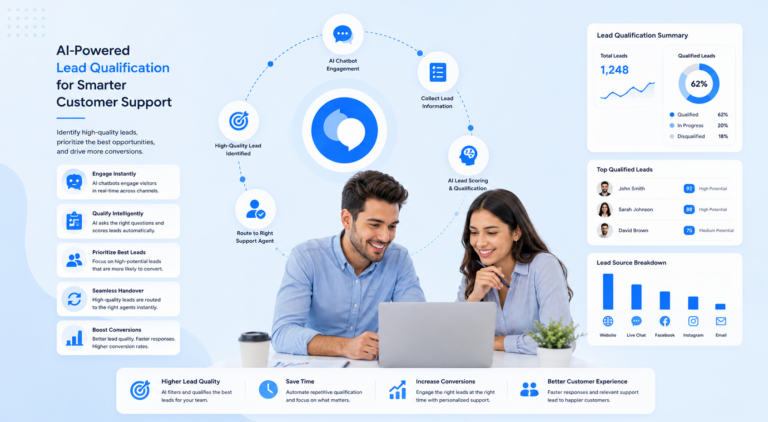
AI on WhatsApp eliminates the latency. The moment someone initiates contact—whether through a Click-to-WhatsApp ad, a QR code at an event, or a website widget—AI can begin qualification immediately. It asks the right questions, interprets the answers, scores the lead based on your criteria, and either books a call, provides a quote, or hands off to a sales rep with a complete lead brief.
For high-volume ecommerce, this looks like a product recommendation engine in a messaging thread. For B2B SaaS, it looks like a discovery call scheduler that pre-qualifies against company size, budget, and use case before a rep ever picks up the phone.
What this requires:
- A well-designed qualification flow (not just a rigid script—AI should adapt to conversational replies)
- CRM integration so leads are captured and scored in real time
- Clear escalation triggers so warm leads get to humans without delay
Abandoned Cart Recovery at Conversational Scale
Abandoned cart emails achieve around 5% recovery rates on average. WhatsApp abandoned cart messages—personalised, conversational, sent within minutes—can achieve 15–25% recovery, and sometimes higher for high-intent product categories.
The difference isn't just the channel. It's the format. An email feels like marketing. A WhatsApp message feels like someone noticed and reached out. When AI handles these messages dynamically—referencing the specific products abandoned, offering to answer questions, surfacing relevant reviews—it further closes the gap between automated outreach and genuine human attention.
A high-converting abandoned cart flow on WhatsApp:
- Message sent within 30–60 minutes of cart abandonment
- References the exact products by name (not "items in your cart")
- Offers assistance ("Any questions about sizing?" / "Want me to check stock at your nearest location?")
- Provides a frictionless one-tap checkout link if available
- Follows up once more 24 hours later with social proof or an incentive if no conversion
AI handles steps 1–5 automatically, with human escalation available if the customer asks something complex.
Upselling and Cross-Selling in Context
Post-purchase is one of the highest-intent moments in the customer lifecycle. A customer who just bought has validated their intent and their payment method. AI can leverage this window to surface relevant accessories, complementary products, or upgrade paths—not as a blast campaign, but as a contextual, conversational suggestion.
Done well, this doesn't feel like being sold to. It feels like being helped.
A customer who just purchased a DSLR camera doesn't want a generic "you might also like" email. They want a message that says "Your camera should arrive by Thursday. One thing a lot of photographers grab alongside this model is [specific lens]—happy to share details if you're interested?"
This is the kind of personalisation that AI on WhatsApp can deliver at scale.
Deploying AI for Support: Reducing Effort, Building Loyalty
The CES Framework Applied to WhatsApp
Customer Effort Score (CES) asks one simple question: how easy was it to resolve your issue? Applied to WhatsApp support, this framework reveals exactly where your AI deployment is working and where it's creating friction.
The goal is not to impress customers. The goal is to make resolution so effortless that they never think about leaving.
AI on WhatsApp reduces effort across every dimension:
| Effort Driver | Traditional Support | AI on WhatsApp |
|---|---|---|
| Wait time | Minutes to hours | Seconds |
| Channel switching | Email → phone → chat | Single thread |
| Repetition | Re-explain to each agent | Context carried forward |
| Availability | Business hours | 24/7 |
| Resolution steps | Multiple handoffs | Resolved in conversation |
The compound effect of removing these friction points is measurable. Companies that have deployed well-structured WhatsApp AI support report CES improvements of 25–40%, with corresponding reductions in churn that translate directly to revenue.
Designing for First-Contact Resolution
The most expensive support interaction is one that requires a follow-up. Every unresolved first contact generates a second contact, and each handoff introduces new opportunities for frustration.
AI on WhatsApp should be architected around first-contact resolution (FCR) as its primary KPI. This means:
Access to real data, not just scripts. An AI that can only tell a customer "please allow 3–5 business days for a response" is not useful. An AI connected to your order management system, returns portal, and inventory database can give a real answer: "Your order #74821 shipped this morning and is due to arrive tomorrow. Here's your tracking link."
Graceful escalation with full context. When a query is beyond the AI's capability or confidence threshold, it should hand off to a human without the customer having to repeat a single word. The agent receives a conversation summary, customer history, and the specific reason for escalation. The handoff should feel seamless.
Learning loops. The AI should flag queries it couldn't resolve, and these should feed back into improvement cycles—whether that's training data, knowledge base updates, or process redesign.
Handling Complexity: What AI Should and Shouldn't Do
A common mistake is asking AI to handle everything, resulting in a system that does everything mediocrely. A better model is to define explicit lanes.
AI handles:
- Order tracking and status updates
- Return and refund initiation
- FAQ responses (shipping policy, sizing, compatibility questions)
- Appointment scheduling
- Account information lookups
- Lead qualification
- Proactive notifications (dispatch updates, appointment reminders)
Humans handle:
- Complaints involving emotional distress
- Complex or ambiguous disputes
- High-value account management
- Edge cases requiring judgment calls
- Situations where the customer explicitly asks for a person
The art is in the handoff. A well-designed system makes the transition invisible to the customer and efficient for the agent.
The WhatsApp Business API: Technical Foundations
To deploy AI on WhatsApp at any meaningful scale, you need access to the WhatsApp Business API (now part of Meta's Business Messaging platform). The standard WhatsApp Business App, designed for sole traders and very small businesses, does not support automation, AI integration, or multi-agent access.
What the API Enables
- Unlimited concurrent conversations with multiple agents and AI handling simultaneously
- Webhooks for real-time message ingestion and event handling
- Message templates for outbound proactive messaging (subject to Meta approval)
- Rich media support including images, documents, buttons, lists, and interactive quick replies
- Integration with CRM, helpdesk, ecommerce platforms, and custom systems
Architecture Considerations
A production-grade WhatsApp AI deployment typically involves:
- Meta Cloud API or BSP (Business Solution Provider) — the gateway to WhatsApp's infrastructure
- Message processing pipeline — receives webhooks, routes messages, manages conversation state
- AI/NLP layer — intent classification, entity extraction, LLM response generation
- Integration layer — connects to Shopify, WooCommerce, Salesforce, Zendesk, or whatever systems hold your customer data
- Agent handoff layer — escalation logic, agent notification, conversation handover
- Analytics layer — CES tracking, resolution rates, deflection rates, conversion attribution
Platforms like Chatloop provide this infrastructure out of the box, removing the need to build and maintain the pipeline yourself. For businesses without significant engineering resources, this is the faster path to production.
Conversation State Management
One of the subtler technical challenges in WhatsApp AI is managing conversation state across asynchronous, intermittent interactions. Unlike a live chat widget where a session is discrete, WhatsApp conversations can span days or weeks. A customer might start asking about a return on Monday, go quiet for two days, and resume the thread on Wednesday expecting context to be preserved.
This requires a persistent conversation store (database-backed, not session-based), and AI that can gracefully re-establish context from prior messages rather than treating each incoming message as a fresh conversation.
Measuring What Matters: Metrics for WhatsApp AI
Deploying AI without measurement is deploying blind. Here are the metrics worth tracking, mapped to business outcomes:
Support Metrics
First Contact Resolution (FCR) — What percentage of queries are resolved in a single interaction without follow-up? Healthy benchmark: 70%+.
AI Deflection Rate — What percentage of inbound queries are handled entirely by AI without human intervention? This directly impacts support team capacity.
Customer Effort Score (CES) — Post-interaction survey: "How easy was it to resolve your issue?" Track by issue type, day of week, conversation length. Benchmark against pre-AI baseline.
Average Handling Time (AHT) — For queries that do require human agents, is AI assistance (suggested replies, context summaries) reducing time to resolution?
Escalation Rate and Escalation Reason — What percentage of AI conversations escalate, and why? High escalation rates on specific topics signal gaps in AI capability or knowledge base.
Sales Metrics
Lead-to-Conversation Rate — For Click-to-WhatsApp campaigns, what percentage of clicks initiate a meaningful conversation?
Qualification Rate — What percentage of conversations result in a qualified lead passed to sales?
Abandoned Cart Recovery Rate — For ecommerce, the direct revenue impact of AI-powered recovery messages.
Conversion Attribution — Revenue generated by WhatsApp AI interactions, tracked via UTM parameters or order tagging.
CLTV Impact — Over time, do customers who engage via WhatsApp AI show higher lifetime value? (Often yes, due to higher retention from lower-effort support.)
Real-World Implementation Patterns
Ecommerce: The Full-Funnel WhatsApp Strategy
A mid-size Shopify store (£5M–£20M GMV) typically sees the following WhatsApp AI deployment:
Inbound support automation: Order tracking, returns, FAQs—deflecting 50–65% of ticket volume. Support team focuses on complex queries and unhappy customers.
Post-purchase sequences: Dispatch confirmation, delivery notification, review request, and cross-sell suggestion—all via WhatsApp, all automated, all personalised to the order.
Abandoned cart recovery: Within 45 minutes of abandonment, a conversational message rather than a promotional email. Recovery rates typically 3–5x email equivalents.
Seasonal campaign support: During peak periods (Black Friday, Christmas), AI handles the volume spike without emergency hiring. Agents focus on the queries that genuinely require judgement.
Typical outcome: 40–60% reduction in support ticket volume, 15–25% improvement in CES scores, measurable increase in post-purchase revenue.
SaaS: Reducing Churn Through Effort Reduction
For SaaS businesses, churn is the core metric. A 1% improvement in monthly retention compounds dramatically over 12 months. WhatsApp AI—deployed as a support and success channel—attacks churn at its root cause: friction.
High-effort support experiences are a leading indicator of churn. When a customer has to work hard to get a feature explained, a billing issue resolved, or an integration debugged, they're making a mental note. Accumulate enough of those notes and they start evaluating alternatives.
WhatsApp AI for SaaS typically focuses on:
- Onboarding assistance: Proactive messages during trial periods, triggered by in-app behaviour ("We noticed you haven't connected your first integration yet—here's a 2-minute guide")
- Renewal engagement: AI-initiated conversations at renewal risk points, surfacing value metrics and addressing objections before a human CSM needs to step in
- Billing and account queries: Low-effort resolution of invoice requests, seat management, plan questions
- Feature education: Contextual feature suggestions based on usage patterns
A SaaS company with 12% monthly churn that reduces effort-related churn by a third is looking at a meaningful revenue impact—often £500K–£2M+ annually depending on ARPU and customer volume.
Common Mistakes and How to Avoid Them
Mistake 1: Deploying AI Before Mapping the Journey
The most common failure mode is deploying a generic chatbot without understanding the specific queries your customers are actually sending. Before writing a single prompt or configuring a single flow, spend time analysing your support ticket categories, your most common FAQ searches, and the specific language your customers use. AI trained on realistic query patterns dramatically outperforms AI trained on what you think customers ask.
Mistake 2: Optimising for Deflection, Not Resolution
Deflection and resolution are not the same thing. An AI that tells customers "I can't help with that, please email support@" has deflected the conversation but not resolved the issue—and has actively increased customer effort. Deflection that doesn't result in resolution is worse than no automation at all.
Optimise for FCR, not just deflection rate.
Mistake 3: No Human Escalation Path
Every WhatsApp AI deployment needs a clear, accessible path to a human. Customers who cannot reach a person when they need one report dramatically higher effort scores and are at significant churn risk. The escalation path should be obvious ("Type AGENT at any time to speak to a person") and the handoff should be seamless.
Mistake 4: Ignoring Message Template Quality
For proactive outbound messaging, the quality of your approved Meta message templates is the ceiling on performance. Bland, generic templates—"Your order has been updated. Click here."—achieve a fraction of the engagement of conversational, specific templates. Invest in template copywriting. Test multiple variants. The WhatsApp AI that converts isn't just technically sophisticated—it sounds like a person who cares.
Mistake 5: Set-and-Forget Deployment
AI quality degrades relative to your catalogue, your policies, and your customers' language if it isn't maintained. Build a cadence for reviewing AI-handled conversations, updating the knowledge base when policies change, and retraining or reprompting when new query types emerge. The businesses with the best-performing WhatsApp AI treat it like a team member: they onboard it carefully and continue to develop it.
Chatloop and the Future of Conversational Commerce
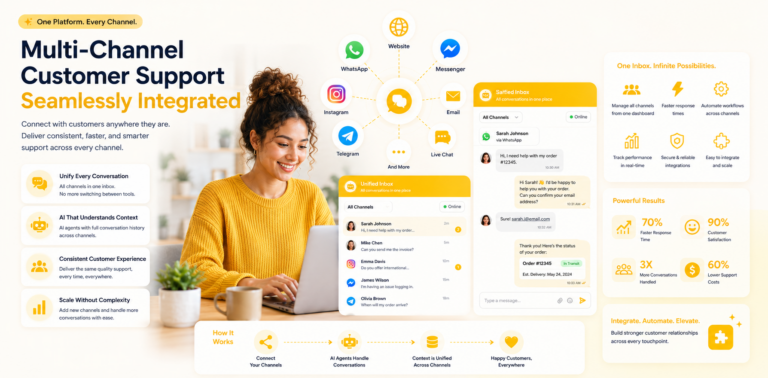
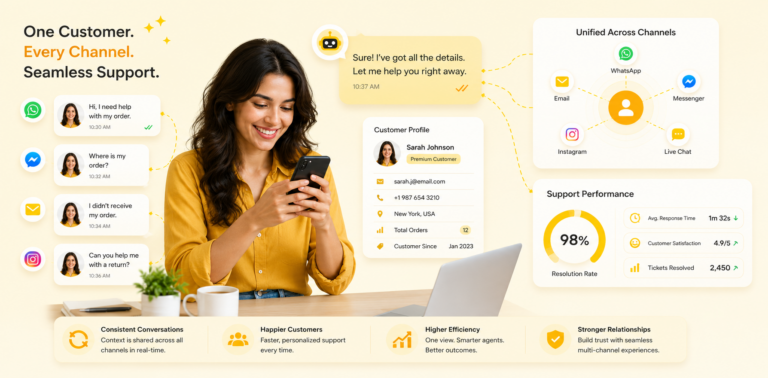
Platforms like Chatloop represent the direction the market is moving: unified, AI-powered customer engagement across WhatsApp, Instagram DM, Facebook Messenger, Telegram, and email—all managed from a single inbox, with AI as the first line of response and humans stepping in precisely where they're needed.
The shift from channel-by-channel, tool-by-tool customer communication to a unified conversational layer is not incremental. It's a fundamental change in how businesses relate to customers—from reactive, transactional interactions to proactive, contextual, continuous relationships.
WhatsApp is the most mature and highest-volume channel in that layer for most businesses. Getting it right creates a compounding advantage: better customer data, higher retention, lower support costs, and a growing base of customers who actively prefer to engage with you on a channel they already use every day.
Getting Started: A Practical Roadmap
You don't need to deploy all three layers at once. A phased approach reduces risk and lets you validate before scaling.
Phase 1 — Foundation (Weeks 1–4)
- Set up WhatsApp Business API access via a BSP or platform
- Define your top 10 most common inbound query types
- Build AI responses for these query types, connected to real data sources where possible
- Set up CES survey post-interaction
- Establish baseline metrics: volume, handling time, current CES
Phase 2 — Expansion (Weeks 5–10)
- Expand AI coverage to top 25 query types
- Integrate with order management, returns portal, or CRM
- Launch first outbound template campaign (post-purchase follow-up or order confirmation)
- Begin tracking FCR and deflection rate
- Review escalation logs weekly and update AI flows accordingly
Phase 3 — Optimisation and Revenue (Weeks 11+)
- Launch abandoned cart recovery flow
- Add proactive engagement triggers (back-in-stock, renewal reminders, onboarding nudges)
- A/B test message templates for conversion
- Review CES by issue type and target improvements in highest-effort categories
- Calculate and report revenue impact
Conclusion
WhatsApp is not just a messaging app. For businesses willing to invest in it properly, it is the highest-intent, lowest-friction customer engagement channel available today. AI makes it scalable.
The businesses winning with WhatsApp AI share a common philosophy: they have stopped asking "how do we respond to more messages?" and started asking "how do we make every customer interaction so effortless that loyalty becomes the natural outcome?"
That shift—from volume management to effort reduction—is the same shift that drives Customer Effort Score thinking. It's not about being impressive. It's about being easy. And in a world where customers have endless alternatives and zero patience for friction, being easy is the competitive advantage that compounds.
Start with your top 10 queries. Connect AI to real data. Measure effort. Reduce it systematically. The revenue impact will follow.


3 Responses on this post
Comments are closed.