


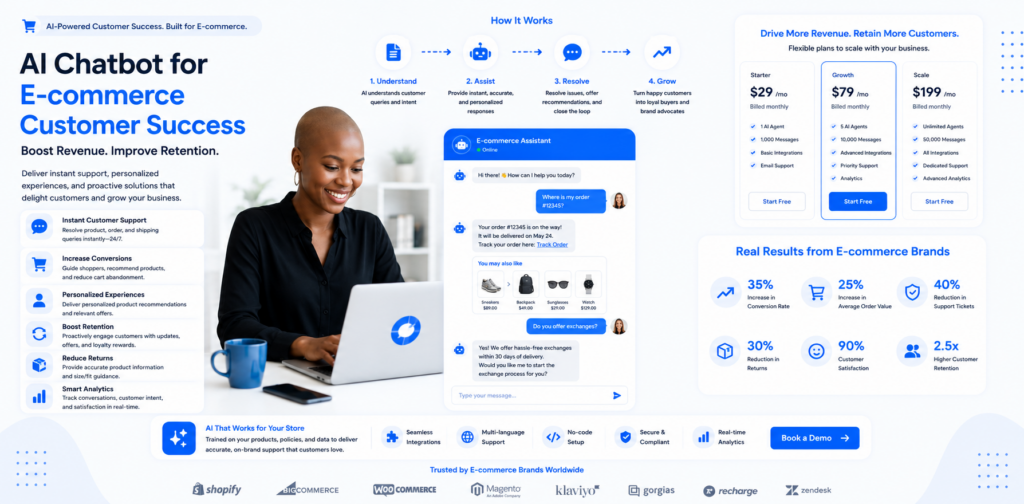
E-commerce businesses face a specific version of the customer service challenge: high query volume, predictable query types, and strong commercial stakes attached to every interaction. A customer asking about their order status at 11pm is not just looking for information — they are forming an opinion about whether they will buy from you again. A customer mid-checkout who has a sizing question and cannot get an instant answer is a cart abandonment event in progress.
This guide covers the full stack of e-commerce chatbot deployment — from pre-purchase conversion through post-purchase retention — with specific configuration guidance, real performance benchmarks, and the integration steps that connect your chatbot to your store's live data.
The E-Commerce Chatbot Opportunity
E-commerce businesses are among the best-suited for AI chatbot automation for several reasons.
High query volume with predictable patterns. Online stores generate large volumes of customer queries, but the vast majority fall into a small number of categories: order status, returns, sizing, product questions, shipping, and payment issues. These categories are perfectly suited to AI automation.
Strong conversion value per interaction. A chatbot that recovers one abandoned cart per day for a store with a £75 average order value is worth £2,250/month in recovered revenue — before any cost saving from support automation is counted.
24/7 buying behaviour. E-commerce customers buy at all hours. The support expectations that come with that buying behaviour extend to all hours too. An online store that closes its support at 6pm is leaving a significant proportion of its customer interactions unresolved.
For data on how response time directly affects e-commerce revenue, see the true cost of slow customer response times.
Pre-Purchase: Converting Browsers to Buyers
Product Questions at the Point of Decision
Customers researching a purchase frequently have questions that a product page cannot fully answer: does this sizing run large or small? Is this compatible with my specific device? How long does delivery take to my postcode? Each unanswered question increases the probability of abandonment.
A chatbot trained on your product catalogue, sizing guides, and delivery information resolves these questions in seconds. The conversion impact is measurable — businesses with AI chat available during the browsing and decision phase report 12–18% improvement in add-to-cart rates from visitors who engage with the chatbot.
Configure your chatbot to appear proactively on product pages after a defined engagement threshold — for example, after a visitor has spent 60 seconds on a product page without adding to cart. The proactive trigger increases engagement rates significantly compared to passive availability.
Cart Abandonment Recovery
Cart abandonment is the most discussed conversion problem in e-commerce, with average rates between 65–75% across the industry. A chatbot integrated with your store's cart data can identify abandonment events and trigger recovery conversations.
When a customer starts a checkout and leaves without completing it, the AI sends a contextual message: "You left something in your cart — do you have questions about your order?" This is different from a generic email sequence because it is immediate (within minutes, not hours), conversational, and relevant to the specific items the customer was considering.
Businesses using chatbot-triggered cart recovery report 15–23% recovery rates on engaged conversations — significantly higher than email cart abandonment sequences, which typically recover 3–8%.
For context on how this fits into the broader e-commerce AI picture, see conversational AI for ecommerce customer success.
Checkout Support
Questions during checkout are particularly high-stakes — the customer has already decided to buy, and only a friction point is preventing completion. Common checkout questions — payment methods accepted, whether a discount code is valid, what happens if an item is out of stock after ordering — can all be resolved instantly by an AI with access to your store data.
Integrate chatloop.io with your e-commerce platform through the chatloop.io integrations to give the AI real-time access to discount code validity, stock levels, and payment method information.
Post-Purchase: Turning Customers into Repeat Buyers
Order Status and Tracking
Order status queries are the single highest-volume post-purchase interaction for most e-commerce businesses, and they are entirely automatable. An AI connected to your order management system can provide real-time tracking information, estimated delivery windows, and status updates without human involvement.
For a store receiving 200 monthly order status enquiries, automating these saves approximately 16 hours of support agent time per month at five minutes per query. That is 200 interactions that contribute directly to customer satisfaction and zero incremental labour cost.
Returns and Refund Processing
Returns are high-frequency and rule-based — ideal for automation. Configure your chatbot to handle the complete returns flow: verify eligibility against your policy, provide return instructions, generate a return label (if connected to your logistics platform), and confirm the refund timeline.
Standard, policy-compliant returns can complete entirely without human involvement. Non-standard returns — late requests, damaged items, exceptions to standard policy — are escalated to a human agent with full context, so no returns request falls through the cracks.
For a detailed guide on returns automation, see how to automate customer support.
Post-Purchase Upsell and Cross-Sell
The moment after a purchase confirmation is peak engagement for a customer. They are satisfied with their decision and receptive to relevant recommendations. An AI that presents a contextual, relevant follow-up offer — "customers who bought this also frequently buy X" — at this moment converts at higher rates than any cold outreach.
Configure post-purchase upsell conversations based on the specific product purchased. A customer who bought a camera is a candidate for a lens recommendation. A customer who bought a printer is a candidate for ink or paper. The personalisation is driven by purchase data from your store integration — no manual segmentation required.
Subscription and Repeat Purchase Reminders
For businesses selling consumables or subscription products, the AI can monitor purchase history and send proactive re-order reminders when a customer's previous purchase cycle suggests they are running low. This proactive engagement drives repeat purchase rates without requiring the customer to remember to reorder.
Integration Requirements for E-Commerce AI
The capabilities described above — real-time order status, cart abandonment detection, stock level queries, dynamic product recommendations — require live integration between your chatbot and your e-commerce platform.
Shopify integration. Chatloop.io's Shopify connection provides the AI with access to order status, customer history, product catalogue, and discount code validity in real time. Configuration is completed through the chatloop.io integrations page without developer involvement.
WooCommerce / WordPress integration. For businesses running WooCommerce, the integration provides equivalent order and product data access. The connection is configured through chatloop.io's dashboard with the same no-code setup process.
Custom stores. For proprietary store platforms, the chatloop.io API allows connection through webhook integrations, providing the AI with the data access it needs regardless of the underlying platform.
E-Commerce Chatbot Performance Benchmarks
Based on typical chatloop.io e-commerce deployments:
- Automation rate: 60–70% of all post-purchase queries resolved without human involvement
- Cart recovery rate: 15–23% of abandoned carts where the chatbot initiates a recovery conversation
- Order status query resolution: Near 100% automation for customers with order numbers
- Average first response time: Under 5 seconds (vs. industry average of 2+ hours without AI)
- Post-purchase CSAT improvement: +0.5 to +0.8 points on 5-point scale within 90 days
These figures reflect 60+ days of deployment with a well-maintained knowledge base and active store integration. Early deployment results (days 1–30) will typically show 45–55% automation as the knowledge base is refined.
Configuring Your E-Commerce AI: A Priority Sequence
Week 1: Deploy with a knowledge base covering product FAQs, returns policy, and shipping information. Connect your order management integration for real-time order status. These three elements alone handle 55–65% of typical e-commerce query volume.
Week 2–3: Configure cart abandonment triggers and post-purchase follow-up messages. Test cart recovery conversations with your five most common abandoned cart scenarios.
Week 4: Add proactive product page engagement triggers for high-value product categories. Configure post-purchase upsell conversations for your top five product combinations.
Month 2+: Add language support if you serve international markets, refine recommendation logic based on conversion data, and expand knowledge base coverage based on real query data.
FAQ
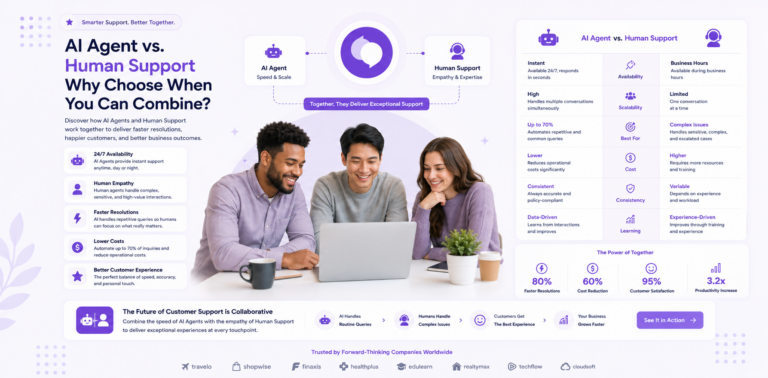
Does the chatbot replace the need for a human support team in e-commerce? No. The chatbot automates tier-1, routine queries — the majority of volume. Complex complaints, high-value customer issues, and non-standard situations still benefit from human handling. The chatbot's role is to ensure human agents spend their time on interactions that actually require them. See AI agent vs human support for the full framework.
Can the chatbot handle queries about specific product variants (size, colour, compatibility)? Yes, provided your product catalogue is included in the knowledge base. The more specific and structured your product data, the more precisely the AI can answer variant-specific questions.
How does the chatbot handle a return that does not meet the standard policy? Exceptions to standard policy are escalated to a human agent automatically, with full conversation context. The customer receives an acknowledgement and a timeline for human response. No exception falls through the cracks.
Can I customise the chatbot's personality to match my brand? Yes. Chatloop.io allows you to configure the chatbot's name, tone, greeting messages, and response style to match your brand voice. A luxury fashion brand can configure a different tone than a discount retailer, even using the same platform.
How does chatloop.io compare to Tidio for e-commerce? Both platforms support e-commerce chatbot use cases. For a detailed breakdown of features, pricing, and e-commerce-specific capabilities, see chatloop.io vs Tidio.
Turn your e-commerce support into a revenue engine. Start your free chatloop.io trial and recover your first abandoned cart this week.


Comments are closed.