


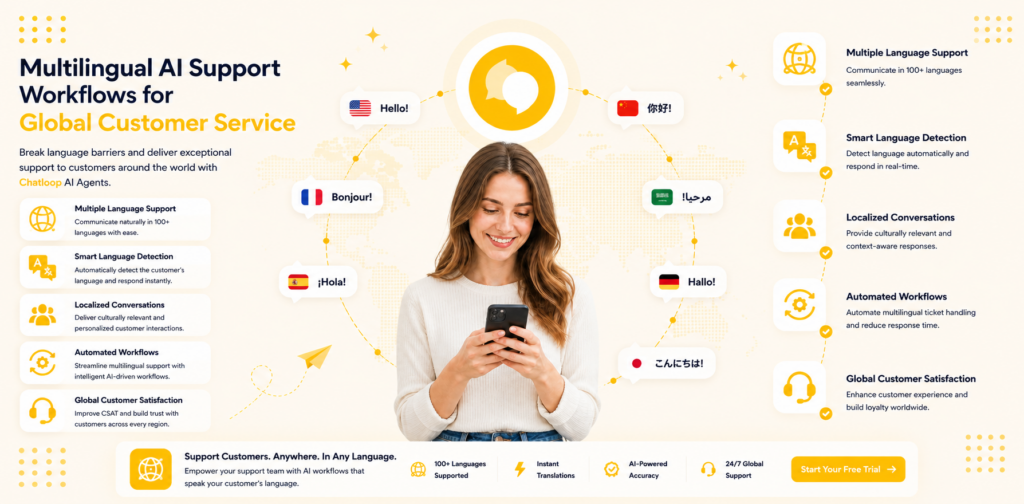
Global customer service has a staffing paradox. You need to serve customers in Spanish, French, German, Portuguese, Arabic, Japanese, and a dozen other languages — ideally 24/7. But building dedicated agent teams for each language is prohibitively expensive. Hiring bilingual agents is time-consuming, and their availability in each language doesn't align neatly with your customers' time zones.
Multilingual AI support workflows break this paradox. They allow a single AI infrastructure to handle customer interactions across 20, 40, or 80 languages — automatically detecting language, responding appropriately, and escalating to human agents only when genuinely needed. Human agents remain essential, but their language coverage requirements become dramatically less constraining.
This guide covers how to design, implement, and continuously improve multilingual AI support workflows for global customer service operations — including the language tiers, quality controls, regional compliance requirements, and escalation logic that make the difference between a functional system and an exceptional one.
The Global Support Challenge
Language is just the most visible dimension of global support complexity. The full challenge includes:
Volume distribution: Your customer base doesn't distribute evenly across languages. You might have 60% English-speaking customers, 15% Spanish, 10% Portuguese, 5% French, and 10% spread across 20 other languages. Your support infrastructure must handle peak volumes in each language without building duplicate teams.
Time zone coverage: A customer in Tokyo expects a response at a reasonable hour in their time zone, not 9 hours later when your English-speaking team in London comes online. Without AI, 24/7 multilingual coverage requires multiple regional agent teams working in shifts.
Cultural communication norms: Directness that feels professional in English can feel brusque in Japanese. Formal honorifics required in Korean feel stiff in Brazilian Portuguese. AI systems must be culturally calibrated, not just linguistically translated.
Regional legal and compliance requirements: GDPR affects European customers differently than CCPA affects California customers. Data retention, consent requirements, and how you communicate about privacy vary by region. Your AI workflows must reflect these differences.
Knowledge base localization: A knowledge base article written in English and machine-translated into Spanish is not a localized article — it's a translated one. Regional differences in product features, pricing, legal terms, and support processes mean true localization requires human expertise, not just translation.
Language Tier Architecture
Not all languages warrant the same investment in AI support infrastructure. Designing your multilingual AI system around language tiers helps you allocate resources efficiently while maintaining quality across your entire customer base.
Tier 1: Full AI Automation (High-Volume Languages)
Typically your top 3-8 languages by customer volume. These receive full AI support capability:
- Native-language intent classification models trained on real support data in that language
- Localized knowledge base articles (human-written or human-reviewed, not raw machine translation)
- AI-powered automated resolution for Tier 1 issues (FAQs, order status, password reset, etc.)
- Native-language conversational AI flows for more complex interactions
- Language-matched human agent escalation during business hours
Common Tier 1 candidates for global SaaS and ecommerce: English, Spanish, French, German, Portuguese (Brazilian), Japanese, Simplified Chinese, Arabic
Tier 2: AI-Assisted Translation (Medium-Volume Languages)
Languages with meaningful volume but not enough to justify full localization investment. These receive:
- Automatic language detection and response in the customer's language
- High-quality machine translation with human agent review on escalations
- Shared knowledge base content translated at article level (not localized)
- Escalation to the nearest language-adjacent agent team (e.g., Italian tickets escalate to French-speaking agents when Italian agents are unavailable)
Common Tier 2 candidates: Italian, Dutch, Swedish, Korean, Turkish, Polish, Russian
Tier 3: Machine Translation with Human Review Gate
Low-volume languages handled primarily through machine translation, with every non-trivial interaction reviewed by a human agent before the response is sent. These receive:
- Language detection and machine translation to a Tier 1 language for internal routing
- Machine-translated response drafted and reviewed by an agent before sending
- Longer response time expectations communicated to customers upfront
Common Tier 3 candidates: All other languages in your customer base
This tiered architecture ensures you never send an unreviewed response in a language your AI handles poorly while still providing meaningful language support to customers who aren't in your top-volume groups.
Language Detection and Routing
Language detection is the foundation of the entire workflow — if the AI misclassifies language, everything downstream is wrong. Modern NLP language detection is highly accurate for Tier 1 and Tier 2 languages but needs careful configuration for edge cases.
Detection inputs (in priority order):
- CRM language preference: If your CRM stores the customer's preferred language (set during onboarding or from previous interaction history), use this as the primary signal. Customer preference overrides everything.
- Detected language from the ticket/message content: NLP classification of the incoming text. Accurate to 98%+ for Tier 1 languages, lower for short messages or heavily technical content.
- Browser/device locale: Available from web chat interactions — useful for very short messages where content-based detection is unreliable.
- IP geolocation: Use as a fallback signal only, not primary. A French customer on an English-language VPN will have mismatched geolocation.
Short-message handling: Language detection on messages under 10 words is unreliable. For short messages, ask a brief clarifying question in the two most likely languages simultaneously. "Hi / Bonjour — would you prefer English or French?"
Code-switching handling: Some customers mix languages (e.g., Spanish with English technical terms). Classify based on the dominant language and flag for human review if confidence is below threshold.
Routing based on language: Once language is detected, route to the correct queue:
- Tier 1 language: Direct to AI resolution flow with language-specific knowledge base
- Tier 2 language: AI resolution attempt with agent review gate for escalations
- Tier 3 language: Machine translation + human review queue
- Language ambiguous: Human routing queue with language flag for agent to confirm
Building Multilingual Knowledge Bases
The quality of your multilingual knowledge base directly determines your AI's resolution capability in each language. Machine translation of an English knowledge base is the minimum viable approach, not the gold standard.
Knowledge base quality levels by tier:
Tier 1 (Localized): Content is written or professionally reviewed by native speakers in each language. Regional differences are reflected — pricing pages show the correct local currency, legal references cite the correct regional regulations, product features that differ by region are documented separately. Localized content typically performs 20-30% better in customer satisfaction than machine-translated content for the same information.
Tier 2 (Translated + Reviewed): Content starts as machine translation but every article is reviewed by a native-speaking agent or contractor before publication. Terminology is standardized. Cultural awkwardness is corrected. This approach costs roughly 40-60% less than full localization while achieving 80-85% of the quality.
Tier 3 (Machine Translated): Content is machine-translated and published without individual review. Accuracy is high for factual content (pricing, dates, instructions) but may miss cultural nuance. Supplement with clear escalation paths so customers who find machine-translated content confusing can reach human help quickly.
Maintenance workflow: Changes to the English knowledge base must trigger update flags in all translated/localized versions. Use a content versioning system that tracks which translated articles are out of sync with their source article. Stale translations — especially for policies, pricing, and legal content — cause compliance and customer experience problems.
AI Response Quality Control for Multilingual Workflows
Machine translation quality has improved dramatically, but it's not perfect — and in customer service, translation errors have real consequences. A mistranslated refund policy or a culturally inappropriate response can escalate a routine interaction into a serious problem.
Quality control layers:
Confidence threshold gating: Set a translation confidence threshold below which the AI adds a human review flag before sending. Low-confidence translations go to an agent review queue rather than directly to the customer.
Terminology standardization: Build a glossary of key product terms, proper nouns, and technical vocabulary for each supported language. Translation models should use your standardized terminology rather than generic translations. "Help Center" should translate consistently across every interaction, not differently each time.
Backtranslation auditing: Periodically sample outgoing responses, machine-translate them back to English, and compare to the original. Significant semantic drift signals a translation quality problem that needs correction in your terminology glossary or model configuration.
Native speaker review sampling: Route 5-10% of AI-handled conversations in each Tier 1 language to native-speaking QA reviewers monthly. They score responses on language quality, cultural appropriateness, and factual accuracy. Use this data to identify systematic quality issues.
Customer satisfaction by language: Track CSAT scores separately for each language. A language with CSAT 10+ points below your overall average is signaling a systematic quality problem — either in translation quality, knowledge base content, or cultural calibration.
Human Escalation in Multilingual Workflows
Even well-designed multilingual AI workflows generate escalations. The escalation design for multilingual support has unique considerations that monolingual support doesn't face.
Language-matched escalation (preferred): Route escalated tickets to agents who speak the customer's language natively. This is the best experience and produces the fastest resolution. Build your human agent team with language coverage mapped to your Tier 1 and Tier 2 language volumes.
Language-bridged escalation (when native coverage isn't available): When a Tier 1 or Tier 2 language agent isn't available, assign the ticket to an agent who can read machine-translated content while responding in the customer's language with AI translation assist. The agent sees the customer's message translated, drafts a response in English, and the AI translates the response to the customer's language for the agent to review before sending.
Time zone coverage for escalations: Map your agent language coverage to your customers' active hours by language. Spanish support staffed only during Madrid business hours misses Latin American customers in the evening. Consider overlapping shifts or remote agent arrangements for high-volume languages with significant time zone gaps.
Escalation context transfer across languages: When the AI escalates a multilingual ticket to a human agent, the handoff summary should be in the agent's language, not the customer's. The agent needs to quickly understand the context in their working language. The agent then communicates with the customer in the customer's language.
Regional Compliance in Multilingual Support Workflows
Global support operations intersect with a complex patchwork of regional privacy, data, and consumer protection regulations. Your multilingual AI workflows must account for these differences.
Key regional compliance considerations:
GDPR (European Union): Data minimization requirements, right to erasure, explicit consent for certain data uses. Your AI workflows for EU customers must not store data beyond the defined retention period, must honor erasure requests within mandated timelines, and must have consent recorded for any marketing-adjacent communication.
CCPA (California): "Do not sell my personal information" rights, disclosure requirements. Californians who opt out of data sale cannot have their support interaction data shared with third-party service providers without further disclosure.
LGPD (Brazil): Brazil's privacy law closely mirrors GDPR. Similar requirements for consent, data minimization, and deletion rights. Separate consideration for Brazilian Portuguese content from European Portuguese — the laws affecting these customer segments differ.
Local consumer protection laws: Many countries have specific regulations about response time guarantees, right to human agent access, and mandatory disclosures in customer communications. Germany, France, and Japan each have requirements that may affect how your AI workflows communicate with customers in those markets.
Implementation approach: Consult legal counsel for each major market before launch. Build compliance rules into your routing and workflow logic as explicit conditions, not as afterthoughts. Compliance failures in global support operations can be expensive and reputationally damaging.
Measuring Multilingual AI Support Performance
Global support requires global measurement — broken down by language and region, not just in aggregate.
| Metric | Measurement | Target |
|---|---|---|
| Language Detection Accuracy | % correctly detected vs. human-verified | 95%+ |
| AI Deflection Rate by Language | % resolved without human per language | Varies; track trends |
| CSAT by Language | Customer satisfaction score per language | Within 5 points of English baseline |
| Translation Quality Score | Native speaker QA rating | 4.0+/5.0 |
| Escalation Rate by Language | % escalated per language | Track and investigate outliers |
| Response Time by Region | Avg. first response by time zone | Per SLA by customer tier |
| Knowledge Base Freshness | % of translated articles current with source | 90%+ |
Review these metrics monthly at minimum. Language-level performance data reveals problems that aggregate metrics hide entirely.
Frequently Asked Questions
How does multilingual AI customer support work in practice?
When a customer contacts support, the AI detects their language from message content, browser locale, and CRM preferences. It then routes the interaction to a language-appropriate flow — using a localized or translated knowledge base to attempt automated resolution. If the issue requires escalation, the AI routes to a native-speaking agent when available, or prepares a machine-translated handoff for a language-bridge agent. The customer experiences the entire interaction in their language.
Which languages can AI support handle automatically without human review?
High-quality automated handling is most reliable for Tier 1 languages — English, Spanish, French, German, Brazilian Portuguese, Japanese, Simplified Chinese, and Arabic — where AI models have been trained on large volumes of native-language support data and knowledge bases are localized. For Tier 2 languages, AI handles initial response but escalations benefit from human review. For Tier 3 languages, human review of every non-trivial interaction is the safe standard.
How do I maintain quality in machine-translated support responses?
Four practices maintain quality: First, build a product-specific terminology glossary for each supported language that translation models use consistently. Second, set confidence thresholds that gate low-confidence translations to human review before sending. Third, run monthly native-speaker QA sampling of 5-10% of AI-handled conversations in each language. Fourth, monitor CSAT by language and investigate any language with scores more than 5 points below your English baseline, as this signals a systematic quality problem.
How do I route multilingual support tickets to the right agents?
Define routing rules based on language tier and agent language capabilities. Language-detected Tier 1 tickets route to queues staffed by native or fluent agents in that language. When native coverage isn't available (due to time zone or agent unavailability), tickets route to language-bridge agents — agents who can review machine-translated content and send AI-translated responses. Build your escalation paths before launch and map agent language coverage against your customer volume by time zone to identify coverage gaps.
What are the compliance considerations for multilingual AI support?
The main considerations are data residency (some regions require customer data to be stored within regional boundaries), privacy law compliance (GDPR for EU, CCPA for California, LGPD for Brazil), consumer protection law adherence (some markets require disclosures or mandated response times), and right to human agent access (some jurisdictions give consumers the right to request a human agent). Engage legal counsel for each major market before launch and build compliance rules into your routing logic as explicit conditions.
How much does multilingual AI support reduce costs compared to hiring language-specific teams?
Savings vary significantly by portfolio, but a useful benchmark: a company serving customers in 10 languages that previously employed 3 agents per language group (30 agents total) can typically achieve equivalent or better coverage with 8-12 agents and a multilingual AI infrastructure — a 60-75% headcount reduction for language coverage. The savings come from AI reducing support costs by handling Tier 1 ticket volume in all languages and language-bridge escalation reducing the need for dedicated native-speaker agents in Tier 2 languages.
Conclusion
Multilingual AI support workflows give global companies a capability that was previously only available to organizations with massive support budgets: 24/7 customer service across dozens of languages, delivered at consistent quality, without proportional headcount growth.
The architecture is clear — language tiers, localized knowledge bases, quality control through native speaker QA and CSAT monitoring, language-matched escalation where possible and language-bridge escalation where not. The technology exists to deliver this today. The remaining challenge is organizational: committing to the localization investment, building the compliance infrastructure for each major market, and designing escalation paths that reflect both agent language capabilities and time zone coverage.
Companies that solve this challenge gain a genuine competitive advantage in global markets where local-language support is the expected baseline, not a differentiator. For customers in markets where English-only or poor-quality translated support is the norm, high-quality native-language AI support creates a loyalty advantage that's difficult for competitors to match quickly.
Ready to serve your global customers in their language? Book a Chatloop demo to see how our multilingual AI support platform handles language detection, routing, and translation quality control across your customer base.


5 Responses on this post
Comments are closed.