


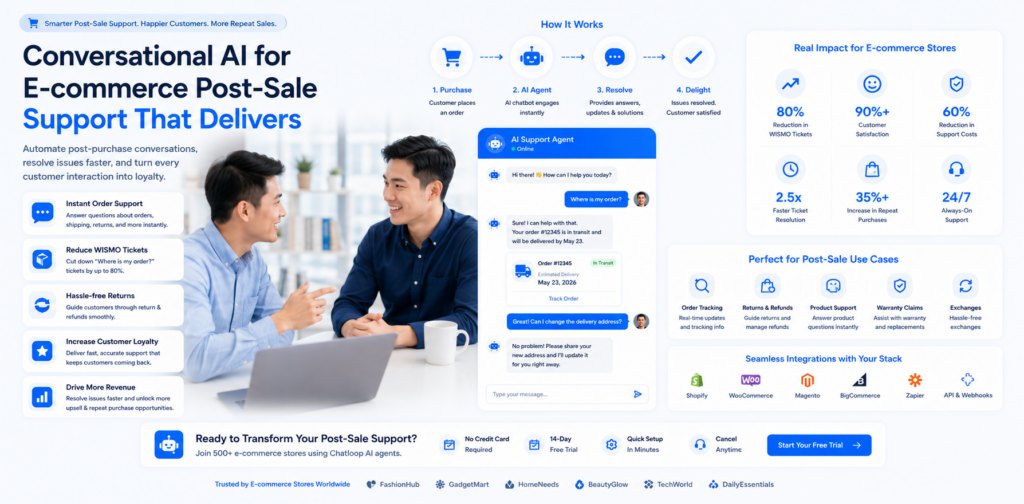
The checkout is not the finish line — it's the starting gun. In ecommerce, the post-sale experience determines whether a customer becomes a loyal repeat buyer or never returns. Yet most ecommerce brands invest the bulk of their support resources in pre-sale and checkout while leaving the post-purchase journey to slow, manual processes.
Conversational AI for ecommerce post-sale support changes this equation. When properly optimized, AI handles the highest-volume support categories — order tracking, returns, refunds, and delivery exceptions — automatically and at scale. Human agents are freed to focus on edge cases, retention conversations, and high-value customer relationships.
This guide covers how to structure, implement, and continuously optimize conversational AI across every major post-sale support category for ecommerce operations.
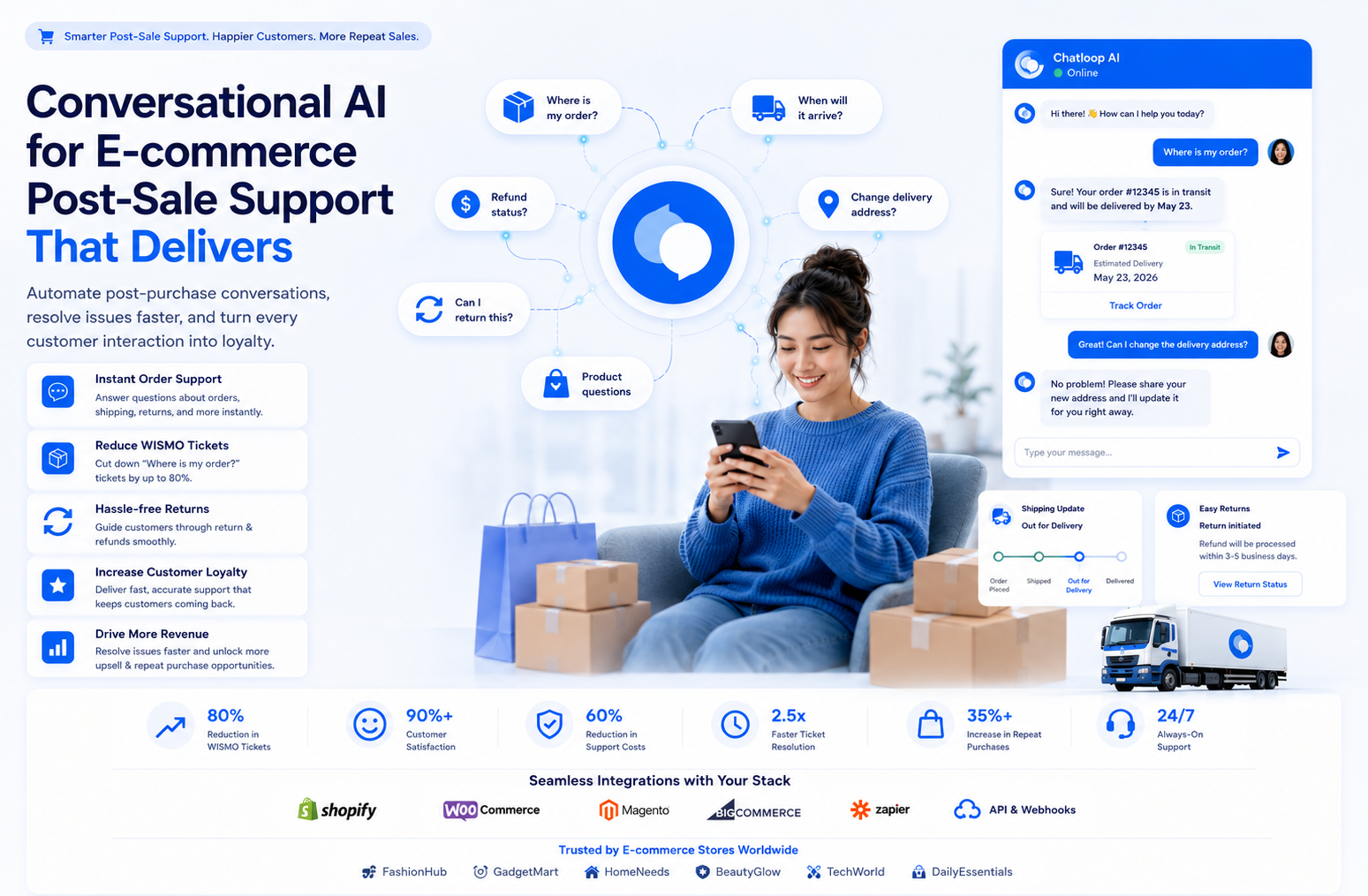
The Post-Sale Support Problem in Ecommerce
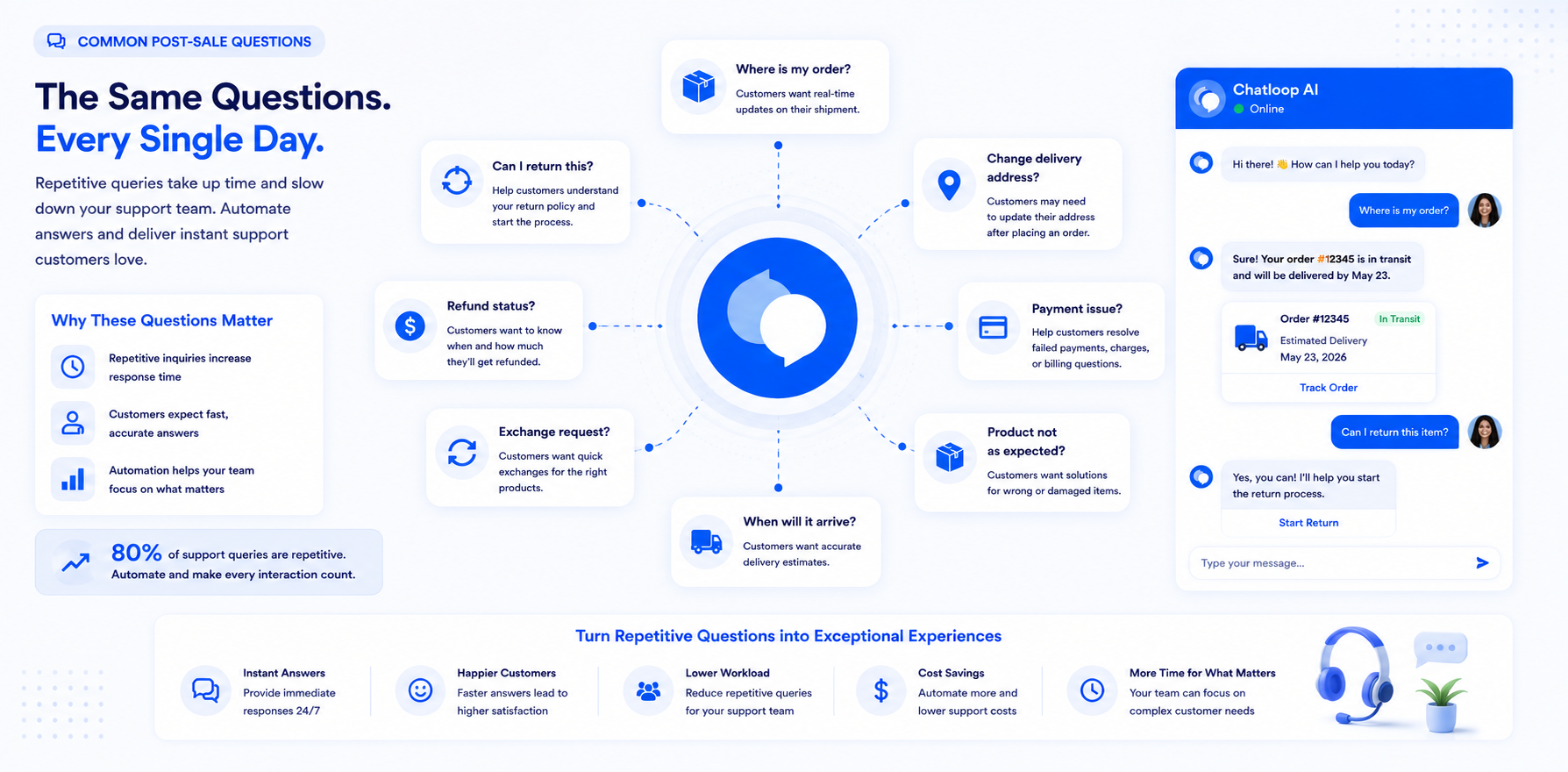
The average ecommerce company receives 40-60% of its total support volume from just three inquiry types:
- WISMO (Where Is My Order?) — customers tracking shipment status
- Returns and exchanges — initiating, tracking, and confirming returns
- Delivery exceptions — failed deliveries, wrong addresses, damaged items
These three categories share a critical characteristic: they are repetitive, data-driven, and highly automatable. A customer asking "where is my order?" doesn't need a human agent — they need their tracking number, estimated delivery date, and a carrier link. That information is already in your order management system. Conversational AI retrieves it in milliseconds and delivers it in the customer's preferred channel.
The cost of handling this manually is enormous. If your team handles 5,000 WISMO contacts per month at an average handling time of 4 minutes and a labor cost of $25/hour, that's $8,300 per month on a single inquiry type that AI can handle at near-zero marginal cost.
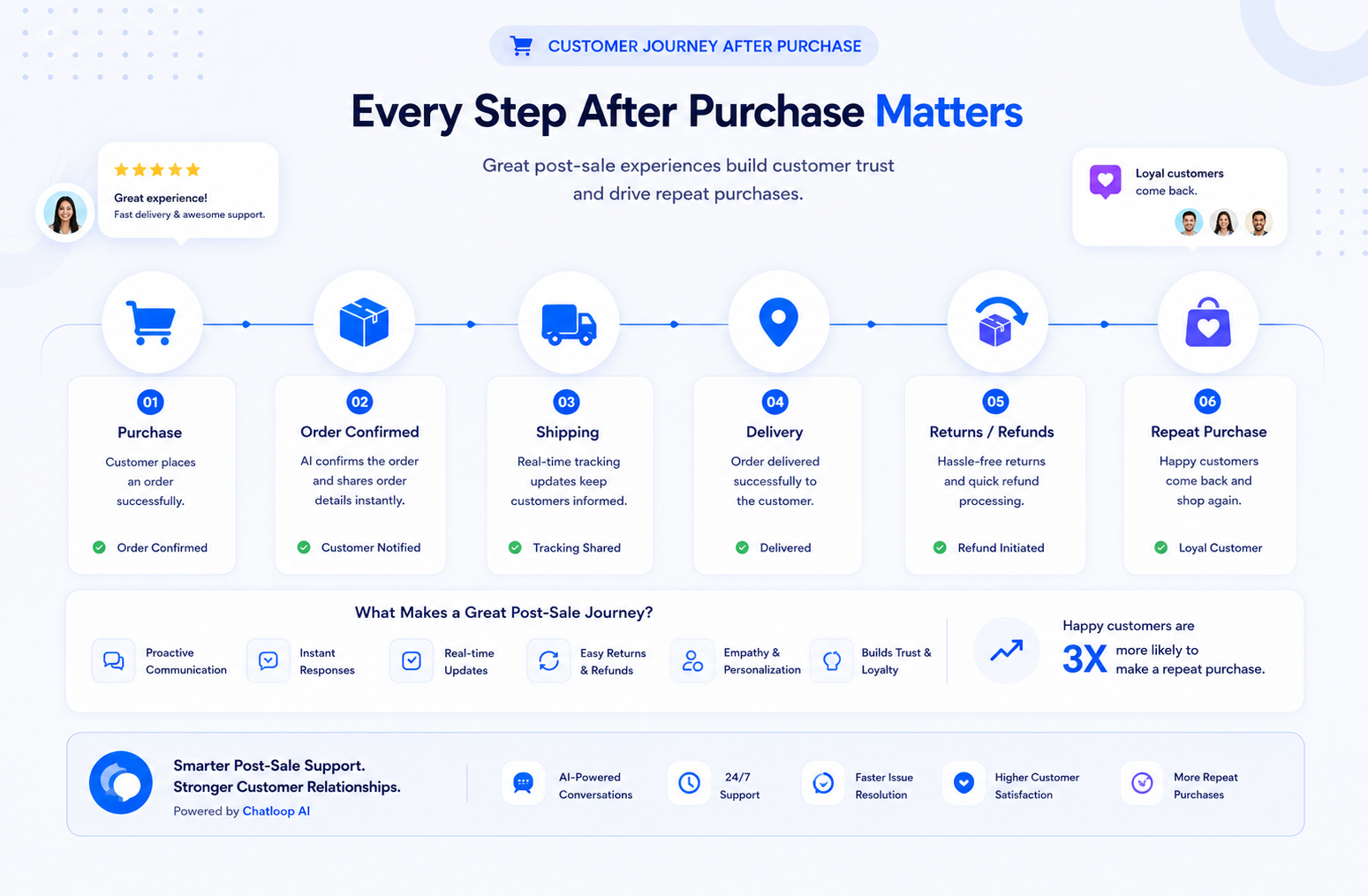
Optimization Framework: The Post-Sale AI Stack
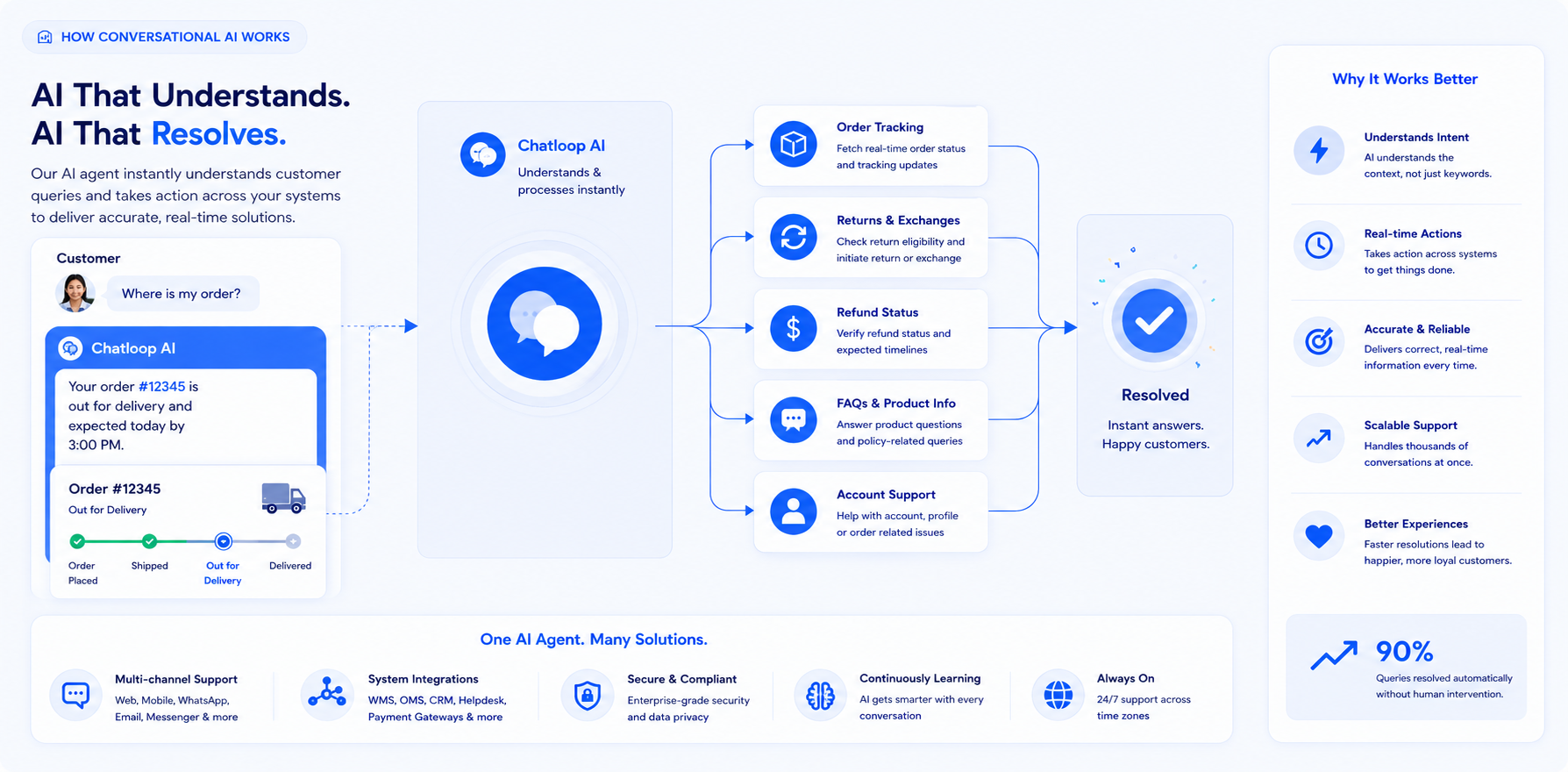
Optimizing conversational AI for post-sale support is not just about the chatbot. It requires four integrated layers:
Layer 1: Data Integration
Your AI is only as useful as the data it can access. Essential integrations for post-sale AI:
- Order management system (OMS): Order status, line items, payment status
- Logistics / carrier APIs: Real-time tracking events, delivery windows, exception flags
- Returns management system (RMS): Return eligibility, label generation, refund status
- CRM: Customer tier, purchase history, previous support interactions
- Warehouse management system (WMS): Stock availability for exchanges
Without these integrations, your AI can only answer general questions. With them, it can resolve specific customer issues instantly.
Layer 2: Conversation Design
Post-sale conversations have predictable patterns. Design intent-specific conversation flows for each major use case rather than relying on a single general-purpose flow. Each flow should:
- Identify the customer (email, order number, or phone number lookup)
- Pull the relevant data point
- Present it in a clear, actionable format
- Offer a logical next step (e.g., "Would you like to initiate a return?")
- Escalate gracefully when the data doesn't match or the issue is complex
Layer 3: Channel Deployment
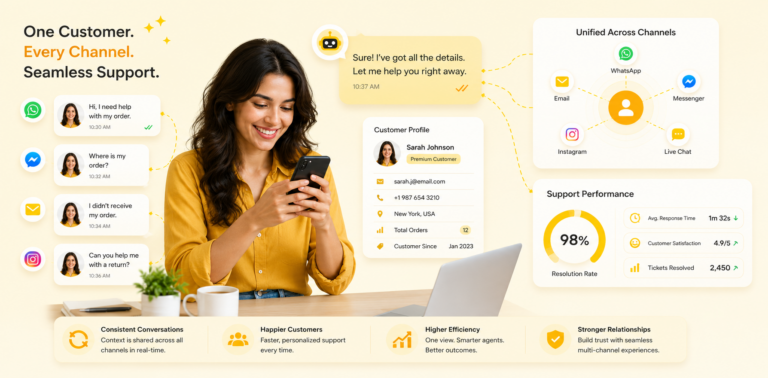
Post-sale AI should operate on every channel your customers use post-purchase:
- Email: Automated acknowledgment and status update emails
- Live chat: On-site chat widget for logged-in customers
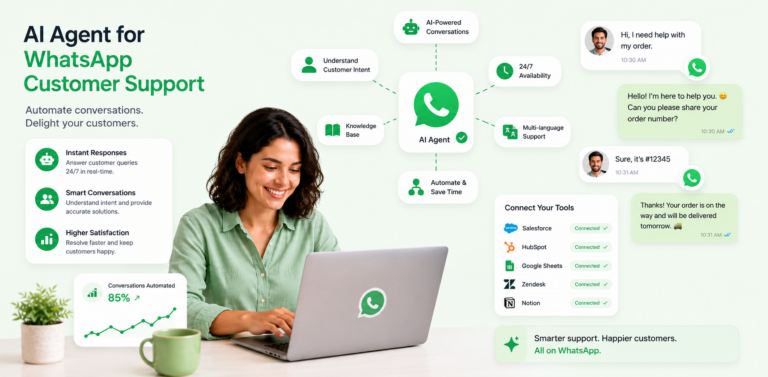
- WhatsApp / SMS: Proactive outreach and reactive support via messaging
- Chatbot on order confirmation page: Proactive "track my order" prompts
Layer 4: Continuous Learning
Analyze conversations weekly to identify failure points — where customers repeat themselves, where escalation rates spike, where CSAT drops. Use these signals to refine intent models, update knowledge base content, and improve conversation flows.
Optimization Area 1: WISMO (Where Is My Order?)
WISMO queries represent the single largest opportunity for post-sale AI deflection in ecommerce. The optimization goal is 70-85% full automation — meaning customers get a complete, accurate answer without any human involvement.
Optimized WISMO flow:
- Customer opens chat or sends message: "Where is my order?"
- AI identifies the customer via account login or asks for order number + email
- AI queries the OMS and carrier API in real time
- AI responds with: order status, carrier name, tracking number with clickable link, estimated delivery window, and last tracking event
- If the order shows a delivery exception (delay, failed attempt, wrong address), the AI proactively offers resolution options
- If the customer is satisfied, the conversation closes; if not, escalation triggers
Common failure points and fixes:
- Customer provides wrong order number: Add fuzzy matching (last 4 digits + email combination)
- Carrier API lag: Display cached status with timestamp and offer to send a tracking link
- Order not found: Ask for alternative identifiers before offering human escalation
- International orders with complex tracking: Use a unified tracking aggregator API that normalizes data across carriers
Benchmark: A mid-size ecommerce brand (50,000 orders/month) that achieves 75% WISMO deflection eliminates approximately 15,000-20,000 human-handled contacts per month.
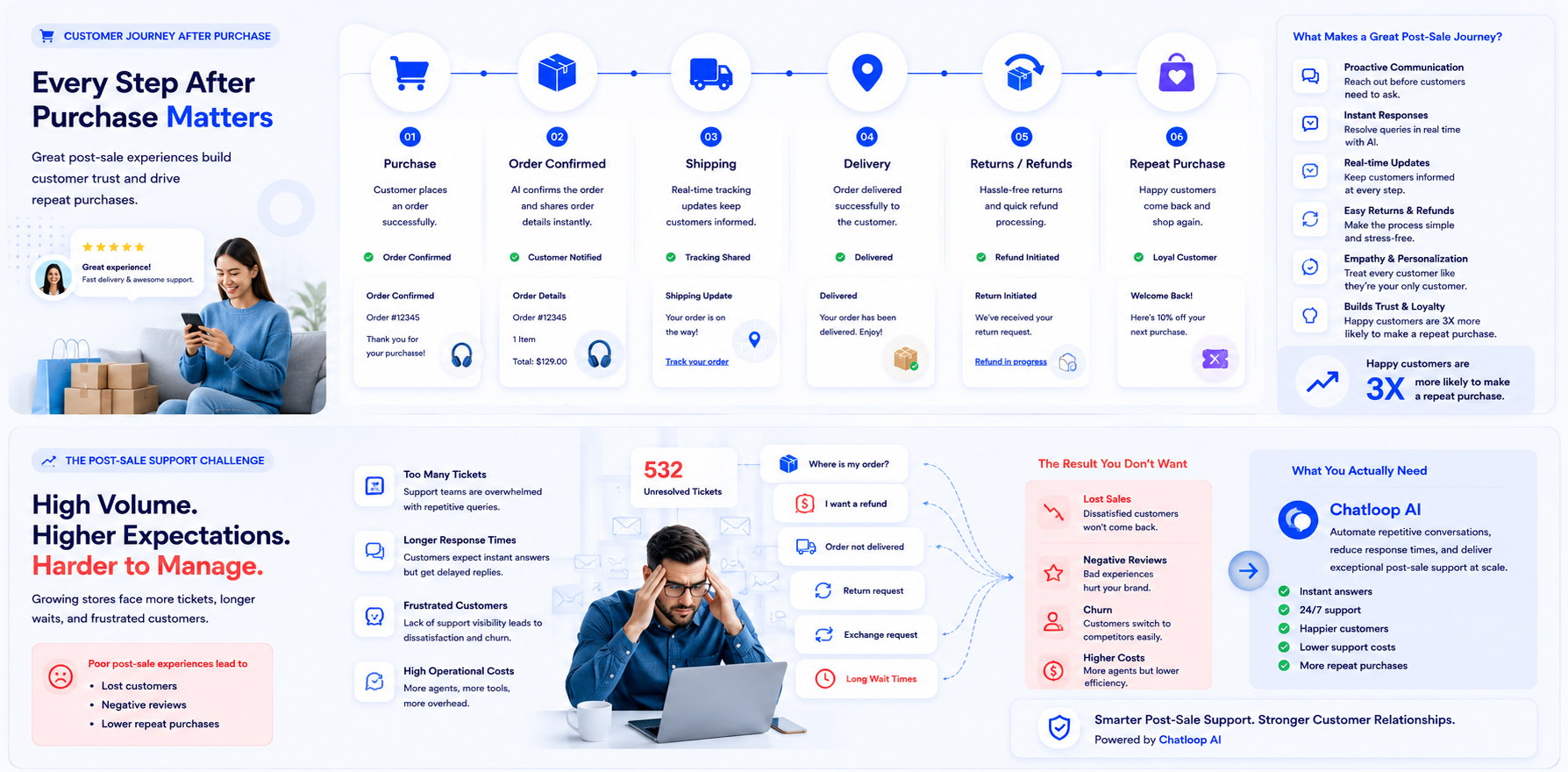
Optimization Area 2: Returns and Exchanges
Returns are emotionally charged interactions. A frustrated customer initiating a return is either a loyal customer you can retain or a lost customer heading to your competitor. Conversational AI plays a critical role in both the mechanics of the return and the retention outcome.
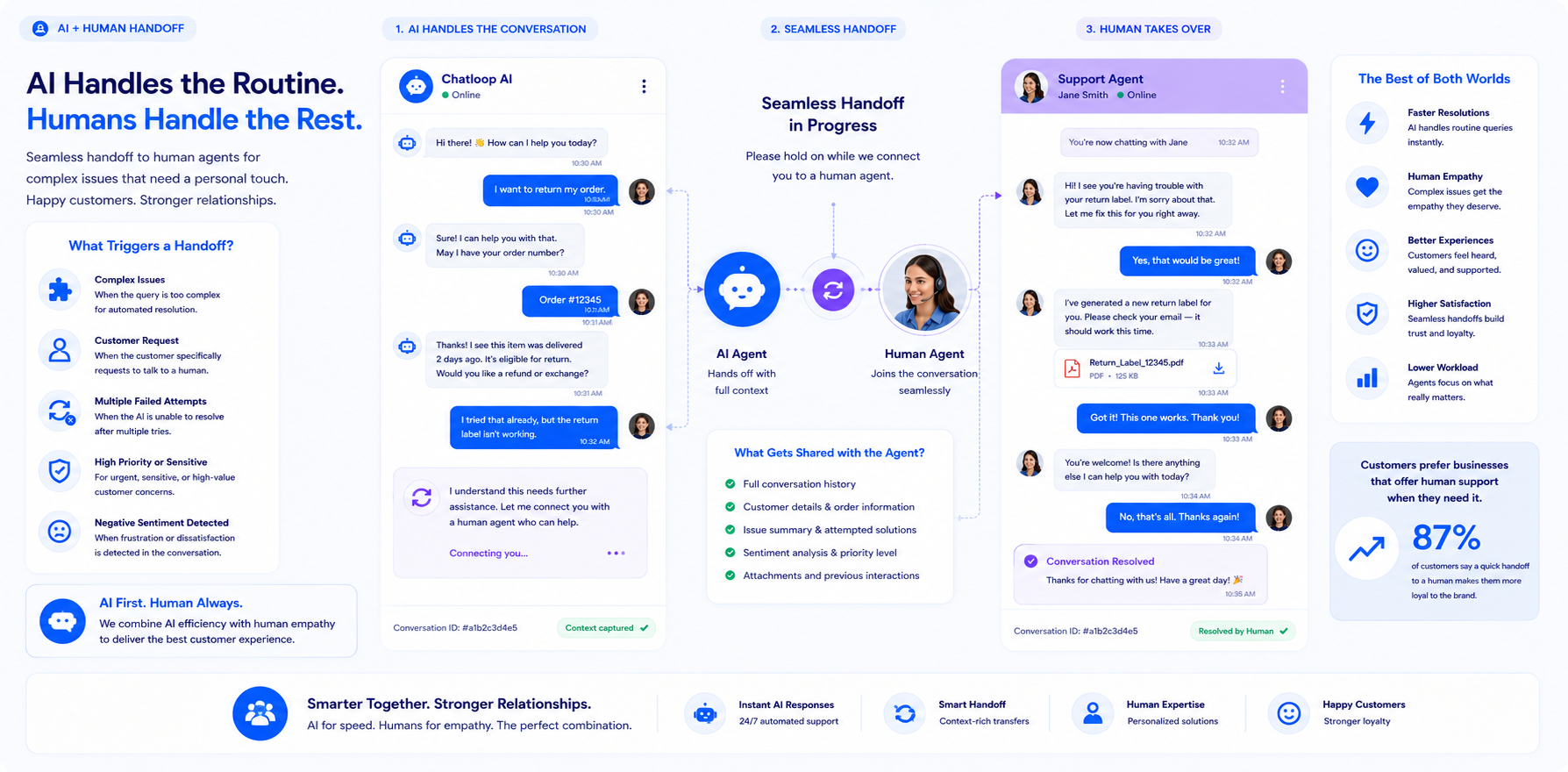
Optimized returns flow:
- Customer: "I want to return my order."
- AI identifies order and checks return eligibility (within return window? Item type eligible?)
- If eligible: AI presents return options — refund, exchange, or store credit — and asks for the reason
- AI generates a return label (via your RMS API) and sends it via email or displays it in chat
- AI sets expectations: when the warehouse receives the return, when the refund processes
- AI asks: "Would you like to exchange for a different size/color instead?" — this is the retention moment
- If customer chooses exchange, AI checks stock and creates the exchange order
Retention optimization: Train your AI to insert a retention offer at the right moment. When a customer initiates a return citing "wrong size," the AI offers to send the correct size with expedited shipping before completing the return. Many customers accept. This is not possible with purely transactional return flows — it requires conversational intelligence.
Return reason capture: Every return reason collected by the AI feeds your product and merchandising teams. Structured reason data (not free-text) from 10,000 returns per month reveals fit issues, quality problems, or photography mismatches far faster than manual ticket review.
Optimization Area 3: Delivery Exception Handling
Delivery exceptions — missed deliveries, damaged packages, wrong-address deliveries, lost shipments — create urgent, high-stress contacts. These are situations where a slow response directly increases refund rates and negative reviews.
Exception categories and AI responses:
| Exception Type | AI Response | Human Needed? |
|---|---|---|
| Delivery attempt failed | Reschedule delivery via carrier API | No |
| Wrong address entered | Address correction form + carrier redirect | No |
| Item damaged in transit | Replacement order trigger or refund | No (if within policy) |
| Lost shipment (7+ days delayed) | Claim investigation initiation | Yes (for high-value) |
| Delivered but not received | Escalate to carrier + offer refund hold | Yes |
Implementation tip: Set up proactive exception alerts. When your logistics integration detects an exception event, the AI sends the customer a message before they contact you. "We noticed your delivery attempt was missed today — click here to reschedule." This proactive approach reduces inbound contact volume by 25-40% for exception categories.
Optimization Area 4: Post-Purchase Retention and Upsell
This is the most underutilized capability of post-sale conversational AI. After a successful resolution, the AI can transition into a retention and revenue conversation.
Scenarios:
- Successful delivery confirmation: AI sends a "Your order arrived — how do you love it?" message with a review request link and a personalized product recommendation based on purchase history.
- Post-return resolution: AI follows up 48 hours after a return is confirmed: "Is there anything we can help you find?" with curated alternatives.
- Loyalty program activation: AI identifies customers approaching a loyalty tier threshold and sends a message highlighting the next reward level and how close they are.
- Replenishment reminders: For consumable products, AI sends a replenishment reminder based on average usage period (e.g., 25 days after purchase of a 30-day supply).
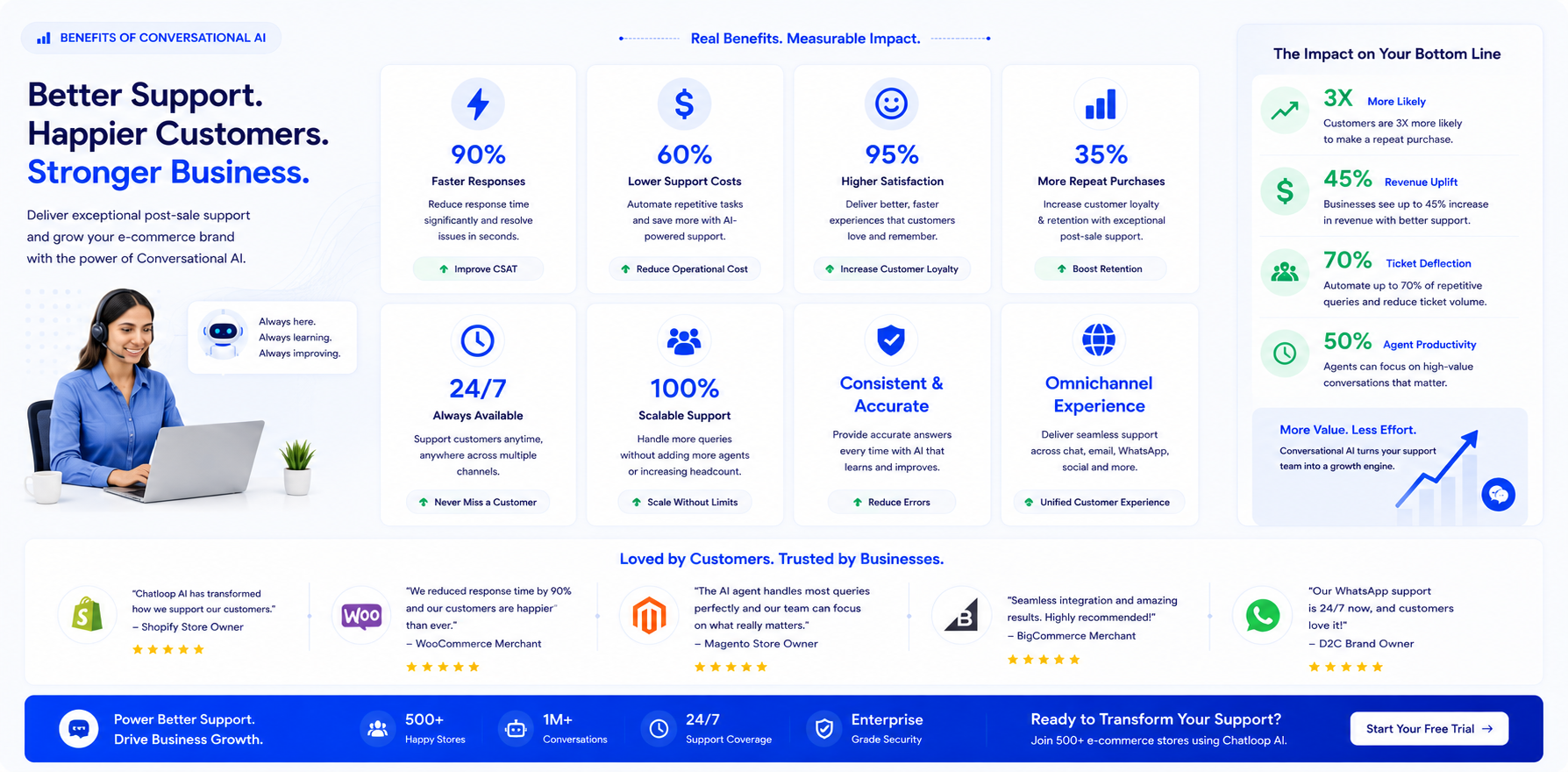
Revenue impact: Ecommerce brands using AI-driven post-purchase upsell and retention messages report 8-15% incremental revenue from the segment receiving these messages, compared to customers who received no post-purchase outreach.
Optimization Area 5: Review and NPS Collection
Authentic product reviews drive organic search rankings and conversion rates. NPS data measures overall brand health. Both require high response rates to be statistically meaningful — and conversational AI dramatically improves those rates.
Optimized review collection flow:
- Trigger 5-7 days after confirmed delivery
- Message via SMS or WhatsApp: "Hi [Name], how are you enjoying your [Product]? We'd love your review."
- Quick rating (1-5 stars) via chat buttons
- One-question follow-up: "What did you love most?" (for 4-5 star ratings) or "What could we improve?" (for 1-3 star ratings)
- Link to publish the review on your platform
Response rates via conversational channels (WhatsApp, SMS) average 40-60%, versus 5-15% for email-based review requests. More reviews, faster, with structured data on both positives and improvement areas.
Measuring Post-Sale AI Performance
Track these metrics weekly across your post-sale AI deployment:
| Metric | Definition | Target |
|---|---|---|
| AI Deflection Rate | % of contacts resolved without human | 60-75% |
| WISMO Automation Rate | % of order status queries fully automated | 70-85% |
| Return Initiation Time | Avg. time from request to label sent | Under 3 minutes |
| Exception Alert Coverage | % of exceptions with proactive outreach | 80%+ |
| Post-Resolution Upsell Rate | % of resolved contacts that convert upsell | 5-12% |
| Review Response Rate | % of delivery-confirmed customers who submit review | 35-55% |
| Post-Sale CSAT | Customer satisfaction after AI-handled contact | 80+ |
Frequently Asked Questions
What is post-sale conversational AI for ecommerce?
Post-sale conversational AI refers to AI-powered chatbots and automation systems that handle customer interactions after a purchase is made — including order tracking, returns, delivery exceptions, reviews, and retention. Unlike pre-sale AI (which handles product discovery and checkout), post-sale AI focuses on fulfillment-related and loyalty-building interactions.
How do I reduce WISMO tickets with AI?
Integrate your AI with your order management system and carrier APIs. When a customer asks "where is my order?", the AI retrieves real-time tracking data and responds with the status, carrier, estimated delivery date, and tracking link — all automatically. The key is real-time data access, not just scripted responses. Teams achieving 70%+ WISMO automation typically combine order management API integration, carrier API aggregation, and proactive shipping notification flows.
Can AI automate ecommerce returns?
Yes, for standard return scenarios. The AI checks return eligibility, presents options (refund, exchange, or store credit), collects the return reason, generates a return label via your RMS, and sets expectations on refund timing — all without human involvement. Complex cases (fraud suspicion, high-value claims, policy exceptions) route to human agents with full conversation context pre-loaded.
How does conversational AI improve post-purchase customer retention?
AI improves retention in three ways. First, faster resolution of post-sale issues reduces frustration and prevents the churn that follows a poor support experience. Second, proactive outreach (shipping updates, delivery confirmations) creates touchpoints that build trust. Third, personalized post-resolution follow-ups (product recommendations, review requests, loyalty nudges) generate incremental engagement. Together, brands report 5-15% higher repeat purchase rates in customer segments served by optimized post-sale AI.
What metrics should I track for ecommerce AI support?
The core metrics are: AI deflection rate (target 60-75%), WISMO automation rate (target 70-85%), average return initiation time (target under 3 minutes), post-sale CSAT (target 80+), and review response rate (target 35-55%). Secondary metrics include exception alert coverage, upsell conversion rate, and cost per resolved contact. Review these weekly in the first three months, then monthly once performance stabilizes.
Conclusion
Post-sale support is the highest-volume, most predictable, and most automatable phase of the ecommerce customer journey. Conversational AI applied here generates immediate, measurable ROI — reduced support costs, faster resolution times, higher customer satisfaction, and improved retention.
The optimization path is clear: integrate your AI with your operational data systems, design intent-specific conversation flows for each post-sale scenario, deploy across every channel your customers use, and measure performance rigorously. The brands leading in ecommerce customer experience are already doing this — and using the cost savings to reinvest in the human interactions that genuinely require empathy and judgment.
Ready to automate your ecommerce post-sale support? Book a Chatloop demo to see how our conversational AI platform integrates with your OMS, returns system, and carrier APIs out of the box.


2 Responses on this post
Comments are closed.