


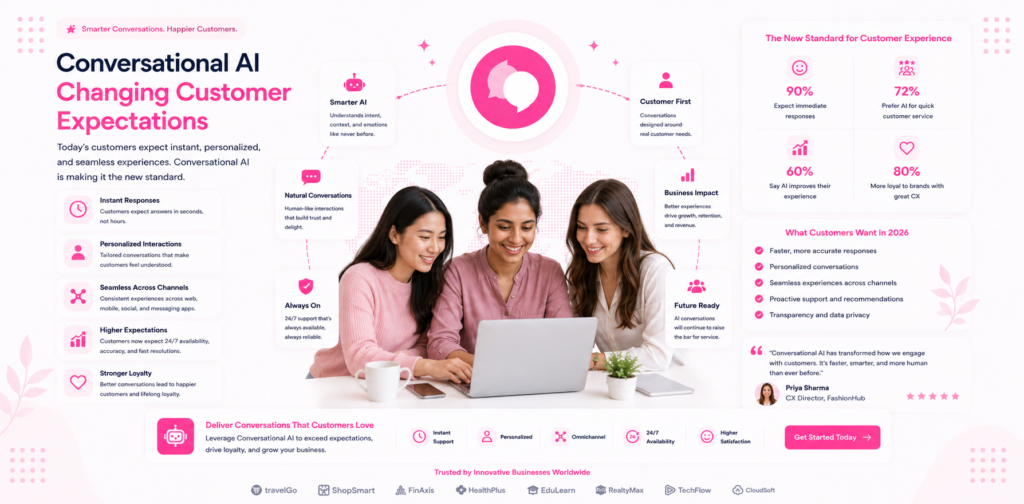
Something permanent is happening to customer expectations, and it is driven almost entirely by their experience with AI. When customers interact with Amazon's recommendation engine, get an instant response from a well-configured chatbot, or receive a proactive update before they even thought to ask, they recalibrate what they consider normal. And once expectations recalibrate upward, they do not come back down.
This article examines the specific ways conversational AI is shifting customer expectations, what those shifts mean for businesses that have not yet deployed AI, and how to position your customer experience for the expectations your customers will hold in 2026 and beyond.
The Expectation Ratchet
Economic theory has a concept called the ratchet effect — the tendency for things to move in one direction and then resist moving back. Customer service expectations work this way. Once a customer has experienced instant, accurate, 24/7 AI support — even from a competitor, a bank, or a retailer in an unrelated category — their baseline expectation shifts.
Conversational AI is the primary driver of this upward ratchet in three specific dimensions: speed, availability, and personalisation.
Dimension 1: Speed — The Instant Response Baseline
The most fundamental shift driven by conversational AI is the new baseline expectation for response time. For most of the history of digital customer service, same-day response was considered good and next-day was considered acceptable. That standard is now obsolete for messaging channels.
The experience of getting a two-to-four second response from a well-configured AI chatbot recalibrates what a customer considers instant. Having received that experience, a 30-minute human response to a routine query does not feel like a different speed — it feels like neglect.
Research published in 2024 found that customers who had previously experienced AI-powered instant responses rated human responses arriving within 60 minutes 23% lower in satisfaction than customers who had no prior AI experience — even when the content of the response was identical. The expectation set by AI is being applied to human interactions.
The practical implication: businesses that rely on human response times alone for routine queries are being evaluated against an expectation set by AI, which means the gap between their actual performance and customer expectations is widening even if their response times have not changed.
Dimension 2: Availability — The End of Business Hours
Customers who have experienced 24/7 AI support no longer mentally exempt businesses from after-hours expectations. The concept of "we are closed, please call back during business hours" is increasingly at odds with how customers experience the digital world.
This shift is particularly significant for businesses in B2C and SMB segments, where the traditional assumption was that small businesses naturally operated on limited hours and customers accepted this. That acceptance is eroding — not because customers have become less reasonable, but because their experience with AI-powered services has given them a reference point for always-on availability.
After-hours contact rates across digital channels have grown by approximately 35% over the past two years. This is not a random change in customer behaviour — it is a behavioural shift driven by the expectation that digital channels should be responsive regardless of the time.
For businesses without AI coverage, this means a growing volume of after-hours queries going unanswered, and each unanswered query represents a customer whose experience has created a negative data point about your business, measured against an expectation they formed from AI interactions elsewhere.
Dimension 3: Personalisation — The Memory Expectation
Conversational AI with CRM integration remembers. It knows the customer's name, purchase history, previous contacts, and preferences. When a customer has experienced this — "I see you ordered the XL last time, would you like the same size?" — they carry that expectation forward.
Returning to a support channel that asks "Can you tell me your order number?" after multiple previous interactions feels, by contrast, dismissive. The customer has not changed. The expectation of being remembered has been set by AI and is now applied universally.
This personalisation expectation is the most difficult one for businesses to meet without technology. Human agents can remember regular customers within limited contexts, but genuine memory across all interactions, channels, and transaction history requires system integration that only AI with CRM connection can deliver at scale.
Dimension 4: Consistency — The Reliability Standard
AI chatbots give the same answer every time. Human agents, with the best intentions, give varied answers based on interpretation, fatigue, and individual judgment. Customers who have experienced the consistency of AI responses have a new reference point for reliability.
When an AI tells a customer that a return can be processed within 5 days, and that answer is consistent across every interaction, every channel, and every time zone — customers begin to expect this level of consistency. When they then encounter a business where one agent says 5 days and another says 10, the inconsistency registers not as "that is just how human support works" but as "this business does not have its information together."
Consistency is increasingly a trust signal. AI's inherent consistency in answer delivery is training customers to notice and penalise inconsistency elsewhere.
What This Means for Businesses Without AI
For businesses that have not yet deployed conversational AI, these shifting expectations create a compounding challenge. The gap between what customers expect and what a human-only support operation can deliver is widening on multiple dimensions simultaneously.
This gap has three business consequences.
Customer dissatisfaction scores are rising without any change in your actual performance. If your response times have stayed constant but customer expectations have increased, your CSAT will decline. You have not gotten worse — the benchmark has moved.
Competitive disadvantage compounds over time. Every month that a competitor deploys and refines AI customer service, they are building knowledge base depth, operational expertise, and customer experience advantage that takes time to replicate.
The cost of catching up increases. A business deploying AI in 2026 starts with modern platforms, competitive pricing, and 12 months of accumulated knowledge from early deployments. A business deploying in 2027 will need to match what has become the baseline — a much higher bar.
How to Meet the New Expectations
Meet the speed expectation immediately. Deploy an AI chatbot for your most common query categories. Even a focused deployment handling 40–50% of your query volume will eliminate the most damaging response time gaps — after-hours queries and peak-period backlogs.
Build toward continuous availability. The minimum viable AI deployment for availability is website chat and WhatsApp coverage outside business hours. A well-configured after-hours chatbot that captures, qualifies, and routes enquiries meets the expectation without needing to resolve every query autonomously.
Connect your data. Personalisation expectations cannot be met without CRM integration. Connect your chatbot to your customer database so it can greet returning customers by name, reference their history, and route based on customer tier.
Standardise your answers. Use your AI knowledge base as the single source of truth for your policy answers. When your AI and your human agents are answering from the same knowledge base, consistency improves across all channels.
The Businesses Winning on Customer Experience in 2026
The businesses achieving the highest customer satisfaction scores in 2026 are not necessarily the ones with the largest support teams or the most expensive technology. They are the ones that have understood the new expectation landscape and configured their AI deployments accordingly.
They respond instantly to routine queries. They are available after hours. They remember customers across interactions. They give consistent answers. And they escalate to humans with full context, quickly, when the query genuinely requires it.
The technology to do all of this is available to any business at SMB pricing. The differentiator is not the technology — it is the decision to deploy it, configure it well, and maintain it over time.
FAQ
Are customer expectations genuinely different now or has AI just revealed existing expectations? Both. Some expectations — like fast responses — always existed but were suppressed because customers had no reference for anything better. Others — like 24/7 availability and persistent memory — are genuinely new, created by AI capability.
Is it possible to meet these expectations with improved human support alone? For speed and availability, no — human-only support cannot economically deliver sub-10-second response times or genuine 24/7 coverage. For personalisation and consistency, partially yes, but only at a cost that makes it impractical for most SMBs.
How long before AI customer service becomes a universal baseline expectation? Industry analysts broadly agree on a 24–36 month window. Businesses deploying now have that window to build expertise before AI becomes table stakes rather than a differentiator.
Will customers who prefer human service always resist AI? Customer preference for human service is not binary. Most customers who prefer human service are actually expressing preference for quality, speed, and accuracy. When AI delivers all three, human preference softens significantly.
What is the most important thing to deploy first to meet shifted expectations? After-hours coverage. The availability gap is both the most damaging expectation failure and the easiest one to close with a basic AI deployment.
Meet your customers' 2026 expectations today. Start your Chatloop free trial and deploy 24/7 AI customer service in under a day.


3 Responses on this post
Comments are closed.