


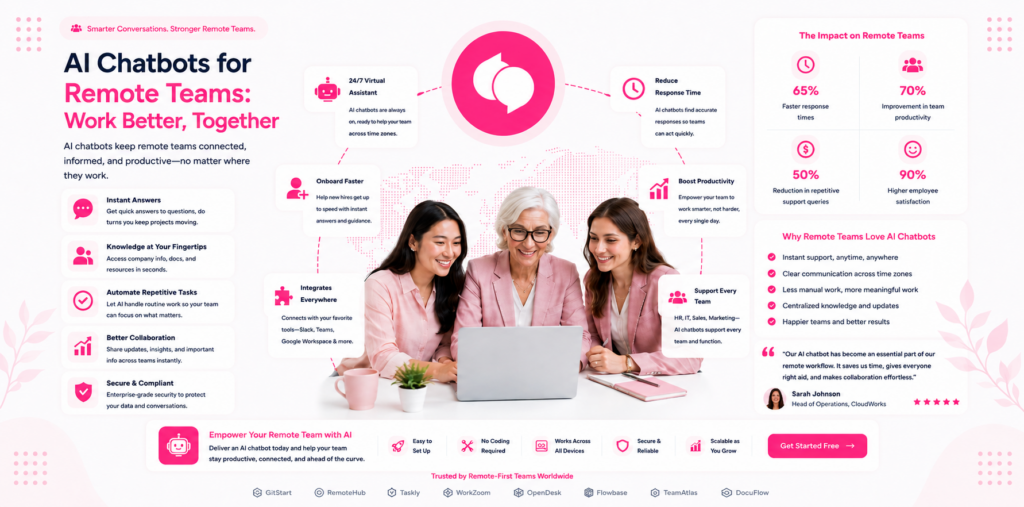
Remote and distributed teams face a challenge that office-based businesses do not: the customers and colleagues who need information do not share your working hours. A customer in Dubai enquiring at 9pm their time reaches a team in London that clocked off two hours ago. A team member in Singapore needs a process clarification at 6am local time when their manager in New York is asleep.
These timezone gaps are not minor inconveniences. They create multi-hour delays in communication that slow down projects, frustrate customers, and erode the efficiency that remote work is supposed to deliver. An AI chatbot for remote teams closes these gaps without requiring anyone to work unsociable hours.
The Timezone Problem in Remote Business Operations
Before understanding the solution, it helps to quantify the problem precisely. For a business with a primary team in the UK and customers or partners in multiple timezones, the communication gap analysis looks roughly like this.
A customer in New York enquiring at 4pm EST reaches the UK at 9pm GMT — outside business hours. Their query goes unanswered until 9am GMT the following morning — a 12-hour delay. A customer in Singapore enquiring at 3pm SGT reaches the UK at 7am GMT — technically within hours, but the team is not yet fully active.
For businesses serving customers across multiple regions, or managing remote teams distributed globally, these gaps compound. A project that could progress in one day with instant communication takes three days because each exchange waits for the next working window of the relevant timezone.
This is why after-hours AI coverage is consistently cited as one of the highest-value AI deployments regardless of business size — not because of automation volume, but because of the disproportionate commercial importance of the queries that arrive during those gaps.
How AI Chatbots Solve Timezone-Driven Communication Delays
Customer-Facing Coverage
For remote businesses serving customers globally, an AI chatbot deployed on your website and WhatsApp ensures that every customer query receives an immediate response regardless of when it arrives.
The AI handles tier-1 queries — FAQs, pricing, order status, policy questions, booking requests — instantly at any hour. For tier-2 queries that require human judgment, it captures full context, acknowledges the query, and notifies the relevant team member for when they return to their working window.
The customer experience is fundamentally different in both cases. Instead of "your query will be responded to in the next business day," the customer receives either an instant resolution or an instant acknowledgement with a clear timeline. This distinction matters significantly for customer satisfaction and reduces the churn risk from unacknowledged after-hours queries.
Internal Team Communication
For distributed teams, an AI assistant trained on internal documentation removes the dependency on specific colleagues being available for routine information requests.
A developer in Singapore at 6am local time who needs to know the process for requesting a code review does not need to wait for their London lead to wake up — they ask the AI assistant, which draws from the process documentation and answers immediately. A sales rep in Dubai at 8pm local time who needs the current pricing structure for a client proposal does not need to ping the finance team — they ask the AI.
This async capability is explored in detail in the guide on AI chatbot for team collaboration, which covers the full range of internal use cases. The remote team context adds a specific urgency: when your team is distributed across three or more timezones, the value of instant async information access is multiplied by the frequency of timezone-dependent bottlenecks.
Specific Use Cases for Remote Business AI
Customer Support Across Timezones
Deploy chatloop.io on your website and WhatsApp with a knowledge base covering your top 50 customer queries. Customers in every timezone receive instant responses. Human agents review and resolve the escalated cases that arrived during their previous off-hours window at the start of each working day — rather than trying to catch up on a backlog of unanswered messages.
This workflow converts what was previously a reactive firefight at the start of each day into a structured triage of only the queries that genuinely needed human judgment. The routine tier-1 queries are already resolved by the time the team logs in.
Sales Qualification Across Markets
For businesses selling to global markets, lead qualification delays are a direct revenue cost. A prospect in a different timezone who submits an enquiry and waits 18 hours for a response has often moved on. An AI agent that qualifies the lead immediately, answers their initial product questions, and schedules a follow-up call for the relevant timezone closes this window.
The chatloop.io for sales configuration supports this: the AI qualifies inbound leads around the clock, routes to the relevant regional sales contact based on the prospect's location, and notifies that contact at the start of their working day with a briefed, pre-qualified opportunity ready to action.
Internal IT and HR Support
Remote teams rely heavily on internal tooling. When tools break at 11pm for a team member in a different timezone, the alternative to waiting for the IT team's working hours is either lost productivity or the IT team being contacted outside their hours.
An AI assistant trained on your IT troubleshooting guides and HR policies handles the tier-1 queries — "How do I reset my password?", "What is the VPN setup process?", "What are the public holidays for my country?" — instantly, regardless of the hour. For the queries that genuinely require human IT support, the AI logs the ticket with full context so the IT team can action it efficiently when they are available.
Project Coordination
Distributed project teams frequently need to coordinate work across handover windows — the moment when one timezone team finishes their day and the next timezone team begins theirs. An AI assistant that can answer questions about current project status, outstanding blockers, and process requirements helps handovers happen more smoothly.
This use case requires the AI to be connected to project documentation and status updates. With chatloop.io's integrations, you can connect the AI to project management tools so that queries about current project status draw from live data rather than static documentation.
Configuring Your Remote Team AI Deployment
Map Your Timezone Coverage Gaps
Start by identifying where your coverage gaps actually are. For each hour of the 24-hour cycle, determine what proportion of your customer query volume arrives during that hour. The hours where volume is significant but your team is not active are your highest-priority AI coverage windows.
Most businesses find that 20–35% of their total customer query volume arrives outside their primary working window. These are the queries with the longest response delays and the highest risk of customer frustration or abandonment.
Build a Timezone-Aware Routing Configuration
For businesses with team members in multiple timezones, configure your AI agent's escalation routing to be timezone-aware. A query arriving at 3am GMT that requires human judgment should not route to a GMT-timezone agent's inbox — it should route to the on-duty agent in the timezone where it is currently working hours.
Chatloop.io allows you to configure routing rules based on availability and time windows. Review the features page for current routing configuration options.
Set Accurate Response Expectations
For queries that require human response, the AI should communicate realistic timelines. "A member of our team will follow up within four hours" is more trust-building than no timeline — and ensures that when the team does respond, they are meeting the expectation set rather than arriving late against an unstated deadline.
Configure your after-hours AI messages to include accurate response windows based on your team's actual working schedule.
Multi-Language Configuration for Global Teams
Remote businesses serving global markets often need multilingual support. Chatloop.io supports multi-language knowledge bases and automatically responds in the customer's language. This capability is particularly valuable for after-hours coverage — a French-speaking customer enquiring at 11pm French time receives an accurate response in French, not a prompt to contact during business hours.
For detailed guidance on multilingual configuration, see chatloop.io's features.
Measuring the Impact on Remote Team Operations
Track these metrics to quantify the benefit of your remote team AI deployment.
After-hours response rate. Before deployment: percentage of after-hours queries that receive a response within 2 hours. After deployment: same metric. The improvement should be immediate and dramatic.
Timezone-related escalations. The number of issues that required a team member to be contacted outside their working hours. This should decline significantly as AI handles tier-1 queries regardless of time.
Customer satisfaction by timezone. If you have CSAT data segmented by region or timezone, compare scores for customers who historically received slower responses due to timezone gaps. Post-deployment improvement confirms the impact.
Internal query resolution time. For distributed team members, the average time between asking an internal question and receiving an answer. Pre-AI deployment, this is heavily influenced by timezone availability. Post-deployment, it should approach minutes regardless of when the question is asked.
FAQ
Does an AI chatbot replace the need for team members in different timezones? For businesses that currently employ team members specifically for timezone coverage, AI can reduce that need for tier-1 query handling. However, complex support, sales, and management functions still benefit from timezone-appropriate human coverage. AI reduces the cost of timezone coverage; it does not eliminate the need for human presence in key markets.
Can the AI handle queries about real-time data like order status across timezones? Yes, provided the AI is connected to your back-end systems. Chatloop.io's integrations allow the AI to look up live order, account, and inventory data regardless of when the query arrives.
How do I prevent the AI from making commitments our team cannot honour during their off-hours? Configure the AI with clear boundaries about what it can commit to autonomously (query resolution, information provision) and what requires human confirmation (custom quotes, non-standard requests, complaint resolution). The AI should acknowledge the latter and set a response timeline.
What is the minimum team size where remote AI deployment makes sense? Any business with customers or colleagues in different timezones benefits from AI coverage. Even a two-person business serving an international customer base sees immediate value from eliminating 12-hour response delays on routine queries.
How does chatloop.io handle languages other than English? Chatloop.io supports real-time translation and multilingual knowledge bases. A customer writing in French receives a French response. A customer writing in Arabic receives an Arabic response. The same knowledge base serves all languages. Review the AI help desk automation for remote teams article for more on multilingual configuration.
Stop losing customers and productivity to timezone gaps. Deploy chatloop.io and give your remote business 24/7 coverage starting today.


1 Response on this post
Comments are closed.