


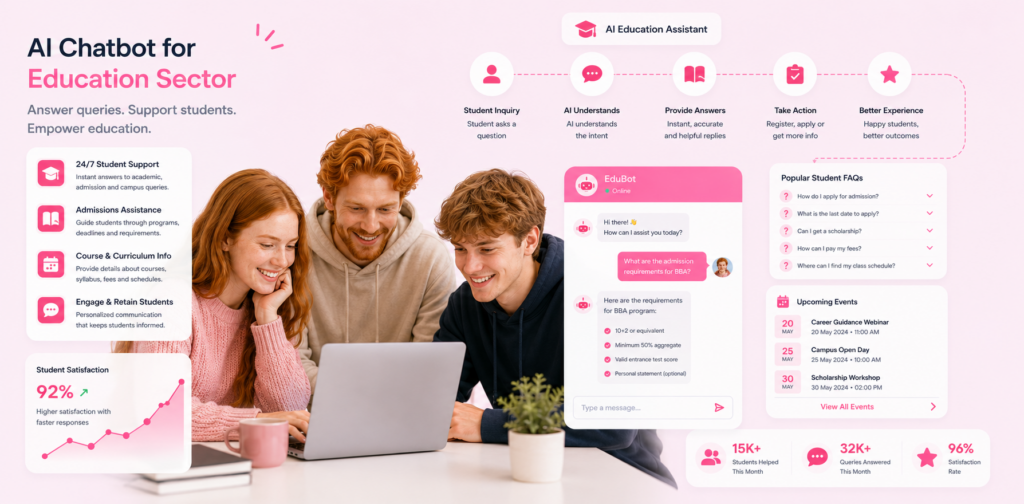
Educational institutions — universities, colleges, training providers, and online learning platforms — handle enormous volumes of repetitive administrative queries. Prospective students ask about course content, fees, entry requirements, and application processes. Current students ask about deadlines, timetables, submission requirements, and campus services. Each of these queries is handled by a member of staff who could otherwise be providing higher-value student engagement.
An AI chatbot for education automates the administrative tier of student communication, giving prospective students instant answers that convert more enquiries into enrolments, and freeing staff to focus on the pastoral and academic support that genuinely requires human involvement.
Why Education Is Ideal for AI Chatbot Deployment
Education sector query patterns align well with AI automation for several reasons.
High volume, predictable query types. Admissions offices and student support teams handle large volumes of enquiries where the same questions recur constantly: "What are the entry requirements for this course?", "When is the application deadline?", "What are the fees?", "Is there student accommodation?", "How do I apply for a bursary?".
Seasonal peaks with fixed staffing. Application seasons, enrolment periods, and exam results periods generate query spikes that exceed normal staffing capacity. An AI chatbot absorbs peak volume without requiring additional temporary staff.
24/7 student expectations. Students research courses and complete applications at all hours. A prospective student who visits your website at 10pm and cannot find an answer to their question is a conversion opportunity lost. An AI chatbot provides the instant response that converts that evening research session into an enquiry.
International student enquiries across timezones. For institutions attracting international students, query volume arrives across all timezones. For more on timezone-responsive AI deployment, see AI chatbot for remote teams.
Key Use Cases for Education AI Chatbots
Admissions and Course Enquiries
Prospective students go through a research phase before making an application. During this phase, they have specific questions about course content, entry requirements, fees, scholarships, and application processes. An AI trained on your course catalogue, entry requirements, and admissions policies answers these questions instantly and accurately.
The conversion impact is significant. Prospective students who receive instant, accurate answers during their research phase are more likely to progress to application than those who submit an enquiry form and wait days for a response. For context on how response time affects conversion, see the true cost of slow customer response times.
Configure the chatbot to offer proactive engagement on course pages — a student who has been browsing a specific course page for two minutes has shown clear interest and is a candidate for a targeted "Can I answer any questions about this course?" prompt.
Enrolment and Onboarding Support
Newly enrolled students navigate a complex onboarding process: registration, timetable access, student ID, accommodation, financial administration, and library access. Each step generates queries that can be answered from a well-structured onboarding FAQ knowledge base.
An AI chatbot that guides new students through the onboarding process — answering questions at each step, providing links to relevant portals, and confirming completed actions — reduces the administrative burden on enrolment teams significantly.
Student Services and Campus Information
Timetables, room locations, library hours, IT support, financial aid deadlines, extracurricular activity information — the operational information that students need throughout the academic year is well-suited to AI delivery. This content is standardised, accurate, and high-volume.
Configure your chatbot with a comprehensive knowledge base covering student services information for the current academic year. Update it at the start of each term to reflect any changes to timetables, services, or deadlines.
Assessment and Submission Guidance
Submission deadlines, formatting requirements, submission portals, and late submission policies are among the most common student queries during term time. These are high-stakes for students — an incorrect answer about a submission deadline has real consequences — which means accuracy of the knowledge base is critical.
Ensure these entries are reviewed at the start of each academic year and updated immediately when any change is made. Assign a specific member of academic administration to own knowledge base accuracy for assessment-related content.
International Student Support
International students have a specific set of enquiries: visa requirements and support, English language requirements, scholarship availability for international applicants, accommodation options, and arrival guidance. An AI chatbot that handles these queries 24/7 and in the student's preferred language is particularly valuable given the timezone differences involved.
Chatloop.io supports multilingual knowledge bases — the same knowledge base can serve an enquiry in Mandarin, Arabic, or Portuguese as effectively as one in English. Review chatloop.io's features for current language support.
Configuration Guide for Education Institutions
Phase 1: Prospective Student Enquiry Automation (Weeks 1–2)
Start with admissions and course enquiry automation. Build your knowledge base from existing course pages, admissions FAQs, and prospectus content. Configure the chatbot for your primary website.
Priority entries for this phase: entry requirements by course, application deadlines, fees and payment options, scholarship and bursary availability, course content overviews, open day dates, and contact details for the admissions team.
Deploy with a clear escalation path to admissions staff for non-standard enquiries. Test with your top 20 prospective student questions before going live.
Phase 2: Current Student Support (Weeks 3–6)
Add a knowledge base covering current student information: timetable access, submission deadlines, campus services, IT support, and financial services queries. Deploy to student-facing pages on your student portal or intranet.
For institutions with a student portal, integrate chatloop.io with the portal through chatloop.io's integrations to allow the AI to reference student-specific information where appropriate.
Phase 3: Multi-Channel Deployment
Many students prefer WhatsApp for communication with institutions. Deploying chatloop.io on WhatsApp gives students a channel that feels natural and accessible. For configuration, see how to integrate an AI agent with WhatsApp.
Managing AI in an Academic Safeguarding Context
Educational institutions, particularly those serving young people or vulnerable adults, must configure AI chatbots with appropriate safeguarding considerations.
Wellbeing and crisis escalation. Any indication of a student in distress, experiencing mental health difficulties, or raising safeguarding concerns must trigger immediate escalation to a human staff member trained in student wellbeing. Configure these triggers explicitly and test them before launch.
Age-appropriate communication. For institutions serving under-18 students, configure the chatbot's tone and content to be appropriate for that age group. Review responses regularly to ensure age-appropriateness is maintained.
Data protection for students. Students are entitled to GDPR protections, and for under-18 students, additional data protection considerations apply. Ensure your data processing agreement with chatloop.io covers your specific student data protection requirements.
AI transparency. Students should be informed they are interacting with an AI. This is particularly important in educational contexts where some students may be vulnerable and need to know that human support is available.
Measuring Impact in Education Institutions
Track these metrics to demonstrate and improve the value of your education AI deployment.
Admissions enquiry conversion rate. The percentage of chatbot enquiry interactions that result in a completed application. Improvement in this metric is direct evidence that the AI is contributing to enrolment targets.
Admissions team query volume. The number of standard admissions queries reaching the human admissions team. This should decline as AI automation handles routine enquiries, freeing admissions staff for complex cases and student relationship building.
Student satisfaction scores. Include chatbot satisfaction ratings in your student feedback processes. Target CSAT of 4.0/5.0 or above for AI-handled queries.
After-hours enquiry capture. The percentage of prospective student enquiries that arrive outside business hours and are handled by the AI rather than going unanswered. This metric is directly related to international student enquiry volumes.
Response time. Average time from enquiry submission to first meaningful response. Pre-AI: hours to days for email-based enquiries. Post-AI: seconds for queries the AI can handle, with clear escalation paths for those it cannot.
FAQ
Can an AI chatbot help with UCAS application guidance? The AI can provide general information about the UCAS process — deadlines, personal statement guidance links, reference requirements — but should not attempt to provide personalised application advice, which requires human admissions expertise. Always direct specific UCAS guidance queries to your admissions team.
How does the AI handle inaccurate course information? This depends entirely on the accuracy of your knowledge base. Institutions must assign clear ownership for knowledge base accuracy and update content whenever course information changes. An inaccurate AI response about entry requirements has real consequences for prospective students — accuracy review is not optional.
Can the AI handle student finance queries? The AI can provide general information about student finance processes and deadlines, but should not provide personalised financial advice. Financial aid eligibility, means-tested bursary calculations, and similar queries require human financial administrators.
How should we deploy the chatbot during UCAS clearing? Clearing is an ideal AI chatbot use case — extremely high query volume, standardised information about available courses and requirements, and time-sensitive enquiries. Pre-configure a specific clearing knowledge base and test it thoroughly before the clearing period begins.
Can chatloop.io integrate with our student management system? Chatloop.io supports integrations through its integrations library and webhook connections. The specific integration with your student management system depends on whether a pre-built connector is available or a custom webhook connection is needed.
Help more students, engage fewer repetitive queries. Start your free chatloop.io trial and see how education institutions are transforming student communication.


1 Response on this post
Comments are closed.