


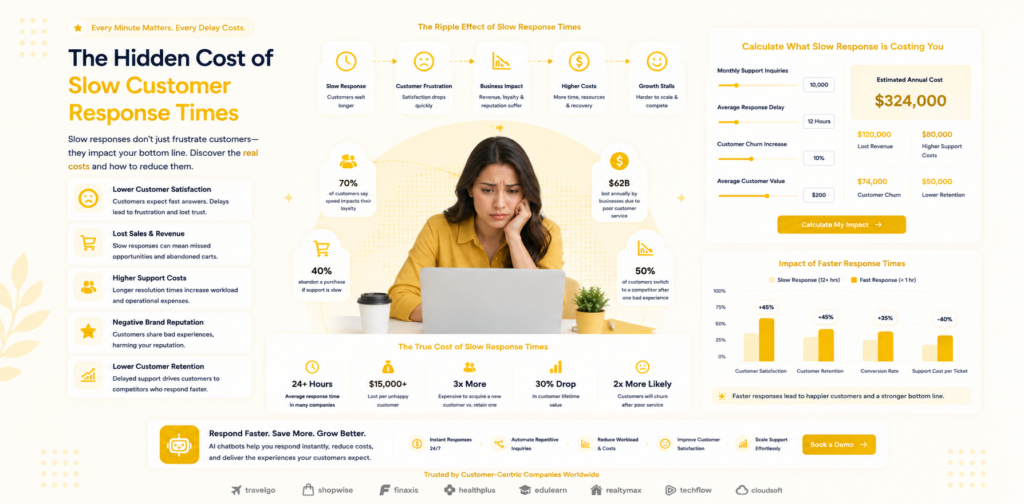
Most businesses know that slow response times make customers unhappy. Fewer businesses have calculated what that unhappiness actually costs. When you run the numbers, the financial impact of delayed responses is almost always larger than expected — and the case for AI-powered instant responses becomes straightforward.
This guide quantifies the cost of slow customer response across five dimensions, gives you the data to calculate your own exposure, and explains how AI chatbots eliminate the problem at the source.
Why Response Time Is the Most Underestimated Metric in Customer Support
Response time is not a soft metric about customer experience. It is a hard commercial variable that directly affects conversion rates, repeat purchase behaviour, churn rates, and brand reputation.
The research is unambiguous: customers have fundamentally recalibrated their expectations in the era of instant digital communication. A response time that would have seemed excellent ten years ago — same day, for example — is now perceived as slow. The standard expectation for chat and messaging enquiries is measured in minutes, not hours.
When businesses fail to meet those expectations, the consequences materialise in five distinct ways.
Cost 1: Lost Sales from Prospective Customers
When a potential customer contacts a business with a pre-purchase question — about a product, pricing, compatibility, or availability — they are at peak buying intent. The response time at this moment directly affects whether the purchase happens.
Research from Harvard Business Review found that businesses responding to enquiries within five minutes were 21 times more likely to qualify the lead than those responding within 30 minutes. After 24 hours, the lead qualification rate drops by over 80%.
For a business with a £500 average order value, 100 monthly pre-purchase enquiries, and a 4-hour average response time, the estimated monthly lost sales from leads that go cold before a response arrives can reach £8,000–12,000.
How AI fixes it: A chatbot responds in two to four seconds. Every pre-purchase query is answered instantly, at any hour, with accurate product information. The lead has no reason to look elsewhere.
Cost 2: Cart Abandonment and Purchase Friction
E-commerce businesses with live chat or messaging support see a consistent pattern: customers who ask a question mid-checkout convert at significantly higher rates when they receive an instant answer versus a delayed one.
Studies across e-commerce businesses show that cart abandonment rates increase by 15–25% when support queries during the checkout process go unanswered for more than five minutes. For a business with £50,000 in monthly transaction value, a 20% cart abandonment increase driven by slow responses represents £10,000 in lost revenue.
How AI fixes it: An AI chatbot integrated into the checkout flow can answer product, shipping, and payment questions in real time, keeping the customer in the purchase funnel rather than bouncing to search for answers elsewhere.
Cost 3: Customer Churn from Post-Purchase Dissatisfaction
Slow response times after purchase — for order queries, returns, or product support — are among the leading drivers of customer churn. If a customer's post-purchase experience involves a frustrating wait for help, they associate the brand with difficulty and are less likely to return.
Research has established that a 5% reduction in customer churn increases profitability by 25–95%, depending on industry. Customers who experienced slow responses are 2.5 times more likely to not repurchase.
For a subscription or repeat-purchase business with £200 average customer lifetime value and 500 active customers, even a 5% churn rate increase driven by response time disappointment represents £5,000 in lost customer value per year.
How AI fixes it: Post-purchase queries are among the highest-volume, most repeatable categories — exactly where AI excels. Instant answers to order status, returns, and product queries remove the friction that drives churn.
Cost 4: Negative Reviews and Reputation Damage
Customers who wait hours for a response and either receive a late answer or no answer are significantly more likely to leave a negative review. On platforms like Google, Trustpilot, or TripAdvisor, a single one-star review citing slow response times can depress conversion rates for weeks or months.
Research consistently shows that negative reviews reduce conversion rates by 10–20% for the period during which they appear prominently. For a business generating £30,000/month, a 15% conversion depression from response-related reviews represents £4,500 in monthly lost revenue.
How AI fixes it: Customers who receive instant, accurate responses do not leave reviews complaining about slow service. Removing response time as a negative review trigger is a measurable reputation improvement.
Cost 5: Internal Cost of Backlog Management
Slow response times create backlogs. Backlogs create pressure. The management overhead of maintaining and clearing a support backlog — prioritisation, triage, follow-up — is itself a significant hidden cost.
For a team of three support agents spending 30 minutes per day each on backlog management: 3 agents × 0.5 hrs × £20/hr × 22 working days = £660/month in pure overhead, before a single query is resolved.
How AI fixes it: By handling 55–65% of queries instantly, backlogs cease to accumulate at the same rate. Human agents deal with a manageable, prioritised queue of genuinely complex issues rather than a mountain of unanswered FAQs.
Calculating Your Exposure
To estimate the revenue at risk from your current response times, apply this framework.
Monthly pre-purchase enquiry value at risk: (Monthly pre-purchase queries) × (Average order value) × (Estimated lead cold rate) × (Close rate if contacted instantly)
Monthly churn contribution from slow post-purchase response: (Monthly post-purchase queries with more than 2hr response) × (Churn probability multiplier of 2.5) × (Average LTV)
Monthly cart abandonment increase: (Monthly checkout-stage queries) × (15–25% abandonment increase) × (Average transaction value)
Adding these three figures gives you a conservative estimate of the monthly revenue at risk from response time delays.
The Speed Gap: How Businesses Actually Perform vs What Customers Expect
The expectation gap is striking. Industry surveys consistently show:
- 82% of customers expect a response within 10 minutes on chat or messaging channels
- Average business response time for chat enquiries: 2 hours 40 minutes
- Average business response time for email enquiries: 12 hours
- After-hours queries: often 18–24 hours before any response
This gap is not a minor inconvenience. For many businesses, it is a significant revenue leak that has been normalised through years of accepting manual support limitations as unavoidable.
Implementation: Closing the Speed Gap
Step 1: Audit your current response times by channel. Use your helpdesk or email platform to pull average first response time by hour of day. Identify when response time performance is worst — almost certainly outside business hours.
Step 2: Identify your highest-value query categories. Pre-purchase queries, pricing questions, and checkout-stage support are the highest commercial priority for instant response. Start your AI deployment with these categories.
Step 3: Deploy and measure. Once your chatbot is live, track average first response time weekly. The improvement should be dramatic from day one — from hours to seconds for the categories you have automated.
Step 4: Quantify the revenue impact. Compare pre-purchase conversion rates before and after deployment. Track checkout abandonment rates. Monitor repeat purchase rates. The data will make the ROI case compellingly.
FAQ
What is an acceptable response time for chat support in 2025? Under 5 minutes is considered good; under 60 seconds is considered excellent. AI chatbots achieve under 5 seconds for the queries they handle.
Does instant AI response feel impersonal to customers? No, provided the AI is well-configured and answers accurately. Customers care about speed and accuracy far more than whether the responder is AI or human for tier-1 queries.
How much does response time affect Google reviews? Response time is cited in approximately 23% of negative service reviews. Eliminating it as a factor removes roughly a quarter of your negative review risk.
Can I measure response time improvement from the chatbot directly? Yes. Chatloop provides analytics showing average response time by query type, giving you a direct before/after comparison.
What if the AI cannot answer — does the customer still wait? No. When the AI cannot resolve a query, it escalates immediately to a human agent with full conversation context, ensuring the wait for a human is minimised.
Stop losing revenue to slow response times. Deploy Chatloop and respond to every query in seconds, around the clock.


11 Responses on this post
Comments are closed.