


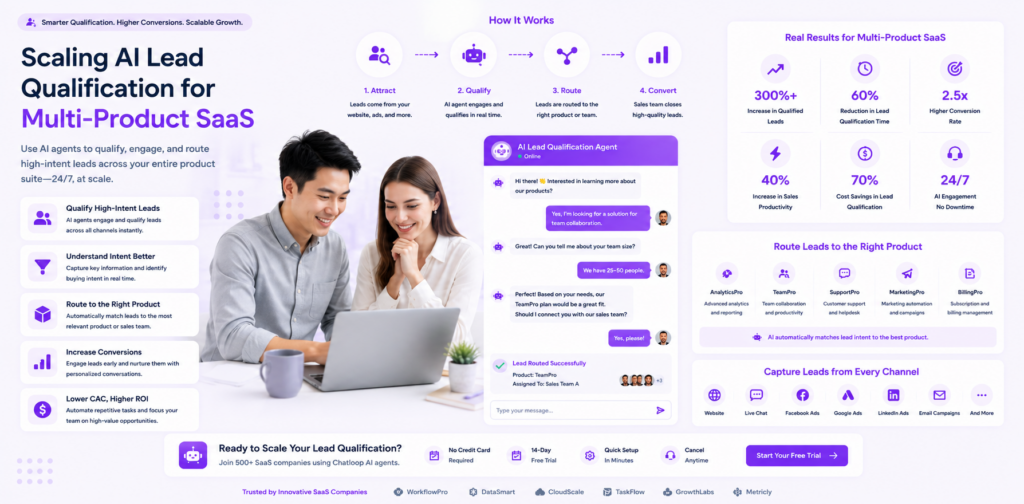
Managing inbound leads for a single SaaS product is complex. Managing them across a portfolio of two, three, or five products — each with different ICPs, pricing tiers, use cases, and sales motions — quickly becomes a scaling crisis. Sales development reps spend hours manually reviewing leads, misrouting happens constantly, and high-potential leads get lost while low-fit prospects burn rep capacity.
AI lead qualification for multi-product SaaS solves this at the infrastructure level. Rather than forcing every lead through the same qualification script and hoping reps route correctly, AI systems analyze dozens of firmographic, behavioral, and contextual signals to determine product fit, qualification tier, and routing destination — in seconds, at any volume.
This guide explains how to architect, deploy, and optimize AI lead qualification across a complex SaaS portfolio, with specific attention to the signals, routing logic, and metrics that drive conversion.
Why Multi-Product SaaS Lead Qualification Breaks at Scale
A single-product SaaS company has a relatively straightforward qualification challenge: does this lead fit our ICP, and are they ready to buy? Multi-product companies face compounding complexity:
Signal overlap: A lead that fits Product A's ICP may also partially fit Product B's ICP. Which product do you lead with? The wrong choice means a longer sales cycle or a lost deal.
Different buyer personas: A product targeting VP of Engineering attracts different signals than one targeting Head of Customer Success. Mixing them in a single qualification queue reduces conversion for both.
Cross-sell vs. net-new distinction: Existing customers expressing interest in a new product require a completely different qualification and sales motion than new logo prospects.
Volume asymmetry: Some products in the portfolio attract 10x the lead volume of others. Manual processes can't prioritize intelligently — they process in order of arrival.
Regional and language variation: Global SaaS portfolios add language, time zone, and cultural context that further fragments qualification accuracy.
Manual processes fail on all five dimensions simultaneously. AI qualification doesn't.
The Architecture of AI Lead Qualification for SaaS Portfolios
A scalable AI lead qualification system for multi-product SaaS has five components:
Component 1: Lead Enrichment Engine
Before the AI can qualify a lead, it needs data. The enrichment layer pulls from multiple sources automatically within seconds of lead submission:
- Firmographic data: Company size, industry, revenue range, geographic location, funding stage
- Technographic data: What software the company already uses — relevant for integration compatibility and competitive positioning
- Behavioral signals: Pages visited on your website, content downloaded, pricing page viewed, product trial activity
- Intent data: Third-party intent signals showing the prospect is actively researching your category
- CRM history: If the account exists in your CRM, pull existing relationship context, past deals, current product usage
This enriched dataset is what the AI qualification model operates on. Richer data means more accurate qualification.
Component 2: Product-Fit Scoring Model
The core of the qualification system is a scoring model that evaluates product fit for each product in your portfolio. This is not a single score — it's a matrix:
| Lead | Product A Fit Score | Product B Fit Score | Product C Fit Score |
|---|---|---|---|
| Lead 1 | 87 | 42 | 15 |
| Lead 2 | 23 | 91 | 44 |
| Lead 3 | 55 | 58 | 67 |
Lead 1 routes to Product A sales. Lead 2 routes to Product B sales. Lead 3 triggers a qualification conversation to determine primary need.
Product-fit scores are built from ICP match factors defined for each product:
- Company size range matching
- Industry vertical match
- Job title and seniority match
- Technographic compatibility
- Use case keyword signals from form fields and web behavior
- Behavioral engagement depth
Component 3: Conversational Qualification Layer
High-fit leads who lack sufficient intent signal, or medium-fit leads needing clarification, route to conversational AI qualification. The AI conducts a structured qualification conversation — via chat widget, email sequence, or WhatsApp — asking targeted questions to resolve ambiguity:
- "What's the primary challenge you're trying to solve?"
- "How large is your current support team?"
- "Are you evaluating any other solutions?"
- "When are you looking to make a decision?"
Responses update the product-fit matrix in real time, determining final routing. The conversation takes 3-5 minutes on average and feels like a natural discovery call rather than a form.
Component 4: Intelligent Routing Engine
Once qualified, the routing engine assigns the lead to the correct destination:
- Product-specific sales rep or SDR queue (based on product-fit winner)
- Account executive queue (for high-score, high-intent leads ready for demo)
- Self-serve trial flow (for high-fit, low-intent or smaller company leads)
- Nurture sequence (for leads needing more education before sales engagement)
- Customer success queue (for existing customers showing cross-sell signals)
Routing rules are configurable by product, region, company size, deal value estimate, and sales capacity. When a rep's calendar is full, the system dynamically reassigns to available reps in the same product team rather than creating queue backlogs.
Component 5: Feedback Loop and Model Improvement
The system learns from outcomes. When a routed lead converts (or doesn't), that outcome feeds back into the scoring model. Over time, the model sharpens its product-fit signals based on what actually correlates with conversion in your specific portfolio. Teams typically see 10-20% improvement in routing accuracy over the first three months as the model learns from real deal outcomes.
Scaling Across Four Common Portfolio Scenarios
Scenario 1: Horizontal Product Suite (Multiple Tools, Same Buyer)
Example: A company offering CRM, support, and marketing automation tools targeting SMB operations managers.
Challenge: The same buyer is the ICP for multiple products. Lead with the wrong product and you miss the entry point.
AI approach: Use behavioral signals to identify which pain point is most acute. A prospect spending significant time on your support platform pages gets routed to the support tool sales flow, even if the CRM is a better long-term fit. Win the first product, then expand.
Scenario 2: Vertical Product Suite (Same Function, Different Industries)
Example: A company offering industry-specific versions of a core platform — one for healthcare, one for financial services, one for logistics.
Challenge: The product is fundamentally similar, but compliance requirements, terminology, and buyer personas are completely different. Wrong industry routing creates instant credibility damage.
AI approach: Industry classification from firmographic data drives primary routing. Secondary signals (specific compliance keywords in form fields, technographic data showing industry-specific tools) confirm the route. The AI sales conversation uses industry-specific language and pain points from the first message.
Scenario 3: Tiered Product Ladder (Entry, Mid-Market, Enterprise)
Example: A company offering a self-serve starter product, a mid-market plan with an SDR-led motion, and an enterprise solution with a full AE sales cycle.
Challenge: Self-serve leads contaminate the SDR queue; enterprise prospects don't get enough attention.
AI approach: Company size and deal value estimate drive tier routing automatically. Leads from companies with 1-50 employees route to self-serve trial flow with nurture. 51-500 employees route to SDR queue. 500+ employees route directly to AE with a high-touch outreach sequence.
Scenario 4: Acquired Product Portfolio
Example: A SaaS company that has grown through acquisitions and now manages four products with different brand identities, sales teams, and customer bases.
Challenge: Inconsistent data models, different CRM records, overlapping ICPs, and customer accounts that may exist in multiple product databases.
AI approach: A unified lead enrichment layer normalizes data across all product CRMs. Cross-product account matching ensures a prospect already using Product A is flagged as an expansion opportunity rather than a new logo. Routing logic respects existing account ownership to avoid internal conflicts.
Designing Qualification Conversations for Multi-Product Context
The conversational AI layer is where lead qualification becomes an experience rather than a form. Multi-product context adds a specific design challenge: the AI must identify which product the lead needs without revealing its own reasoning process or making the prospect feel interrogated.
Design principles:
Lead with the problem, not the product: "What's the biggest challenge your support team faces today?" surfaces intent more naturally than "Which of our products are you interested in?"
Use progressive disclosure: Start with one or two broad questions, then drill down based on responses. Don't ask 10 questions upfront.
Branch based on company context: A company of 500 people gets different follow-up questions than a company of 15, even if their first answer is identical.
Be transparent about the handoff: "Based on what you've shared, our [Product B] team is the best fit. I'm connecting you with [Rep Name] — you'll hear from them within 2 business hours."
Capture disqualification gracefully: If a lead doesn't fit any product in the portfolio, the AI acknowledges it clearly rather than routing them to a confused rep: "It sounds like you might be looking for a solution we don't specialize in. Happy to point you in the right direction."
Integration Requirements
For AI lead qualification to work across a multi-product SaaS portfolio, these integrations are essential:
- CRM integration (Salesforce, HubSpot, Pipedrive): Bi-directional sync for lead creation, enrichment writing, and routing execution
- Data enrichment API (Clearbit, Apollo, ZoomInfo): Firmographic and technographic data on lead submission
- Calendar integration (Calendly, Chili Piper): Auto-book demos for high-scoring leads without SDR involvement
- Marketing automation (Marketo, HubSpot Marketing): Trigger nurture sequences for low-score or low-intent leads
- Intent data platform (Bombora, G2): Import third-party intent signals for in-market identification
- Analytics platform: Route performance data to your BI tool for ongoing optimization
Key Metrics to Track
| Metric | Definition | Target |
|---|---|---|
| Routing Accuracy Rate | % of leads routed to correct product team | 85%+ |
| AI Qualification Rate | % of leads fully qualified without human SDR | 50-65% |
| MQL to SQL Conversion | % of AI-qualified leads converting to SQL | 35-50% |
| Time to Route | Avg. time from lead submission to routing decision | Under 5 minutes |
| Demo Show Rate | % of AI-booked demos that attend | 70%+ |
| Cross-Sell Identification Rate | % of existing customers flagged for expansion | Track monthly |
| SDR Time Saved | Hours saved per week from AI pre-qualification | Track and report |
Frequently Asked Questions
How does AI qualify leads for multiple SaaS products simultaneously?
The AI maintains a separate product-fit scoring model for each product in your portfolio. When a lead submits, the enrichment engine pulls firmographic, technographic, and behavioral data. The scoring model evaluates fit against each product's ICP parameters simultaneously, producing a fit score matrix. The highest-scoring product determines routing, with conversational follow-up resolving ties or ambiguity.
What is product-fit lead scoring, and how is it different from traditional lead scoring?
Traditional lead scoring assigns a single score based on demographic and behavioral signals, ranking leads by overall quality. Product-fit scoring produces separate fit scores for each product in your portfolio, enabling routing to the right product team rather than just the right quality tier. This distinction is critical for multi-product companies where the same lead quality can mean very different things depending on which product the prospect needs.
How do I route leads across a SaaS portfolio with AI without creating rep conflicts?
Define clear product ownership rules in your routing engine before launch. For leads that score well against multiple products, establish a primary routing priority based on business strategy — for example, always lead with Product A if fit scores are within 10 points. For existing customers showing expansion signals, route to their assigned account manager, not the product-specific SDR queue. Document these rules explicitly and review them quarterly as your portfolio evolves.
Can AI identify cross-sell opportunities within an existing SaaS customer base?
Yes. The AI monitors usage patterns, support interactions, and engagement signals from your existing SaaS customer base, comparing them against the ICP profiles of other products in your portfolio. When an existing customer's behavior matches a cross-sell opportunity, the AI flags the account for customer success outreach and enriches the record with relevant product-fit context. This surfaces expansion opportunities that manual review would miss.
What metrics matter most for AI lead qualification in multi-product SaaS?
Routing accuracy rate (target 85%+) is the foundational metric — if leads land with the wrong product team, everything downstream suffers. MQL to SQL conversion rate measures whether AI-qualified leads actually convert for sales, validating the scoring model's calibration. Time to route (target under 5 minutes) measures responsiveness, which directly impacts lead conversion since faster response dramatically improves contact rates.
How long does it take to train the AI model on my specific portfolio's ICP?
Initial model configuration using your ICP definitions typically takes 2-4 weeks. The model starts making routing decisions immediately but improves significantly over the first 3 months as it learns from actual conversion outcomes in your sales pipeline. Teams with good historical CRM data (12+ months of qualified leads with conversion outcomes) can accelerate this training period. Training the AI model never stops — it continuously refines based on new deal outcomes.
What happens when a lead fits two products equally well?
Your routing engine should have explicit tie-breaking rules. Common approaches: route to the higher-margin product, route to the product with shorter average sales cycle, route to the product team with more available capacity, or trigger a conversational qualification sequence to ask one or two clarifying questions that resolve the tie. Whatever rule you choose, define it before launch so reps don't receive conflicting assignments.
Conclusion
Scaling lead qualification across a multi-product SaaS portfolio is a systems challenge that manual processes cannot solve at volume. The combination of enrichment, product-fit scoring, conversational qualification, and intelligent routing gives your sales organization a structural advantage: every lead gets the right product conversation, the right rep, and the right follow-up speed — automatically.
The compounding effect is significant. Better routing improves conversion rates. Faster response improves show rates. Accurate qualification reduces wasted rep time. Together, these gains translate to more pipeline, shorter sales cycles, and higher revenue per rep — without proportional headcount growth.
The companies winning in multi-product SaaS aren't just building better products — they're building smarter go-to-market infrastructure. AI lead qualification is a core part of that infrastructure.
Ready to scale your lead qualification? Book a Chatloop demo to see how our AI qualification platform integrates with your CRM and handles multi-product routing out of the box.


1 Response on this post
Comments are closed.