


As support teams grow, maintaining consistent quality becomes difficult. One agent delivers exceptional service; another sends rude emails. Some interact with customers professionally; others sound robotic. Without structured quality assurance, consistency suffers and customer satisfaction varies widely.
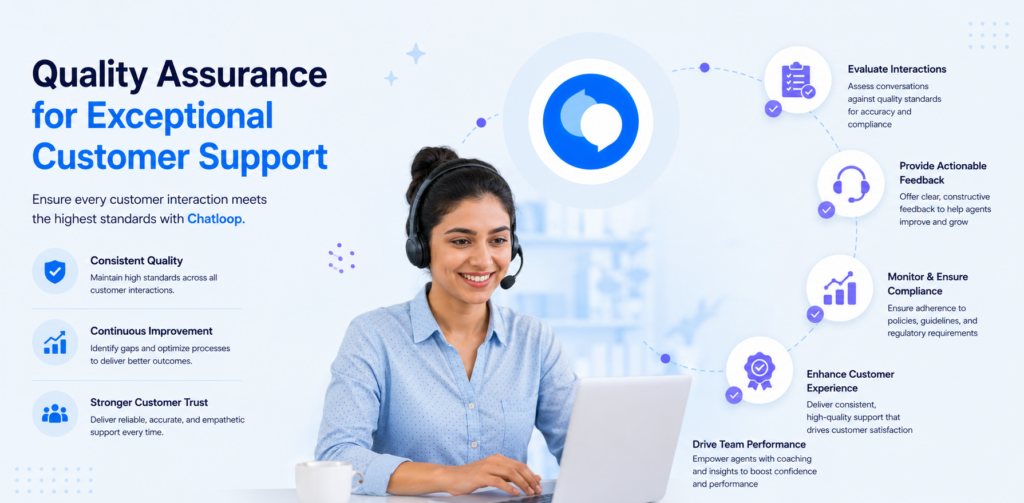
Quality assurance in customer support ensures every customer interaction meets standards, identifies improvement opportunities, and drives continuous enhancement across the team.
The QA Challenge
Consistency Crisis
Most support teams lack objective quality standards. Training covers policies but not quality expectations. When senior agent is busy, they can't mentor. New agents develop bad habits that go uncorrected. Complaints appear in patterns but often too late—customers already left.
The Cost of Poor Quality
Quality issues drive churn, damage brand reputation, and create support backlog. One poor interaction doesn't just lose that customer; the customer tells 5-10 others. Return customers from poor experiences rarely give second chances.
QA Implementation
Key Metrics
Establish quality standards: response professionalism (scored 1-5), accuracy of information, empathy/tone, first-contact resolution, adherence to policies.
Monitoring Approach
Monitor 10-15% of interactions weekly. Use automated monitoring where possible (tone analysis, policy violation detection, factual accuracy checking). Combine with human review for subjective measures.
Feedback Process
Share feedback privately and constructively. Highlight both strengths and opportunities. Provide training on gaps. Follow up to ensure improvement.
Escalation
Serious issues require immediate intervention. Quality issues become coaching opportunity for manager/trainer. Patterns get escalated for training redesign.
Real-World Results
Case Study: 40-Agent Support Team
Before QA Program: Satisfaction varied 60-90%. Quality issues identified reactively after customer complaints.
After QA Program: Satisfaction consistent 82-87%. Issues identified proactively. Monthly training on improvement areas.
Results:
- Satisfaction consistency improved
- Quality issues detected early
- Customer retention: +7 points
- Workplace culture: improved (clear standards)
- Training effectiveness: +25%
Best Practices
Start Simple
Don't measure everything. Focus on 3-5 key metrics. Expand as you mature.
Make Standards Clear
Post quality standards visibly. Provide examples of excellent interactions. Make expectations transparent.
Balance Coaching
QA isn't punishment; it's development. Even excellent agents have improvement opportunities. Focus on growth, not blame.
Track Trends
Look for patterns, not just individual interactions. If 30% of team scores low on empathy, that's training opportunity.
Celebrate Excellence
Highlight and reward excellent interactions. This drives culture that values quality.
Conclusion
Quality assurance creates consistent customer experiences at scale. By establishing standards, monitoring systematically, and coaching continuously, support teams maintain excellence even as they grow.
Organizations with strong QA programs typically see 10-15 point satisfaction improvement and significantly higher retention.
Next Steps
- Define quality standards - what does excellence look like?
- Select 3-5 key metrics - what will you measure?
- Start monitoring - begin with small sample
- Provide feedback - coach agents
- Measure impact - track improvement
Ready to scale quality? Start with monthly reviews of 10% of interactions and measure the impact.



3 Responses on this post
Comments are closed.