


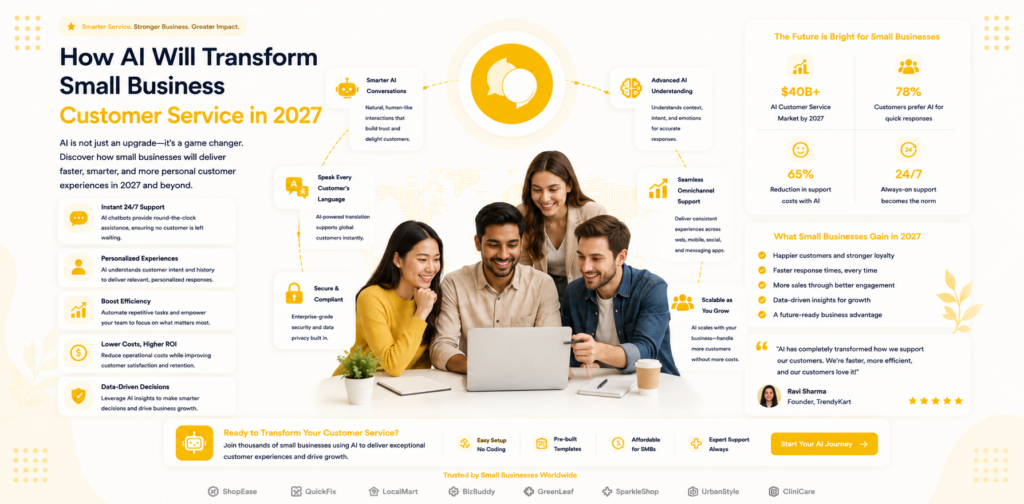
The next 18 months will see more change in how small businesses deliver customer service than the previous decade. The combination of maturing AI capability, falling deployment costs, and rapidly shifting customer expectations is creating a transformation that is both faster and more profound than most business owners have planned for.
This article looks forward to 2027 with ten specific predictions for how AI will transform small business customer service — grounded in current technology trajectories, market data, and early deployment signals. Understanding these shifts now gives you time to prepare and position your business ahead of them.
1. Proactive AI Will Replace Reactive Support as the Standard
The dominant model for customer service in 2026 is still reactive: a customer has a problem, contacts the business, and receives help. By 2027, the leading model will be proactive: AI detects signals of an emerging problem or opportunity and initiates contact before the customer does.
A customer whose delivery is running late will receive a message before they ask. A customer approaching the end of their subscription who has not renewed will receive a targeted retention offer. A customer who viewed a product three times without purchasing will receive personalised assistance.
This shift requires AI connected to operational data — shipping APIs, CRM, e-commerce platforms — and configured to monitor signals and trigger outreach. Small businesses that deploy this capability first will dramatically differentiate their customer experience and retention rates.
2. AI Will Handle First-Contact Resolution for Most Query Types
In 2026, AI chatbots handle routine queries well and escalate complex ones. By 2027, the definition of "routine" will have expanded significantly. Advances in agentic AI — the ability to not just answer questions but execute actions — will mean that returns processing, subscription changes, appointment rescheduling, account adjustments, and personalised troubleshooting will all be resolvable by AI without human involvement.
For small businesses, this means the support team's role shifts from resolving a wide range of queries to handling the genuine exceptions — the truly novel, high-stakes, or emotionally complex situations that require human judgment.
3. WhatsApp Will Become the Dominant AI Customer Service Channel in the UK
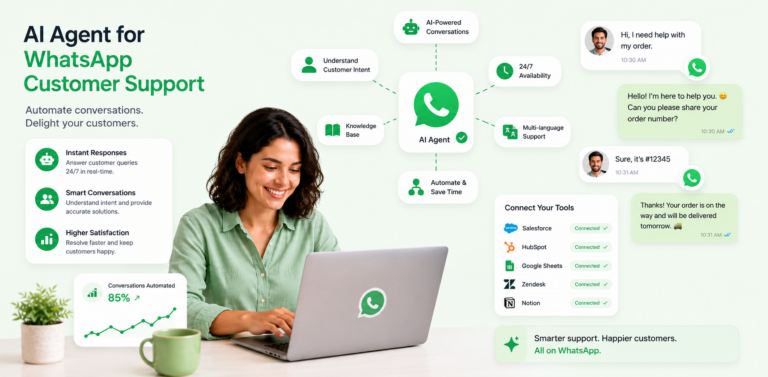
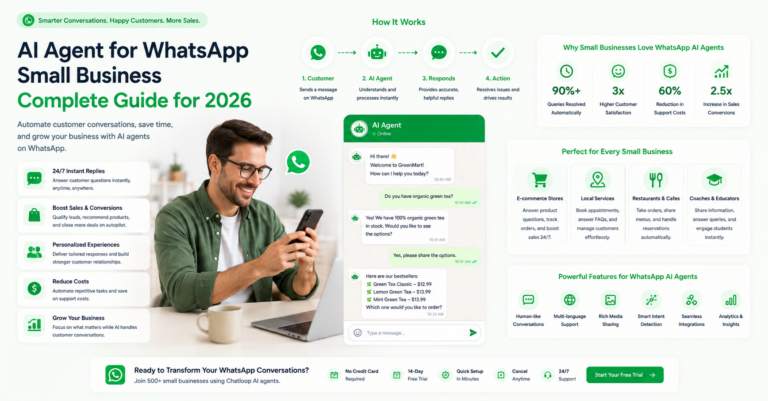
Website chat is currently the primary AI deployment channel. By 2027, WhatsApp will have overtaken it as the preferred channel for customer service AI interactions in the UK and across Europe. WhatsApp already handles billions of customer-to-business messages globally, customers do not need to visit a website to initiate contact, and message history persists across sessions in a way website chat typically does not.
Small businesses that deploy AI on WhatsApp in 2026 will have operational fluency in what becomes the primary channel in 2027. Businesses that delay will be deploying into an established channel where customer expectations are already high.
4. Personalisation Will Reach Account Manager Quality
By 2027, AI customer service will have access to enough customer context — transaction history, communication history, product usage, preference signals — to behave like a knowledgeable account manager rather than an automated FAQ responder.
The experience of being greeted by name, having your history referenced naturally, and receiving recommendations based on your specific behaviour will transition from impressive to expected. This level of personalisation is technically possible today with full CRM integration. The businesses that build the habit of connecting AI to customer data in 2026 will deliver this experience in 2027 as a natural evolution.
5. AI Will Actively Contribute to Revenue, Not Just Support Cost Reduction
The ROI narrative for AI customer service is shifting from cost reduction to revenue contribution. By 2027, the businesses extracting the most value from AI will be measuring it primarily on revenue metrics: leads generated, upsells completed, retention cases resolved, and abandoned carts recovered.
This requires a reorientation in how AI deployments are designed. Instead of optimising purely for ticket deflection, deployments will be optimised for conversion events — identifying purchase intent, presenting relevant offers, personalising recommendations, and creating paths from support interaction to sale.
6. AI Transparency Will Become a Legal Requirement in the UK
The UK government's AI regulatory framework is advancing, and by 2027 it is widely expected that disclosure requirements for AI in customer-facing interactions will be codified. Businesses that deploy AI without clear identification of it as AI will face compliance risk.
The practical requirements will likely include: an opening statement identifying AI involvement, a clearly accessible option to request human support, data processing disclosures specific to AI interactions, and in regulated sectors, additional compliance requirements.
Businesses that configure GDPR-compliant, clearly disclosed AI deployments now will need minimal adjustment when formal requirements arrive.
7. Knowledge Bases Will Become Living Business Assets
The knowledge base that powers an AI customer service agent contains the most common questions your customers ask and the most accurate answers to them. By 2027, forward-thinking small businesses will have recognised this as a strategic asset with value beyond the chatbot.
A well-maintained knowledge base is the foundation for staff training, product documentation, help centre content, FAQ pages, and regulatory compliance records. Businesses that invest in knowledge base quality for their AI agent in 2026 are building a business asset that pays dividends across multiple functions.
8. AI Will Enable Small Businesses to Compete Directly with Enterprise on Customer Experience
The historical competitive advantage of enterprise businesses in customer service was their ability to staff large support operations and invest in customer experience at a scale that small businesses could not match.
AI eliminates this structural advantage. A five-person business with a well-deployed AI chatbot connected to its CRM delivers an instant, personalised, 24/7 customer experience that matches or exceeds what a 100-person support operation delivers. Speed, availability, consistency, and personalisation — the four dimensions of excellent customer experience — are all achievable by small businesses with AI at SMB pricing.
By 2027, the enterprise advantage in customer experience will largely have shifted from "we can do things small businesses cannot" to "we have been doing it for longer and our knowledge bases are more mature." That is a much smaller and more closeable gap.
9. Multilingual AI Will Open New Markets for Small Businesses
In 2026, multilingual AI support is available but underutilised by small businesses. By 2027, businesses that activate multilingual capability will have expanded their addressable market to international customers who previously experienced friction dealing with English-only support.
For UK businesses in particular, the opportunity in European, Middle Eastern, and South Asian markets — all reachable through WhatsApp-based AI — is significant. The language barrier that historically required local partnerships or expensive multilingual staffing is dissolved by AI that can conduct support conversations in 50+ languages from the same knowledge base.
10. The Gap Between AI Adopters and Non-Adopters Will Define the Next Competitive Cycle
By 2027, the small business market will be clearly divided into two tiers: businesses that have deployed and refined AI customer service for 12–24 months, and businesses that are beginning or considering deployment.
The first tier will have mature knowledge bases, high automation rates, measurable ROI, customer satisfaction advantages, and AI-informed product feedback loops. The second tier will be deploying into customer expectations that the first tier has already set — and will need to match that standard immediately to avoid competitive disadvantage.
The window for building first-mover advantage in small business AI customer service is 12–18 months. It is open now. It will narrow significantly through 2027.
How to Prepare Your Business for 2027
Deploy in 2026, not 2027. Every month of operational experience with AI customer service is compounding knowledge base quality, automation rate improvement, and customer experience data. Deploy now.
Connect your data. The transformations most dependent on data — proactive AI, personalisation, revenue contribution — require CRM integration. Build these connections now to position for 2027 capability.
Treat the knowledge base as a strategic asset. The quality of your knowledge base is the primary determinant of AI performance across every dimension. Invest in it accordingly.
Expand to WhatsApp now. If WhatsApp is going to be the dominant AI customer service channel in 2027, building operational experience with AI on WhatsApp in 2025 is a strategic head start.
Measure revenue, not just cost. Reconfigure your AI success metrics to include lead generation, upsell conversion, and retention impact alongside ticket deflection and cost reduction.
FAQ
How confident are these 2027 predictions? These are informed projections based on current technology trajectories and market data, not certainties. The direction of travel is clear; the exact timing varies. Planning for these outcomes provides value even if timing shifts by six to twelve months.
Is it too early to deploy AI for a very small business? No. The businesses best positioned for 2027 are those with 12–18 months of AI deployment experience by that point. A business with five employees deploying in 2026 is not too small — they are appropriately early.
What is the single most important action to take now? Deploy and connect your CRM. The personalisation and proactive capability that will differentiate businesses in 2026 depends on having customer data available to the AI, and building that connection now gives you the data history you will need.
Will AI replace customer support jobs in small businesses by 2027? Probably not replace — redirect. The most common outcome is that support team members move from handling volume queries to managing AI performance, handling complex exceptions, and conducting proactive outreach to high-value customers.
How does Chatloop position for these 2027 shifts? Chatloop is being built for the 2027 landscape — CRM integration, WhatsApp deployment, agentic capability, and multilingual support are all on the platform roadmap. Deploying now means growing into these capabilities as they arrive.
Position your business for 2027 today. Start your Chatloop free trial and build the AI customer service foundation that will define your competitive position.


Comments are closed.