


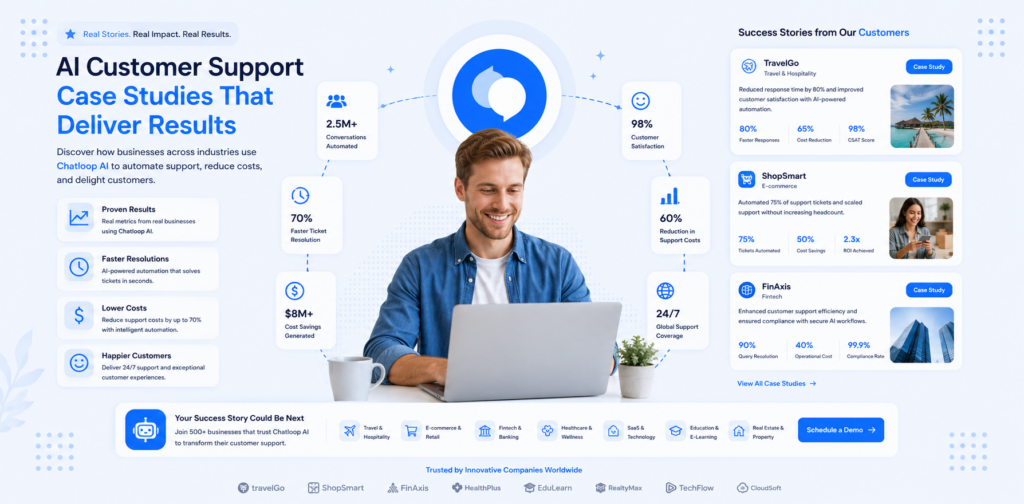
Every AI chatbot vendor publishes headline claims. What businesses actually need before committing budget are detailed, honest examples from companies that have deployed AI in real support operations — with actual automation rates, specific cost savings, problems that arose, and what results look like 90 days in.
This hub compiles the most detailed AI customer support case studies from 2026 deployments, spanning e-commerce, SaaS, hospitality, healthcare, recruitment, and professional services. Each case study includes the specific challenge, what was deployed, quantified results, and the lessons that apply directly to your own deployment planning.
The 2026 Benchmark Numbers
Before the individual cases, here is where data points cluster across all deployments reviewed for this hub.
| Metric | Median | Top Quartile | Bottom Quartile |
|---|---|---|---|
| Automation rate at 30 days | 48% | 62% | 29% |
| Automation rate at 90 days | 58% | 71% | 38% |
| First response time (AI) | 3.1 sec | 1.8 sec | 6.2 sec |
| CSAT improvement at 90 days | +0.5 pts | +0.9 pts | +0.1 pts |
| Labour cost reduction | 38% | 52% | 18% |
| Payback period | 28 days | 14 days | 71 days |
Top-quartile businesses share three characteristics: they launched with 60+ knowledge base entries, they reviewed failed conversations every week in the first 60 days, and they connected their AI to at least one live data source — order management, CRM, or calendar. For the full ROI methodology, see how to calculate AI chatbot ROI.
Case Study 1: DTC Fashion E-Commerce
Business profile: Direct-to-consumer fashion brand, 12 employees, ~900 monthly queries. Challenge: Two-person support team spending 70% of time on repetitive order status, sizing, and returns queries.
Deployment: Chatloop.io connected to Shopify, knowledge base of 42 FAQ topics, website chat and email-to-chat routing.
Results at 90 days:
- Automation rate: 64%
- Average first response: 4 hours → 22 seconds
- Monthly support cost reduction: £1,100
- Customer satisfaction: 76% → 91%
- Frustration-driven return rate: -18%
Key learning: The most surprising result was the downstream impact on returns. Customers getting instant order status stopped raising disputes out of anxiety — which had been driving a measurable share of returns. Speed of answer directly reduced a cost centre the business had not connected to support performance before.
Case Study 2: Series A B2B SaaS
Business profile: Project management SaaS, 28 employees, 1,200 monthly tickets. Challenge: Sales team spending 35% of time on product questions that belonged in marketing, not sales.
Deployment: Chatloop.io on website, pricing page, and in-app help widget, trained on product docs, integration guides, and pricing FAQs.
Results at 60 days:
- 58% of product queries automated
- Sales team time recaptured: 11 hours/month per rep
- Trial-to-paid conversion: +9 percentage points
- Human support ticket volume: -52%
Key learning: The conversion uplift was unexpected. Faster answers at the pricing and integration decision points removed friction that previously caused prospects to pause and research competitors. When the AI answered "Does it integrate with HubSpot?" in three seconds, the prospect kept moving forward. When that took 24 hours, some did not.
See AI agent for sales team for the full sales automation framework.
Case Study 3: Local Trades Business
Business profile: Owner-operated plumbing firm, 4 engineers. Challenge: Missing 30% of after-hours booking requests.
Deployment: Chatloop.io on website with calendar integration and emergency vs. standard booking qualification flow.
Results at 45 days:
- 100% of after-hours enquiries captured
- 40% of bookings completed without human involvement
- Monthly revenue recovered: £620
- Owner's daily response time: 2.5 hours → 40 minutes
Key learning: Capture mattered more than automation rate. Even on bookings that still needed a human call-back, capturing the lead at 11pm rather than missing it entirely was the primary value. The AI's job was triage and capture — and that alone produced clear positive ROI.
Case Study 4: Private Healthcare Practice
Business profile: Private GP and aesthetic clinic, 8 staff. Challenge: Reception spending 3+ hours daily on appointment, pricing, and aftercare queries.
Deployment: Chatloop.io with GDPR-compliant configuration — administrative and informational queries only, no clinical data stored. See AI chatbot for healthcare for the compliance framework.
Results at 90 days:
- 55% of inbound enquiries automated
- Reception capacity freed: 22 hours/month
- Patient satisfaction: 3.8 → 4.6/5
- Appointment no-show rate: -21%
Key learning: The no-show reduction was the most commercially significant finding. The practice was losing revenue to appointment gaps it did not know were preventable. Automated 24-hour reminders produced a 21% reduction — worth several thousand pounds per month in recovered appointment revenue.
Case Study 5: Recruitment Agency
Business profile: 15 consultants, high candidate enquiry volume. Challenge: Consultants handling 25% of their time on candidate status and application process queries.
Deployment: Chatloop.io with ATS integration, knowledge base covering active vacancies, application process, and candidate FAQ.
Results at 60 days:
- 61% of candidate enquiries automated
- Consultant time recovered: 18 hours/week across the team
- Candidate experience scores: +34%
- Off-hours application enquiry capture: +220%
Key learning: The off-hours capture figure was the standout result. Candidates applying after work hours previously chose faster-responding agencies. Instant AI response to evening applications captured a cohort the agency was systematically losing before deployment.
Case Study 6: Boutique Hotel Chain
Business profile: Three-property boutique hotel group, 45 staff. Challenge: Front desk teams overwhelmed by repetitive pre-arrival queries — check-in times, parking, dietary requirements.
Deployment: Chatloop.io on booking confirmation pages and WhatsApp, with pre-arrival FAQ, upsell prompts, and local area guides. See AI chatbot for hospitality for the full guide.
Results at 90 days:
- 72% of pre-arrival enquiries automated
- Front desk calls: -38%
- Room upgrade upsell conversion via AI: 12%
- TripAdvisor average: +0.4 points across all three properties
- Revenue from pre-arrival upsells: +£3,200/month
Key learning: The upsell discovery changed how the hotel group thought about their AI investment. They deployed expecting cost savings. They got cost savings plus a new revenue stream. The 12% AI upsell conversion was actually higher than their front desk conversion on the same offers — because the AI presented them at the right moment, during excited pre-arrival engagement.
Case Study 7: Digital Marketing Agency
Business profile: 9-person boutique agency. Challenge: New business enquiries taking 24–48 hours to receive a response.
Deployment: Chatloop.io qualifying new business enquiries by budget, timeline, and service need, then routing to account directors.
Results at 30 days:
- New business response: 36 hours → under 4 minutes
- Proposal requests: +28%
- Lead routing accuracy: 94%
- Two direct new client wins attributed to chatbot speed
Key learning: The 28% increase in proposals came not from more traffic but from converting enquiries that previously went cold. A significant share of their lead volume was simply not converting because of slow first responses. Speed alone — no AI sophistication required — recovered that latent revenue.
Case Study 8: Online Learning Platform
Business profile: EdTech startup, 7 team members, growing international student base. Challenge: Student queries arriving across multiple timezones; support team UK-only.
Deployment: Chatloop.io with multilingual knowledge base and WhatsApp deployment. See AI chatbot for education sector for full guidance.
Results at 90 days:
- After-hours response rate: 0% → 100%
- International student conversion: +31%
- Human support ticket volume: -44%
- Knowledge base active languages: 4 (English, Spanish, Arabic, French)
Key learning: The international conversion uplift was the primary business impact. Students researching from other timezones previously hit a wall with no instant answers. Instant multilingual AI response removed the timezone barrier from the conversion process entirely.
Case Study 9: Independent Financial Adviser Firm
Business profile: 6 advisers, compliance-sensitive environment. Challenge: Admin team handling high volumes of standardised, non-advice queries — appointment booking, service info, document requests.
Deployment: Chatloop.io with compliance-reviewed knowledge base, administrative queries only, no regulated advice. See AI chatbot for financial services for the full FCA compliance framework.
Results at 60 days:
- Administrative query automation: 52%
- Admin hours freed: 14/month
- Client satisfaction (admin interactions): 4.1/5
- Appointment booking completed via AI: 68%
Key learning: The compliance-first approach produced a slower initial automation rate than other industries — but zero compliance incidents in 60 days, which for a regulated firm is the result that matters most. Taking two weeks before launch for compliance review was the right trade-off.
Case Study 10: Lettings Agency
Business profile: 8-person agency with high seasonal enquiry volume. Challenge: Missing evening and weekend property enquiries; viewing bookings limited to business hours.
Deployment: Chatloop.io with calendar integration for viewing booking, property FAQ knowledge base, and WhatsApp. See AI chatbot for real estate.
Results at 60 days:
- Evening/weekend viewings booked: +41%
- Property enquiry automation: 58%
- Agent time saved on FAQ: 9 hours/week
- Viewing no-show rate with AI reminders: -28%
Key learning: The +41% viewing increase was entirely new revenue — viewings that simply would not have been booked before the chatbot existed. The AI did not make existing viewings more efficient; it created a booking channel that was previously closed.
What All Ten Have in Common
Four patterns appear in every high-performing deployment across these case studies.
Knowledge base depth at launch. Every business exceeding the 30-day median launched with 50+ knowledge base entries. Businesses launching with 20 entries were below median and had more catch-up work. See how to train an AI chatbot with company data for the preparation guide.
Weekly failed-conversation review. Without exception, businesses showing the steepest improvement curves reviewed their failed conversations every week. Those reviewing monthly plateaued earlier.
At least one live integration. Every top-half business was connected to a live data source — order management, calendar, or CRM. Static knowledge bases have a lower automation ceiling.
Escalation design before launch. Businesses that defined their escalation triggers before going live had significantly higher satisfaction scores on escalated conversations. See AI agent vs human support for the escalation framework.
FAQ
How do I know if these results are achievable for my business? Match your profile to the closest case study. If your query volume and team size are similar, the results are reproducible. Use the framework at AI chatbot ROI guide to build a projection specific to your numbers.
What is the most common reason AI deployments underperform? Insufficient knowledge base depth at launch. Businesses launching with 15–20 entries consistently see 25–35% automation. Those reaching 60%+ launched with 50–80 entries covering their real query mix.
How long before I see meaningful results? Most businesses see measurable automation improvement from week one. Full results — CSAT improvement, cost reduction, revenue impact — crystallise at 60–90 days as the knowledge base matures.
What is the minimum query volume to justify deployment? Ten or more daily enquiries is the threshold at which AI chatbots consistently deliver positive ROI. Below this, the payback period extends but the investment can still make sense for after-hours coverage alone.
Where do I start to replicate one of these deployments? Begin with how to set up an AI agent without coding for deployment and how to automate customer support for the strategy framework.
Ready to generate your own case study results? Start your free chatloop.io trial and be live within a day.


3 Responses on this post
Comments are closed.