


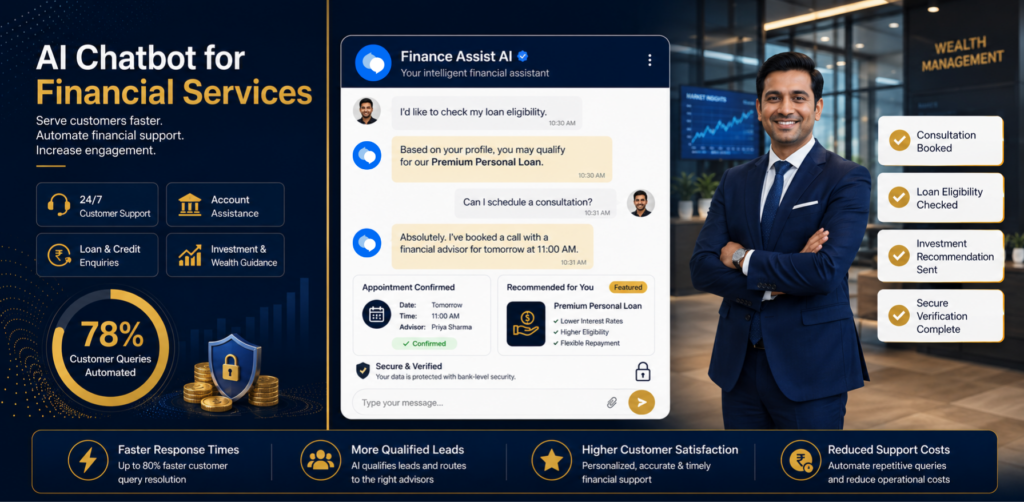
Financial services businesses face a specific challenge with AI deployment: the regulatory environment is sophisticated, the consequences of non-compliant communication are significant, and client communication is heavily scrutinised. These factors have led many firms to either avoid AI chatbots entirely or deploy them so conservatively that they deliver minimal value.
The right approach is neither avoidance nor unconstrained deployment. It is precise scoping — deploying AI for the categories of client communication that are safe, appropriate, and high-value to automate, while maintaining strict human oversight for regulated advice and client-specific recommendations. This guide covers exactly where that line sits and how to build a compliant, high-ROI AI chatbot for financial services.
The Regulatory Framework for Financial Services AI
Financial services firms in the UK are regulated by the Financial Conduct Authority (FCA). AI use in client-facing communication is subject to the FCA's Consumer Duty requirements, which mandate that firms demonstrate they are acting in clients' best interests across all communication channels — including AI-mediated interactions.
Key principles from the Consumer Duty that apply to AI chatbot deployment:
Fair, clear, and not misleading communications. AI responses must be accurate, appropriately qualified where necessary, and cannot present information in a way that misleads clients about products, risks, or eligibility.
Appropriate for the target audience. AI content must be suitable for the specific clients it is addressing. Consumer-facing chatbots have different requirements to professional investor-facing ones.
Consistent with FCA guidance on automated advice. AI that provides personalised recommendations about specific financial products is subject to the FCA's automated advice rules. General information provision is distinct from regulated advice.
Proper records. AI-mediated client communications must be captured and stored in accordance with MiFID II and other applicable record-keeping requirements.
Understanding this framework is essential before configuring your AI chatbot. If you are uncertain about your firm's specific compliance requirements, consult your compliance officer before deployment.
What Financial Services AI Can and Cannot Do
Appropriate for AI Automation
General product information. Information about product types, how ISAs work, what a pension drawdown is, how protection insurance operates — general educational content that does not constitute personalised advice.
Firm-specific administrative queries. Your fees, your onboarding process, what documents clients need to provide, how to access the client portal, account statement requests, contact details for specific advisers.
Appointment booking. Scheduling initial consultations, review meetings, and callback requests. The AI presents available adviser slots and creates the appointment — pure administration with no advice component.
Onboarding process guidance. What information is required during onboarding, how long the process takes, what identity verification involves, what to expect from the first adviser meeting.
Account status queries. Whether a transaction has been processed, whether a form has been received, current contact details on file — administrative account information that does not involve investment recommendations.
FAQ responses about your firm's services. What services your firm offers, minimum investment thresholds for certain services, which jurisdictions you serve, your regulatory status.
Not Appropriate for AI Automation
Personalised investment recommendations. Any advice about which specific product, fund, or strategy a client should use is regulated advice. This must involve a qualified, FCA-authorised adviser.
Risk assessment. Determining a client's attitude to risk or capacity for loss requires qualified human judgment and formal process. AI can capture initial information but must not present risk assessments.
Complaints handling. FCA-regulated complaints must follow a defined process with human oversight. AI can log and acknowledge a complaint and set response timelines, but cannot resolve it or make regulatory determinations.
Vulnerable client situations. Clients who may be in vulnerable circumstances require heightened care that FCA guidance specifies must involve human judgment. Configure your AI with explicit escalation for any indication of client vulnerability.
Building a Compliant Financial Services AI Chatbot
Step 1: Define Your Scope in Writing
Before configuration, produce a written scope document defining what the AI can and cannot do. This document should be reviewed by your compliance officer and signed off before deployment. It serves as both your configuration guide and your evidence of responsible governance.
The scope document should explicitly state: approved query categories with example questions, prohibited categories with escalation instructions, consumer duty compliance rationale for the approved categories, and your record-keeping approach for AI-mediated communications.
Step 2: Draft Knowledge Base Content with Compliance Review
Every knowledge base entry for a financial services AI chatbot should be reviewed for regulatory compliance before upload. This is particularly important for:
- Any content that mentions specific products or funds
- Any content that references past performance
- Any content that could be interpreted as advice rather than information
- Any content that references fees or charges
Include appropriate qualifiers — "this is general information only and does not constitute regulated financial advice" — in your chatbot's standard responses where relevant. This disclaimer should be configured as a standing message that appears in relevant conversations.
Step 3: Configure Compliance-Specific Escalation Triggers
Set up keyword triggers that immediately route conversations to a human adviser or compliance-trained team member. Triggers should include: complaint, ombudsman, FCA, regulated advice, recommendation, should I invest, is this right for me, and similar phrases that indicate the client is seeking personalised guidance.
Test each trigger explicitly. A missed escalation trigger in a financial services context is a compliance risk.
Step 4: Implement Record-Keeping Integration
Connect your AI chatbot to your record-keeping system. All AI-mediated client communications should be captured and stored in accordance with your FCA record-keeping requirements. Review your current record-keeping setup with your compliance team and confirm that chatloop.io conversations can be captured and retained appropriately.
High-Value Use Cases in Financial Services
IFA and Wealth Management Firms
For Independent Financial Adviser (IFA) firms, the highest-value AI use cases are: appointment booking for initial consultations and review meetings, administrative query handling for existing clients (document requests, portal access, contact updates), and FAQ responses about the firm's services for prospective clients.
An IFA firm receiving 30 administrative queries per week — each taking 5–10 minutes for a PA or admin team member to handle — recovers 2.5–5 hours of admin time per week from automating these with AI. At a professional services hourly cost, this is a meaningful saving.
Fintech and Digital Banks
For digital-first financial services businesses, AI chatbots handle tier-1 customer support at scale: account queries, transaction questions, card issues, verification queries, and product information. The consumer-facing AI that a digital bank deploys at scale is subject to the same regulatory requirements as any financial services AI — accuracy, fair communication, and appropriate escalation are non-negotiable regardless of scale.
Insurance Firms
For insurance businesses, AI chatbots automate: policy information queries, claims status updates, renewal reminder conversations, and initial claims notification (not claims adjudication, which requires human involvement). The claims notification use case — a customer notifying you of an incident, with the AI capturing all relevant information and creating a structured claim report — is particularly valuable for reducing handling time on the human side.
Monitoring and Audit for Financial Services AI
Once deployed, financial services AI requires more rigorous ongoing monitoring than a typical business deployment.
Regular conversation audits. Review a random sample of AI conversations weekly. Look for instances where the AI provided information that could be interpreted as advice, where responses were inaccurate, or where escalation should have occurred but did not.
Compliance officer review cadence. Establish a monthly review with your compliance officer covering AI conversation analytics, any escalation failures, knowledge base updates, and any new regulatory guidance relevant to AI communication.
Annual scope review. Review your AI deployment scope annually against current FCA guidance. The regulatory landscape for AI in financial services is evolving; your scope document and configuration should evolve with it.
Client feedback monitoring. Monitor client satisfaction specifically for AI-handled interactions. Any pattern of client dissatisfaction with AI responses is an early warning of compliance or quality issues.
FAQ
Does using an AI chatbot create FCA regulatory risk? Configured correctly — with AI handling only non-advice, administrative communication and strict human escalation for regulated activities — AI chatbot deployment does not create additional FCA regulatory risk. The risk arises when AI is deployed without appropriate scope limits or compliance review. Always involve your compliance officer in deployment decisions.
How should we disclose AI use to clients? FCA Consumer Duty requires fair and transparent communication. Clients should be informed when they are interacting with an AI rather than a human, and the option to speak to a human must be readily available. Include this disclosure in your initial chatbot message and in your firm's communication policies.
Can AI help with vulnerable client identification? AI can flag potential indicators of vulnerability (distress signals, mentions of specific life events) and escalate to a trained human team member. The FCA's guidance on vulnerable clients requires human judgment in these situations — the AI's role is to ensure vulnerable clients reach a human promptly, not to manage the interaction itself.
What record-keeping format is required for AI communications? This depends on your specific regulatory permissions and the nature of the AI-mediated communication. Consult your compliance officer and review the FCA's record-keeping requirements applicable to your firm type. As a starting point, treat AI-mediated client communications with the same record-keeping standards as email communications.
How does chatloop.io support compliance requirements for financial services? Chatloop.io provides conversation logs, audit trails, and data export capabilities. For specific compliance integration requirements, contact the chatloop.io team through the contact page to discuss your firm's requirements.
Deploy AI compliantly and confidently in your financial services business. Start your free chatloop.io trial and speak to the team about financial services configuration.



Comments are closed.