


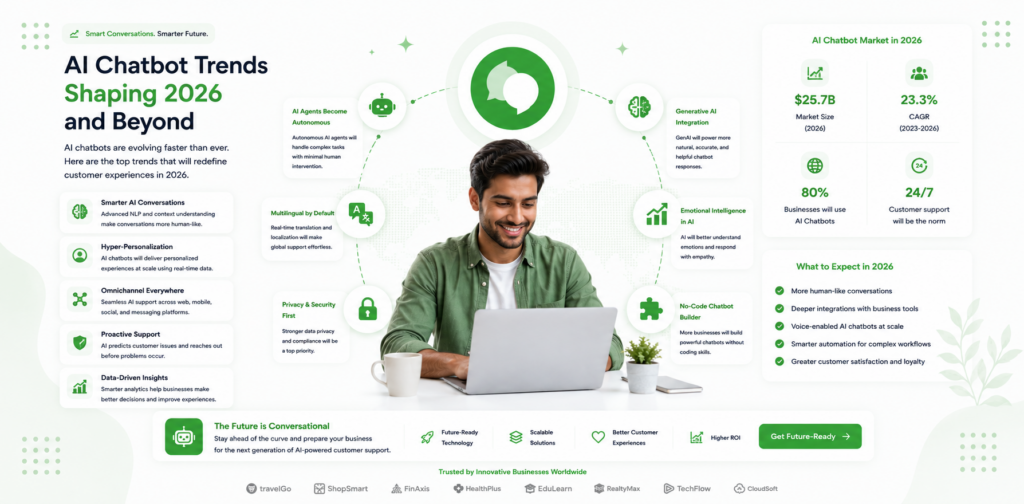
The AI chatbot market is moving faster than most businesses can track. What was cutting-edge six months ago is now the baseline expectation, and what is emerging now will define competitive advantage for the next two to three years. Understanding where the technology is heading — and which trends are worth acting on now versus monitoring — is increasingly important for businesses that rely on AI for customer engagement.
This guide covers the eight most significant AI chatbot trends of 2026, what is driving them, and what practical implications they have for your business.
Trend 1: Agentic AI — From Answering Questions to Taking Action
The most significant shift in AI chatbot capability in 2026 is the move from reactive to agentic behaviour. Traditional chatbots answer questions. Agentic AI takes actions.
An agentic AI can not only tell a customer their order is delayed — it can initiate a reship, apply a discount code, and notify the warehouse, all within the same conversation. It can not only provide appointment availability — it can book, confirm, send a calendar invite, and trigger a reminder sequence.
This shift from information retrieval to task execution fundamentally changes the ROI calculation for AI deployment. Instead of measuring cost-per-ticket, businesses measure tasks-completed-without-human-involvement. The ceiling for automation — and therefore cost reduction — rises substantially.
What this means for your business: Platforms that support tool and API integration are becoming the strategic choice over those limited to text responses. When evaluating or upgrading your chatbot, prioritise the ability to connect to your back-end systems and execute workflows.
Trend 2: Multimodal AI — Beyond Text
Customers increasingly communicate through images, voice messages, screenshots, and documents. The expectation that a support interaction is text-only is eroding rapidly, particularly on mobile-first platforms like WhatsApp.
2026 has seen significant expansion in multimodal AI capabilities: chatbots that can interpret a screenshot of an error message, process a photo of a damaged product for a returns claim, or understand a voice message and respond with text. This capability dramatically expands the range of support queries that AI can handle effectively.
What this means for your business: If your customers share product photos, screenshots, or voice messages, investing in multimodal AI capability will become a competitive necessity within 12–18 months.
Trend 3: Hyper-Personalisation Through Memory and Context
Early chatbots treated every conversation as the first conversation. 2026-generation AI chatbots maintain persistent context — they know who they are talking to, what they previously discussed, what products the customer has purchased, and how sentiment has trended across interactions.
This contextual memory enables a materially different quality of experience. Instead of asking "Can you give me your order number?" for the third time, the chatbot says "I can see you contacted us about this order on Tuesday — here is what has happened since then."
What this means for your business: Connect your AI chatbot to your CRM and purchase history data. The businesses extracting the most value from AI in 2026 are those whose chatbots have access to rich customer context.
Trend 4: AI Chatbots as Revenue Tools, Not Just Support Tools
The perception of chatbots as cost-reduction tools for the support team is being replaced by recognition of their revenue generation potential. In 2026, the most sophisticated AI deployments are operating as proactive sales agents — identifying purchase intent from browsing behaviour, making contextually relevant product recommendations, recovering abandoned carts, and engaging at-risk customers before they churn.
What this means for your business: Define success metrics for your chatbot beyond ticket deflection rate. Add lead qualification conversion rate, upsell conversion rate, and cart recovery rate to your measurement framework.
Trend 5: Voice-Enabled AI Support
Voice search has been growing for years, but voice-enabled support chatbots are now a mainstream reality rather than a novelty. WhatsApp voice messages, phone-integrated AI, and voice-activated website widgets are all in active deployment in 2026.
The implication for businesses is most acute in industries where customers are not in front of a screen: trades, healthcare, logistics, hospitality. The ability to handle a spoken query and respond with voice or text is becoming a genuine competitive differentiator in these verticals.
What this means for your business: If your customer base uses voice messaging — especially on WhatsApp — evaluate your chatbot platform's voice input capability.
Trend 6: Stricter AI Transparency and Compliance Requirements
Regulatory pressure on AI systems is increasing globally. In the UK and EU, requirements around disclosing AI involvement in customer interactions, data retention practices, and the right to request human handling are becoming more prescriptive.
The practical requirements include: clear disclosure that the customer is interacting with AI, easy access to human escalation, data processing transparency, and in regulated industries, additional sector-specific compliance.
What this means for your business: Ensure your chatbot platform is GDPR-compliant, that your deployment clearly identifies itself as AI at the start of interactions, and that your escalation path to a human is always available and prominent.
Trend 7: SMB AI Democratisation
Until 2023, sophisticated AI chatbot capabilities were primarily accessible to enterprises. 2026 has seen a fundamental shift — no-code platforms with enterprise-grade AI capability at SMB-accessible price points are now the market norm.
This means that SMBs that do not deploy AI are increasingly at a disadvantage against competitors that do. Technical barriers are no longer an excuse — deployment that once required a developer and a five-figure budget can now be completed by a non-technical business owner in an afternoon.
What this means for your business: The competitive window for early-mover advantage in AI customer support is narrowing. Businesses that deploy in 2026 will have a 12–18 month advantage over those that wait.
Trend 8: Integration Depth as the Key Differentiator
In 2026, the most meaningful differentiator between AI chatbot platforms is not the language model underneath — most commercial platforms now use models of comparable quality. It is the depth and ease of integration with the systems your business runs on.
A chatbot connected to your CRM, helpdesk, e-commerce platform, and calendar performs fundamentally better than one operating in isolation. The automation rate, personalisation quality, and task execution capability all depend on data access, not just language capability.
What this means for your business: When evaluating platforms, prioritise integration library breadth and ease of connection over headline AI features. A chatbot that cannot see your customer data is an expensive FAQ page.
Which Trends to Act on Now
Not every trend requires immediate action. Here is a prioritised view.
Act now:
- Agentic AI and workflow integration (highest ROI potential)
- Hyper-personalisation through CRM connection (measurable conversion improvement)
- Revenue tool positioning (expands your ROI framework)
Plan for within 12 months:
- Multimodal capability (especially if your customers use WhatsApp voice)
- Compliance alignment with emerging AI transparency requirements
Monitor for now, act within 18–24 months:
- Voice-enabled support
- Advanced predictive engagement
FAQ
Are these trends relevant for small businesses or just enterprises? All eight trends are relevant for SMBs, particularly the democratisation of no-code AI and the revenue tool positioning shift. The agentic AI trend is especially valuable for small teams where every automated task frees meaningful time.
How do I know if my current chatbot platform supports agentic AI? Ask whether the platform supports API connections that allow the chatbot to trigger actions — not just return information — in your connected systems. If the answer is no, it is not agentic.
Is voice AI chatbot integration expensive? Not necessarily. WhatsApp voice message processing through API integration is available on mid-tier platforms.
How should I prepare for AI compliance requirements? Start by ensuring clear AI disclosure in your chatbot opening message, implementing a prominent human escalation option, and reviewing your chatbot platform's data processing agreement.
Will AI chatbots eventually replace all customer support agents? No — the trend is toward augmentation, not replacement. Complex, sensitive, and high-value interactions will continue to benefit from human judgment. The target is intelligent hybrid deployment.


Comments are closed.