


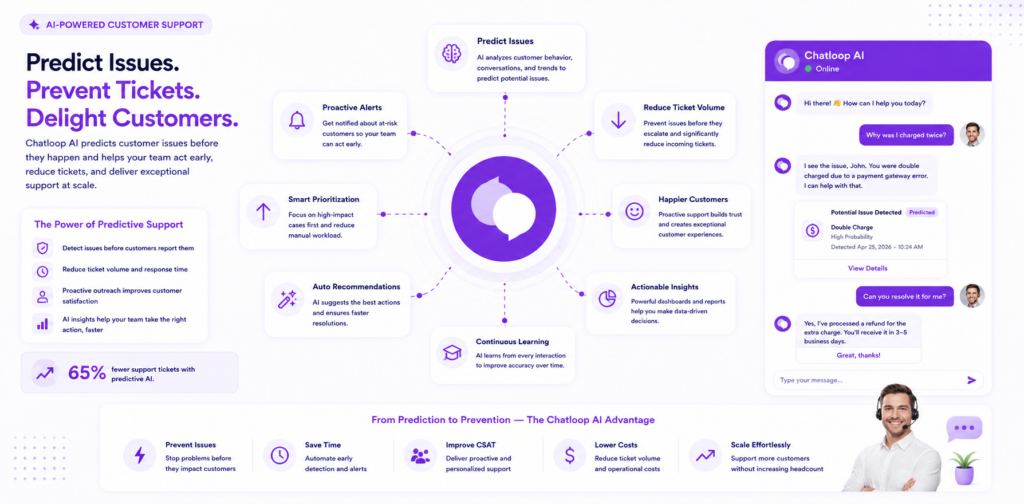
Reactive customer support — waiting for a customer to contact you with a problem — is the standard model. It is also the worst time to engage. By the time a customer sends a complaint, their frustration is already at a peak, their trust in your business has already declined, and the resolution requires more effort to produce the same satisfaction outcome as if the problem had been addressed earlier.
Predictive AI customer support flips this model. Instead of waiting for the complaint, AI monitors behavioural signals that precede problems and triggers proactive outreach before the customer's experience deteriorates. The customer receives help before they knew they needed it. The support interaction becomes a positive experience rather than a damage-limitation exercise.
This guide explains how predictive AI works, which signals to monitor, and how to implement it in your business with the tools you already have.
What Predictive AI Customer Support Actually Means
Predictive support is not about guessing what customers will ask. It is about monitoring specific, observable behavioural signals that reliably precede specific problems — and acting on those signals automatically before the problem manifests as a complaint.
The signals are different for every business, but the patterns are consistent. Customers who cancel have usually shown disengagement signals for weeks. Customers who complain about a delayed order checked their tracking page three or more times in the 24 hours before contacting support. Customers who abandon a checkout had an unresolved question that was not answered in time.
These signals are already happening in your data. Predictive AI surfaces them, connects them to the likely problem, and triggers an appropriate proactive response — before you or the customer has to initiate a support interaction.
For context on how this fits into the direction of AI customer service, see AI chatbot trends 2025 and 10 ways AI will transform small business customer service by 2026.
High-Value Predictive Support Scenarios
Delivery and Fulfilment Issues
A customer who views their order tracking page three or more times in a 24-hour window is almost certainly tracking a delayed or missing delivery. This is the highest-frequency predictive support opportunity for e-commerce businesses.
The signal: repeated tracking page visits without a delivery event. The predicted problem: anxiety or frustration about delivery status. The proactive action: send an empathetic message acknowledging the delay before the customer contacts support, with a clear status update and a resolution if the delay is significant.
A customer who receives a proactive message — "We noticed your order hasn't arrived yet. Here's the latest update, and here's what we're doing about it" — experiences a materially different emotional response than a customer who eventually calls a contact centre and waits on hold to hear the same information. The information is the same; the experience is entirely different.
Churn Risk Detection
Customers who are about to churn typically show a consistent pattern of disengagement before cancelling: reduced login frequency, declining feature usage, ignored renewal communications, and sometimes increased support contacts about specific pain points.
Monitoring these signals and triggering proactive outreach — a personalised check-in from a customer success team member, a product tutorial offer, or a targeted offer — intercepts the cancellation decision before it is made.
For subscription businesses, the financial case is straightforward. If your average customer lifetime value is £800 and your monthly churn rate is 3%, recovering even 10% of churning customers through predictive outreach saves £24/month per 100 customers — compounding significantly over time.
This connects directly to the retention impact discussed in how conversational AI is changing customer expectations forever.
Post-Purchase Friction Points
Customers who purchase a product but do not activate it, complete onboarding, or use key features within a defined window are at high risk of dissatisfaction and return. The signal — no activation or engagement within X days of purchase — is clear and consistent.
Proactive outreach at this point — a helpful "We noticed you haven't set up [feature] yet — here's a guide that takes five minutes" — has high open and engagement rates because it is genuinely relevant and timely. It also catches the customer at a moment when they are still engaged with the product (they just bought it) rather than when they have already disengaged.
Failed Transaction or Payment Issues
A customer whose payment fails does not always realise it immediately. When they do, they are frustrated — both by the problem and by the delay in anyone telling them. Proactive AI that detects a failed payment event and immediately sends a helpful, non-alarming notification — "There was an issue processing your last payment. Here's how to update your details" — converts a frustrating discovery into a routine administrative fix.
Recurring Support Patterns
When a customer contacts support about the same issue more than once, this is a signal that the original resolution was incomplete or that the underlying problem has not been addressed. AI that identifies repeat contact patterns and triggers escalation to a senior team member — before the customer has to ask again — produces dramatically better satisfaction outcomes than waiting for the third contact to recognise the pattern.
The Technical Architecture of Predictive Support
Implementing predictive AI support requires three connected components.
1. Signal Collection
Your existing systems contain the signals you need. The specific data sources depend on your business:
E-commerce: Order management system (tracking page visit frequency, delivery events), website analytics (checkout abandonment, product page visits), email platform (open rates, click patterns).
SaaS: Product analytics (login frequency, feature usage, API call volume), CRM (renewal dates, support contact history), email (renewal communication engagement).
Service businesses: Booking system (appointment frequency, cancellation history), CRM (enquiry patterns, engagement history), website analytics (pricing page visits, return visit frequency).
2. Signal Processing and Trigger Logic
Define the signal combinations that predict specific problems, and set the threshold at which a trigger fires. Signal-to-trigger logic examples:
- Tracking page visited 3+ times in 24 hours AND no delivery event → trigger delivery proactive message
- Login frequency dropped 70%+ over 30 days AND renewal within 60 days → trigger churn risk check-in
- No activation event within 7 days of purchase → trigger onboarding support message
- Payment failure event → trigger immediate payment update notification
Each trigger maps to a specific, pre-configured AI response — a message that acknowledges the situation accurately and offers relevant help.
3. AI Response and Routing
Once a trigger fires, the AI sends the proactive message through the appropriate channel (email, WhatsApp, in-app chat) and monitors for a response. If the customer responds, the AI handles the conversation within its knowledge base scope. If the response indicates a complex situation, it escalates to a human team member.
For configuration guidance on setting up trigger-based AI responses, see AI chatbot workflow automation.
Implementing Predictive Support with Chatloop
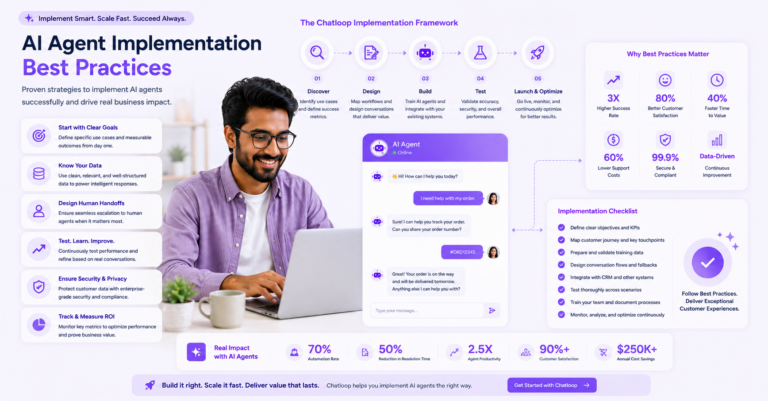
Chatloop.io's workflow automation capabilities support trigger-based proactive messaging. The implementation process:
Step 1: Identify your three highest-value prediction opportunities. For most businesses, these are: delivery/fulfilment anxiety, churn risk signals, and post-purchase non-activation. Start with these.
Step 2: Define the signal and threshold for each trigger. Document the specific signal combination and the threshold that fires the trigger. Be precise — a trigger that fires too early produces unnecessary outreach; one that fires too late misses the intervention window.
Step 3: Write your proactive messages. These messages must be accurate, empathetic, and genuinely helpful. A proactive delivery message that acknowledges the specific order and explains the specific situation performs significantly better than a generic "we noticed you checked your order" message.
Step 4: Connect your data sources. Review chatloop.io's integrations to identify the connections between your signal sources (order management, CRM, product analytics) and the trigger logic. Webhook connections cover data sources not in the pre-built integration library.
Step 5: Test each trigger in a controlled environment. Simulate the triggering signal and verify that the correct message is sent through the correct channel at the correct time. Test the customer response handling and escalation logic.
Measuring Predictive Support Impact
Track these metrics to quantify the value of your predictive support deployment.
Proactive contact rate. The percentage of customers who receive proactive outreach based on AI-detected signals. This is your leading indicator of predictive support activity.
Complaint prevention rate. The percentage of triggered proactive contacts where the customer did not subsequently raise a complaint about the predicted issue. This is the core ROI metric — complaints prevented versus baseline.
Churn reduction. For churn-focused predictions, compare monthly churn rate in the 90 days before and after deployment. Even a 1 percentage point reduction in monthly churn has significant lifetime value impact.
Customer satisfaction for proactively contacted customers. Compare CSAT scores for customers who received proactive outreach with the CSAT baseline. Proactively contacted customers typically rate satisfaction 15–25% higher than customers who had to initiate contact about the same issue.
FAQ
Does predictive AI require big data or enterprise infrastructure? No. The most valuable predictive signals are simple — tracking page visit frequency, login rates, feature usage. These are available in every standard analytics and order management tool. You do not need sophisticated data science to implement high-value predictive support.
Will customers find proactive messages intrusive? When proactive messages are accurate, relevant, and genuinely helpful, customers respond positively. The critical requirement is relevance — a message that acknowledges the specific situation the customer is experiencing is welcomed. A generic outreach that does not reflect the customer's actual situation is not.
How does predictive support change the role of customer support teams? Support teams shift from reactive firefighting to proactive customer success. The skills required — identifying at-risk customers, engaging proactively, building relationships — are more valuable and more satisfying than answering repetitive inbound queries. Predictive AI does not reduce support team value; it elevates the quality of the work they do.
What is the earliest indicator that predictive support is working? Complaint volume reduction is the most direct early indicator. If proactive delivery outreach is working, complaints about delayed orders decline within the first two to four weeks of deployment.
Can I implement predictive support without technical resources? The signal collection step may require some configuration of your existing analytics tools. The trigger logic and AI response configuration is no-code within chatloop.io. Most businesses with standard analytics and CRM tools can implement their first predictive support trigger within one to two weeks without developer involvement.
Start resolving problems before your customers notice them. Start your free chatloop.io trial and build your first predictive support trigger this week.



Comments are closed.