


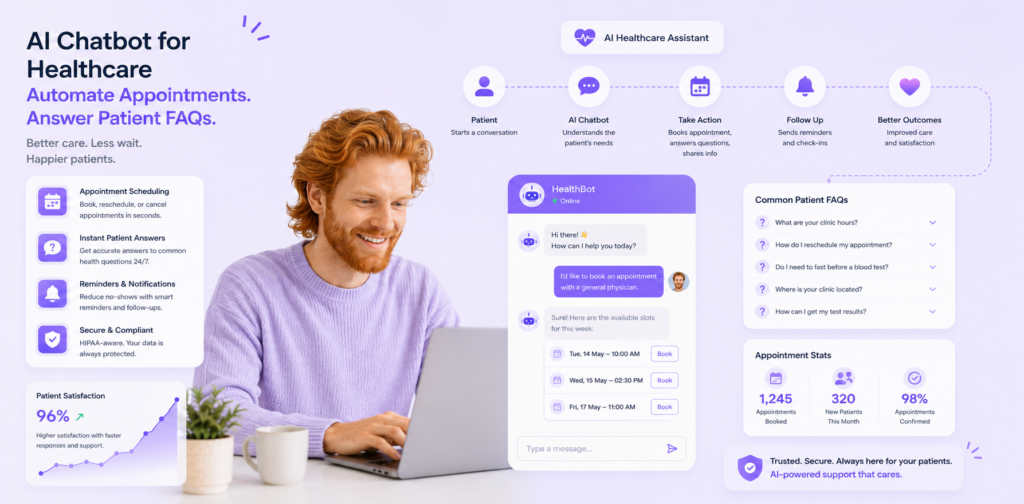
Healthcare practices face a paradox: the administrative burden of patient communication is high enough to require significant staff time, yet the information being communicated is often standardised — appointment availability, treatment pricing, aftercare instructions, and practice policies. These queries are simultaneously important to patients and perfectly suited to AI automation.
This guide covers how an AI chatbot for healthcare is deployed safely and compliantly, which use cases are appropriate, which must remain with human staff, and what real practices are reporting in terms of efficiency gains and patient satisfaction improvements.
The Healthcare Administrative Communication Problem
Reception teams in private practices, GP surgeries, and specialist clinics spend a significant proportion of their time on queries that have standard answers. A 2025 survey of UK private healthcare practices found that reception staff spent an average of 3.2 hours per day answering patient queries that fell into fewer than 25 distinct categories — appointment availability, pricing, treatment preparation, aftercare, insurance, parking, and directions.
Each of these categories is automatable. The information is known, accurate, and consistent. The appropriate answer is the same every time. And yet, because it arrives in the form of a phone call or an email to a human inbox, it consumes a human's time.
An AI chatbot trained on your practice's specific answers to these queries handles them instantly, at any hour, without consuming reception capacity. Reception staff freed from repetitive information delivery can focus on patient experience, clinical coordination, and the nuanced conversations that genuinely require human judgment.
Appropriate AI Use Cases in Healthcare
The critical principle in healthcare AI deployment is scope. AI is appropriate for administrative and informational functions. It is not appropriate for clinical questions, triage, or any interaction where an inaccurate response could affect patient health.
Appropriate for AI Automation
Appointment booking and availability. A chatbot connected to your booking system presents available slots, captures patient preferences, creates the appointment, and sends a confirmation. This is a rule-based, administrative process that AI handles reliably.
Practice information FAQs. Directions, parking, what to bring to appointments, which insurance providers are accepted, payment methods, cancellation policies. All standard, safe, appropriate for AI.
Treatment pricing information. For private practices, pricing for standard treatments is fixed and public. An AI that answers "How much does a consultation cost?" is providing information, not clinical guidance.
Aftercare instruction delivery. Post-procedure instructions are typically standardised documents. An AI that delivers aftercare instructions to a patient who asks is providing information they are already supposed to receive — just faster and more accessibly.
Appointment reminders and preparation instructions. Automated reminders 48 and 24 hours before an appointment, with preparation instructions relevant to the specific appointment type.
NHS versus private pathway queries. For practices that operate both NHS and private pathways, patients frequently ask about the difference, waiting times, and costs. These are information queries that AI handles well.
Not Appropriate for AI Automation
Clinical questions. Any question about symptoms, diagnoses, medication, treatment options, or clinical decisions must be handled by a qualified clinician. The AI should acknowledge these questions with a warm decline and clear escalation path to a clinician or reception team.
Urgent or emergency queries. Any query that might indicate a medical emergency (chest pain, breathing difficulty, sudden worsening of symptoms) must escalate immediately to a human and should include emergency service signposting. Configure explicit keywords that trigger immediate escalation regardless of context.
Complaints about clinical care. Clinical complaints require a human response, proper documentation, and often involvement from a clinical governance lead. These must never be handled by AI.
Mental health crisis indicators. Any indication of a mental health crisis, self-harm risk, or acute distress must trigger immediate escalation and, where appropriate, crisis service signposting.
GDPR and Information Governance for Healthcare AI
Healthcare AI deployment in the UK requires careful information governance. The key principles are:
No clinical data storage. Your AI chatbot should not store, process, or request clinical information. It handles administrative queries only. Configure explicit blocks on the AI engaging with clinical content.
GDPR-compliant data processing. Chatloop.io processes data in accordance with GDPR. Ensure your Data Processing Agreement with chatloop.io covers your specific healthcare data processing requirements. Review chatloop.io's privacy documentation for current compliance details.
AI disclosure. Patients should be informed at the start of any AI interaction that they are speaking to an automated assistant, not a human. This is both ethical best practice and, increasingly, a legal requirement.
Human escalation always available. For healthcare contexts specifically, the option to speak to a human member of staff must be prominently available at every point in an AI conversation. Patients who are anxious, confused, or experiencing health concerns should never be forced through an AI-only path.
Minimum data collection. The AI should collect only the information necessary to handle the specific query. For appointment bookings, this is name, contact information, and appointment type. For FAQ queries, it is nothing — no personal data is collected for information delivery.
Implementation: Setting Up Your Healthcare AI
Define Your Scope Document First
Before configuring anything, document explicitly what the AI can and cannot do. This scope document serves three purposes: it guides your knowledge base development, it informs your AI's escalation rules, and it provides evidence of responsible governance if you are ever asked how you deploy AI in a healthcare setting.
The scope document should list: approved query categories with example questions, prohibited categories with escalation instructions, and emergency escalation procedures for urgent patient queries.
Build Your Knowledge Base from Practice Documentation
Your practice already has the content your AI needs: your website FAQs, appointment preparation guides, aftercare instruction sheets, pricing guides, and patient information leaflets. Start with these as your knowledge base foundation.
Structure each entry as a clear question-and-answer pair using natural patient language — the phrasing your patients actually use when calling reception, not the clinical or administrative terminology your team uses internally. For guidance on structuring entries for maximum AI accuracy, see how to train an AI chatbot with company data.
Connect Your Appointment System
For practices using booking software, connect chatloop.io to your appointment system through the integrations library or webhook connection. Test the booking flow thoroughly: patient requests an appointment, AI presents available slots, patient selects a slot, AI confirms and sends a reminder.
Verify that the AI correctly handles full calendars (offers next available dates), cancellations (removes the slot correctly), and confirmation messages (contains the right information for the appointment type).
Configure Clinical Escalation Triggers
Set up keyword-based triggers that immediately escalate any conversation containing clinical indicators to a human staff member. These triggers should include: symptom descriptions, medication names, emergency indicators, and mental health crisis signals.
Test each trigger explicitly before going live. A correctly configured escalation trigger is a patient safety feature.
Results from Healthcare AI Deployments
Practices using AI chatbots for administrative communication report consistent patterns.
Reception capacity freed. Practices automating appointment booking and FAQ responses report reception staff capacity increasing by 20–35%. This time is redirected to patient experience, clinical coordination, and complex case management.
After-hours query capture. Practices that previously missed all after-hours enquiries report 100% capture rate after AI deployment. For private practices, this translates directly to additional appointment bookings that would previously have been missed.
Patient satisfaction improvement. Average response time for information queries dropping from hours to seconds produces measurable patient satisfaction improvements. Practices report NPS improvements of 15–25 points within six months of deployment.
Appointment no-show reduction. Automated 24-hour and 48-hour reminders with preparation instructions reduce appointment no-show rates by 15–30% — a significant revenue recovery for practices that charge for missed appointments or lose capacity from them.
For case study context from a similar deployment, see AI customer support: 7 real case studies with measurable results.
FAQ
Is a healthcare chatbot safe for patient communication? Yes, when deployed with appropriate scope limits. AI handles administrative and informational queries. Clinical questions, urgent queries, and sensitive situations escalate to human staff. The AI never provides clinical guidance. Configured correctly, it is a safe and responsible patient communication tool.
Do patients accept AI communication in healthcare contexts? Yes, for administrative queries. Research consistently shows patients are comfortable with AI handling appointment booking, pricing, directions, and standard FAQs. The critical requirement is that human access is always clearly available.
What happens if a patient asks a clinical question? The AI should acknowledge it cannot provide clinical guidance, and direct the patient to their clinician, reception team, or (for urgent matters) emergency services. This response should be configured explicitly in your escalation rules and tested before launch.
How does the AI handle urgent patient situations? Urgent keyword triggers escalate immediately to a human team member and, where appropriate, include emergency service contact information in the response. This is the most important configuration step for any healthcare deployment.
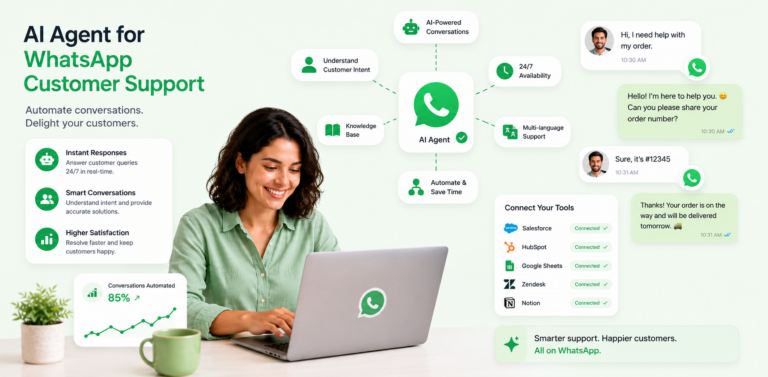
Can chatloop.io be deployed on a healthcare practice website and WhatsApp? Yes. Chatloop.io supports both website chat and WhatsApp deployment from the same configuration. For practices where patients communicate primarily via WhatsApp (common in UK private practices), see how to integrate an AI agent with WhatsApp.
Give your reception team their time back. Start your free chatloop.io trial and automate your practice's administrative communication safely and compliantly.


Comments are closed.