


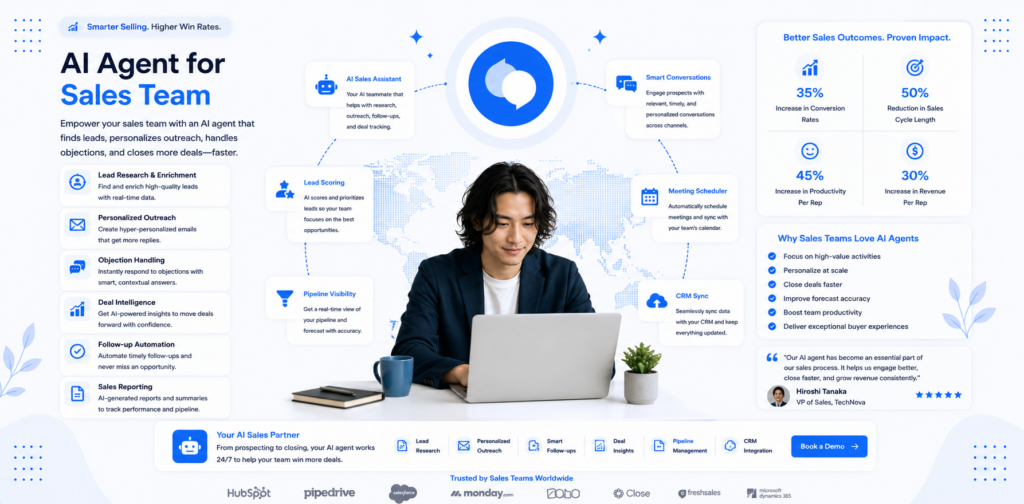
Sales teams lose more time to administrative overhead than most sales leaders want to admit. Updating CRM records after calls, qualifying inbound leads manually, drafting follow-up emails, and chasing prospects who have gone quiet — these tasks are necessary but they are not selling. The average sales rep spends 35–40% of their time on non-selling activities, and most of that time is automatable.
An AI agent for sales team operations changes this ratio. When qualification, follow-up, and CRM hygiene are handled automatically, reps spend more time in meaningful conversations with qualified prospects — which is the only activity that directly drives revenue.
What an AI Sales Agent Actually Does
The term "AI agent for sales" covers a wide range of capabilities. In practice, the most impactful sales AI deployments focus on four areas.
1. Lead Qualification at the Point of Enquiry
Every inbound lead arrives with different intent, budget, and urgency. Without qualification, sales reps spend equal time on high-potential prospects and tire-kickers. An AI agent handles the first layer of qualification — asking the right questions about company size, use case, timeline, and budget — before a human gets involved.
This is the same lead qualification logic that chatloop.io for sales is built around: an AI that engages website visitors the moment they show interest, asks qualifying questions in a natural conversation flow, and routes only genuinely qualified leads to a sales rep.
The impact is measurable. Sales teams using AI lead qualification report spending 40–60% less time on unqualified conversations, with close rates improving because reps are working a better-quality pipeline.
2. Automated Follow-Up Sequences
One of the most significant sources of lost revenue for sales teams is inaction after initial contact. A prospect downloads a resource, a rep sends a first email, and then the follow-up gets deprioritised by the volume of the day's work. The prospect does not hear back. They choose a competitor.
An AI sales agent monitors inbound interest signals and triggers follow-up sequences automatically. When a prospect visits the pricing page for the third time, the AI can send a contextualised message offering a demo. When a trial user has not completed their setup, the AI sends a help-focused check-in. These touches happen without the rep having to remember to send them.
3. CRM Data Entry and Hygiene
Sales reps universally dislike updating CRM records. It is time-consuming, it interrupts the flow between calls, and it is the first thing that gets cut when the day gets busy. The result is CRM data that quickly becomes stale and unreliable.
An AI agent connected to your CRM can capture conversation outcomes, update deal stages, log contact information, and flag inactive deals — all automatically, triggered by conversation events rather than manual input. This keeps CRM data accurate without adding to the rep's workload.
4. Answering Product and Pricing Questions at Scale
For businesses with inbound sales enquiries, the same question is asked thousands of times: How does pricing work? What integrations do you support? How does onboarding work? Each of these questions, answered by a human, costs time. Each one answered by an AI before the rep gets involved saves that time and accelerates the buyer's decision process.
An AI agent trained on your product documentation, pricing pages, and integration guides resolves these questions instantly. The prospect gets information in seconds rather than waiting for a rep's calendar. The rep gets a better-prepared prospect when they do get on a call.
The Sales Productivity Numbers
The operational impact of AI on sales teams is well-documented across deployment patterns.
Time recaptured per rep. Sales reps using AI for qualification, follow-up, and CRM automation typically recover eight to twelve hours per week. At a blended cost of £30/hour for sales staff, that is £240–360/week per rep, or £12,000–18,000 per year per rep in recovered productive capacity.
Pipeline velocity improvement. Faster first responses and automated follow-up compress the time between initial enquiry and qualified conversation. Most businesses see pipeline velocity improve by 15–25% within the first 90 days of AI sales deployment.
Lead-to-opportunity conversion. Automated qualification filters ensure that only genuinely interested, budget-qualified prospects reach reps. Lead-to-opportunity conversion rates typically improve by 20–35% because reps are not wasting time on prospects who would never have bought.
Response time to inbound leads. The single biggest predictor of lead conversion is first response time. An AI agent that responds to a new inbound lead in seconds — rather than the industry average of hours — captures intent at its peak. Businesses with AI first response report 15–30% improvement in lead-to-meeting conversion.
Building Your AI Sales Workflow
Map Your Current Sales Flow First
Before configuring anything, document where your current process loses speed or quality. Walk through a typical lead journey from first contact to close and identify the steps that are: repetitive (same actions every time), administrative (data entry, scheduling, follow-up triggers), and high-frequency (happening tens or hundreds of times per week).
These are your automation targets. The steps that require human judgment, relationship, and negotiation are not automation candidates.
Configure Qualification Logic
Define what a qualified lead looks like for your business. Qualification criteria typically include: company size, budget range, timeline, decision-maker status, and fit with your ideal customer profile.
Build these criteria into your AI agent's conversation flow. The agent asks questions naturally within the chat interaction and scores responses against your qualification criteria. Leads that meet the threshold are routed to a rep immediately. Leads that do not meet the threshold are entered into a nurture sequence.
Review chatloop.io's features to understand the qualification flow configuration options.
Set Up Follow-Up Triggers
Map the behavioural triggers that should initiate AI follow-up. Common triggers include:
- Pricing page visit (third or more)
- Trial account created but not activated
- Demo booked but not attended
- High-scoring lead gone quiet for five or more days
- Product page visited after a previous interaction
Each trigger maps to a follow-up message template. The message is personalised with the prospect's name, company, and relevant context from their previous interaction. The rep is notified when the prospect responds.
Integrate with Your CRM
Connect your AI agent to your CRM so that conversation data flows automatically. Chatloop.io's integrations support connection to common CRM platforms, allowing conversation outcomes, lead scores, and contact details to update in real time without manual input.
Test the integration by running a sample qualification conversation and verifying that the CRM record updates correctly. This validation step is critical — a CRM integration that does not work reliably undermines adoption faster than any other issue.
Define the Human Handoff Point
The AI handles qualification, initial nurture, and administrative tasks. The human rep takes over at the point of genuine sales conversation — when a prospect is qualified, interested, and ready to talk. Define this handoff point explicitly in your workflow.
Configure the handoff so that the rep receives full conversation context from the AI interaction. They should never have to ask a prospect questions that the AI already answered. This context transfer is one of the most important quality details in an AI-assisted sales process — it determines whether the transition feels seamless or abrupt to the prospect.
AI Sales Agents vs Traditional Sales Automation
Many businesses already use some form of sales automation — email sequences, CRM workflows, and lead scoring rules. AI agents are different in three important ways.
Conversational rather than broadcast. Traditional email sequences push messages regardless of engagement. AI agents conduct dialogues — they respond to replies, adapt to context, and route based on what the prospect actually says rather than how many days have passed.
Learning rather than static. Traditional automation rules are fixed. AI agents improve as they process more interactions. Qualification accuracy, follow-up timing, and message content all get better with accumulated data.
Accessible without technical configuration. Traditional sales automation typically requires CRM expertise to configure and maintain. AI agents built on no-code platforms like chatloop.io can be configured and updated by sales managers without engineering support.
Integration with the Broader Revenue Stack
An AI sales agent does not operate in isolation. The most effective deployments connect it to the full revenue stack.
The AI agent on your website captures and qualifies leads from your marketing campaigns, routing them into sequences and triggering alerts to reps. The CRM connection ensures that every interaction is logged. The customer support AI handles post-sale queries, freeing the sales team to focus on new revenue rather than managing existing accounts.
This end-to-end coverage — from first website visit through to customer success — is the architecture that maximises the return on your AI investment.
FAQ
Will prospects know they are talking to an AI during qualification? Best practice and increasingly regulation requires disclosure that an interaction involves AI. Qualified prospects who are asked clear, relevant questions by an AI typically do not object — they appreciate the fast response. Configure your chatloop.io agent to identify itself as an AI assistant at the start of the interaction.
Can an AI agent handle complex pricing or enterprise sales conversations? No, and it should not try. AI agents are appropriate for standardised qualification, FAQ responses, and administrative tasks. Complex pricing, custom enterprise proposals, and negotiation require human sales professionals. The AI's role is to ensure those humans are only in those conversations, not in repetitive qualification calls.
How do I measure whether AI is improving my sales team's performance? Track: lead-to-opportunity conversion rate, time from lead to first qualified conversation, rep time spent per qualified opportunity, and pipeline velocity (average days from first contact to close). Compare these metrics in the 60 days before and after deployment.
What happens to leads the AI cannot qualify? Unqualified leads enter a nurture sequence configured for lower-priority follow-up. The AI continues to monitor their engagement signals and re-escalates to a rep if they show renewed high-intent behaviour. No qualified lead falls through the cracks.
How does chatloop.io compare to dedicated sales AI tools? Chatloop.io provides an AI agent that handles qualification, response, and routing across all your customer touchpoints — website, WhatsApp, and messaging channels — rather than a siloed sales-only tool. See the full feature comparison or review chatloop.io vs Intercom for a direct competitive breakdown.
Let AI qualify your leads so your reps can close them. Start your free 7-day chatloop.io trial and see your first qualified conversations this week.


4 Responses on this post
Comments are closed.