


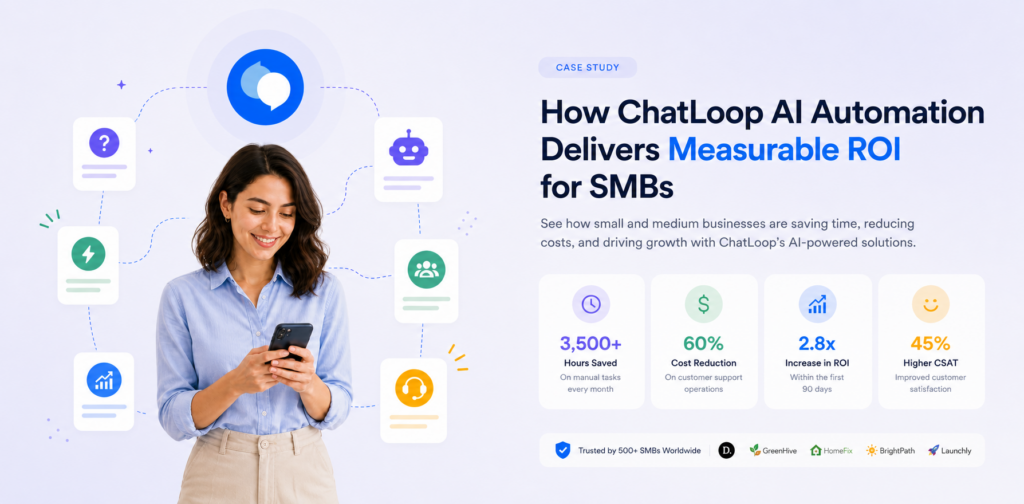
Why SMBs Are the Real Proving Ground for AI Automation
Enterprise businesses have been automating customer support for years. They have the budgets for custom implementations, the engineering teams to maintain integrations, and the luxury of trialling systems across a fraction of their volume before rolling out at scale.
SMBs have none of that. And that's exactly what makes the Chatloop case study for AI automation ROI in SMBs so instructive.
When a 12-person ecommerce brand or a bootstrapped SaaS startup implements AI automation, the stakes are immediate and unforgiving. There's no room for a six-month onboarding process. There's no dedicated ops team to fine-tune the system. Every pound spent needs to return measurably more than it costs — and quickly.
The good news: this constraint produces the clearest ROI data. With limited headcount and tight margins, SMBs feel the impact of AI automation faster and more visibly than any enterprise deployment. The efficiency gains aren't buried in a large team's productivity numbers — they show up directly in ticket volumes, response times, staff hours, and revenue metrics.
This article documents what that impact actually looks like: the challenges SMBs face before AI, the specific ways Chatloop addresses them, and the concrete results that follow.
The Challenge: What SMB Support Looks Like Before AI
To understand the ROI, you first need to understand the starting conditions.
The Staffing Trap
Most SMBs with fewer than 50 employees handle customer support with one of two approaches: a dedicated support person (or small team) who handles everything, or a rotation system where non-support staff — founders, ops, sales — take turns managing the inbox.
Both approaches share the same fundamental problem: support is a fixed human resource competing with every other priority in the business.
When volume spikes — a product launch, a sale period, a viral moment — the inbox overwhelms whoever is responsible. Response times stretch. Customers who emailed Friday afternoon don't hear back until Monday. High-intent leads asking about pricing or upgrades sit unanswered for 18 hours while a stressed support person works through a backlog of order queries.
When volume drops, the human cost of support is still there — a salary, a subscription, a portion of a founder's week — providing no return.
The Repetition Problem
Analysis of SMB support inboxes consistently shows the same pattern: 65–75% of incoming conversations are variations of the same 10–15 questions.
For an ecommerce brand, it's typically:
- Where is my order?
- What is your returns policy?
- Can I change my delivery address?
- Do you offer discount codes?
- Is this product compatible with X?
For a SaaS product, it's usually:
- How do I reset my password?
- Can I upgrade/downgrade my plan?
- Does your product integrate with X?
- How do I export my data?
- What happens when my trial ends?
These questions are not complex. They don't require empathy, judgement, or creativity to answer. But they consume the majority of a support team's time — leaving less capacity for the conversations that genuinely need human attention.
The Missed Revenue Problem
Perhaps the most underappreciated cost of under-resourced SMB support is missed revenue.
Every support inbox contains a mix of support requests and buying signals. Customers asking about pricing, comparing plans, asking for a demo, or checking whether a product meets a specific requirement are, in many cases, on the verge of a purchasing decision. How quickly and how well those conversations are handled determines whether that revenue converts.
When a five-person team is processing 200 support tickets a week, they don't have the bandwidth to triage and prioritise buying signals. The customer comparing enterprise plans gets the same queue position as the customer asking about a missing button on a settings page.
That delay — often 4–24 hours — is frequently the difference between winning and losing the conversion.
The Inconsistency Problem
When support is handled by multiple people on a rotation — or by a single person across varying energy levels and workload days — the experience becomes inconsistent. Different agents answer the same question differently. Tone varies. Policy explanations vary. Some customers get proactive follow-up; others never hear back after their issue is marked resolved.
For a brand trying to build trust, inconsistency is quietly corrosive. Customers notice, even when they don't explicitly articulate it.
The Chatloop Solution: How AI Automation Works in Practice
Chatloop addresses all four of these challenges through a unified AI platform designed specifically for the resource constraints and growth ambitions of SMBs.
Handling Repetition at Scale — Without Headcount
Chatloop's AI knowledge base is trained on your existing FAQs, policies, product documentation, and support history. Once indexed, it handles the high-volume, low-complexity questions that consume most of a support team's time — automatically, instantly, and consistently.
A customer asking "where is my order?" at 11pm on a Saturday gets an accurate, personalised response within seconds — with their actual order status pulled live from your Shopify or WooCommerce store via API integration. No agent required. No next-business-day delay.
The same applies across the full breadth of common queries. Returns policy questions. Plan comparison requests. Password resets. Product compatibility checks. Each is handled by AI in the channel the customer is already using — web chat, WhatsApp, Instagram DM, email — with no friction and no queue.
Identifying and Fast-Tracking Revenue Conversations
Where Chatloop goes beyond basic deflection is in its intent classification layer. Every incoming conversation is analysed for buying signals — keywords, phrasing patterns, and behavioural context that indicate a customer is evaluating a purchase, comparing options, or ready to upgrade.
When those signals are detected, the conversation isn't just answered — it's escalated immediately to a human agent or routed into a conversion-optimised automated flow. The customer who sends "I'm trying to decide between your Growth and Pro plans" at 2pm on a Wednesday doesn't wait in the same queue as a general support request. They get a prioritised, personalised response — fast.
This single capability often produces the clearest and most immediate ROI for SMBs: not just cost reduction, but revenue capture from conversations that would previously have been missed or delayed.
Consistent, On-Brand Responses Across Every Channel
Because Chatloop's AI responses are generated from a controlled knowledge base with configurable tone and style settings, every customer interaction reflects the same brand voice — regardless of channel, time of day, or which agent eventually takes over.
Policy explanations are consistent. Pricing information is current. The handoff from AI to human is seamless, with full conversation context preserved so agents never have to ask a customer to repeat themselves.
Case Study: Results Across SMB Verticals
The following results are representative of SMB deployments across ecommerce, SaaS, and service businesses using Chatloop's AI automation. Figures represent observed ranges across multiple accounts within each vertical.
Ecommerce Brand (Shopify, 8,000 monthly orders)
Before Chatloop:
- 2 full-time support staff handling ~1,600 conversations/month
- Average first response time: 4.2 hours
- 68% of volume was order tracking, returns, and policy questions
- Estimated missed revenue from delayed high-intent conversations: material but untracked
After Chatloop (90 days):
| Metric | Before | After | Change |
|---|---|---|---|
| AI deflection rate | 0% | 61% | +61pp |
| Avg. first response time | 4.2 hrs | 38 seconds | -98% |
| Agent conversations/month | 1,600 | 624 | -61% |
| Support cost per conversation | £4.80 | £1.90 | -60% |
| CSAT score | 3.6 / 5 | 4.3 / 5 | +19% |
| High-intent lead response time | 5.1 hrs | 8 minutes | -97% |
Key outcome: The two existing support staff were redeployed — one into customer success (proactive outreach to high-value accounts), one into a part-time sales support role. The brand effectively converted a support cost centre into a revenue-contributing function without increasing headcount.
B2B SaaS (350 active accounts, predominantly SMB customers)
Before Chatloop:
- Support handled by two founders + one part-time contractor
- Average first response time: 6.8 hours (often next business day for evening queries)
- High churn rate among trial users who didn't receive timely onboarding support
After Chatloop (60 days):
| Metric | Before | After | Change |
|---|---|---|---|
| Trial-to-paid conversion rate | 18% | 26% | +44% |
| Avg. first response time | 6.8 hrs | 52 seconds | -99% |
| Founder hours on support/week | ~14 hrs | ~3 hrs | -79% |
| Churn (trial users, 30-day) | 74% | 61% | -13pp |
| Support tickets requiring human | ~280/mo | ~95/mo | -66% |
Key outcome: The most significant impact was on founder time. Recovering 11 hours per week per founder — previously spent on L1 support — created capacity for product development, sales calls, and investor relations. At a conservative £150/hour opportunity cost, that's £6,600/month of recaptured productivity per founder.
Professional Services Business (Legal Tech, 120 clients)
Before Chatloop:
- Support and client queries handled via email by senior staff
- Average response time: next business day
- Significant after-hours query volume going unacknowledged until morning
- Client satisfaction scores declining, particularly among newer clients
After Chatloop (45 days):
| Metric | Before | After | Change |
|---|---|---|---|
| After-hours queries resolved without human | 0% | 71% | +71pp |
| Client satisfaction score | 3.4 / 5 | 4.1 / 5 | +21% |
| Senior staff time on routine queries | ~8 hrs/week | ~1.5 hrs/week | -81% |
| Client onboarding completion rate | 67% | 84% | +25% |
Key outcome: For a professional services business where senior staff billing rate is £300–500/hour, reducing routine query handling by 6.5 hours per week per senior person represented the clearest ROI of any vertical — direct billable hour recapture.
How to Calculate Your Own AI Automation ROI
Every business is different, but the ROI model for AI support automation follows the same structure. Here's a framework for working out your numbers before you commit.
Step 1: Establish Your Current Support Cost
Calculate the fully-loaded monthly cost of your current support operation:
- Staff cost: Monthly salary × number of support FTEs (or proportion of time for shared-responsibility models)
- Tool cost: Helpdesk software, live chat subscriptions, communication tools
- Opportunity cost: For founders or senior staff handling support, estimate hours × hourly rate
For most SMBs, this total lands between £2,000 and £15,000 per month depending on team size and seniority.
Step 2: Estimate Your Deflectable Volume
Review 30 days of support conversations and tag each one by complexity:
- L1 — Deflectable: Answerable with policy info, order data, or documentation. No judgement required.
- L2 — AI-assisted: Answerable with AI draft + agent review
- L3 — Human-only: Complex, sensitive, or high-stakes conversations requiring human expertise
For most SMBs, 60–70% of volume falls into L1. That's your deflection opportunity.
Step 3: Model the Post-Automation Cost
With a 60% deflection rate, your human agents handle 40% of current volume. That either means:
- Headcount reduction: If you have more agents than needed for 40% volume, you can reduce headcount or redeploy
- Capacity creation: If you're at capacity, you now have 60% more headroom without hiring
Factor in Chatloop's subscription cost against the staff time saved.
Step 4: Add the Revenue Upside
This is where most ROI calculators stop short. Also model:
- Faster high-intent response: If 5% of your conversations are buying signals and your current response time is 6 hours, how many of those convert at 8-minute response vs. 6-hour response? Even a 10% improvement in buying-signal conversion has significant revenue impact.
- Proactive campaign revenue: Chatloop's campaign module enables outbound messaging sequences — reorder nudges, renewal reminders, upsell triggers — that generate incremental revenue from your existing customer base.
Use our Customer Service Automation ROI Calculator to run your own numbers.
Step-by-Step: How SMBs Implement Chatloop
A common concern among SMB decision-makers is implementation complexity. The assumption — shaped by enterprise software experiences — is that meaningful AI automation requires months of setup, technical resource, and ongoing maintenance.
Chatloop is designed to challenge that assumption. Here's what a typical SMB implementation actually looks like.
Week 1: Foundation
Day 1–2: Account setup and channel connection Connect your existing channels — web chat widget, WhatsApp Business, Instagram, email inbox — through the Chatloop dashboard. Most SMBs complete this in under two hours without developer involvement.
Day 3–5: Knowledge base population Upload your existing documentation: FAQ page content, policy documents, product specs, pricing pages. Chatloop indexes this content semantically, so the format doesn't need to be perfect — it's understood by meaning, not just keywords.
Day 5–7: Initial routing configuration Set your deflection thresholds, escalation triggers (low confidence scores, negative sentiment, VIP customer flags), and agent notification preferences. Chatloop provides starter templates based on your industry vertical.
Week 2: Testing and Refinement
Run Chatloop in parallel with your existing support process for one week. Review AI-generated responses daily, flag any inaccuracies, and refine the knowledge base where needed. This parallel period typically surfaces 8–12 knowledge gaps that are easy to fill before going live.
Week 3: Full Deployment
Switch Chatloop to primary for deflectable intents. Monitor deflection rate, CSAT on AI-resolved conversations, and re-contact rate daily for the first two weeks.
Month 2 onwards: Optimisation
With baseline data established, begin expanding scope: proactive campaign sequences, additional channel coverage, intent routing refinements based on observed conversation patterns. Most SMBs see their deflection rate increase by 10–15 percentage points between month one and month three as the system learns from volume.
Common Questions from SMB Decision-Makers
Q: We're a small team. Do we have the bandwidth to manage an AI system on top of everything else?
Chatloop is designed to reduce your management burden, not add to it. Initial setup takes 1–2 weeks of moderate attention. After that, the ongoing maintenance requirement is roughly 1–2 hours per week — reviewing flagged conversations, updating knowledge base content when policies change, and checking performance dashboards. Most SMB teams find this replaces rather than adds to existing support management time.
Q: What if the AI gives a wrong answer to a customer?
Two safeguards prevent this from causing significant damage. First, Chatloop's confidence scoring means that when the AI is uncertain, it defaults to escalation rather than guessing. Second, all AI responses can be configured to include a visible "speak to a human" option, so customers who feel the answer was wrong have an immediate pathway to human resolution. Monitoring the re-contact rate (conversations marked resolved that result in a follow-up) is the key metric for catching and addressing any accuracy issues early.
Q: We use Zendesk / Freshdesk / Intercom. Does Chatloop replace those or integrate with them?
Chatloop integrates with major helpdesk platforms for ticket sync and agent handoff. For SMBs using Chatloop as their primary inbox, it can also operate as a standalone unified inbox — replacing the need for a separate helpdesk subscription. The right setup depends on your existing stack and team workflows.
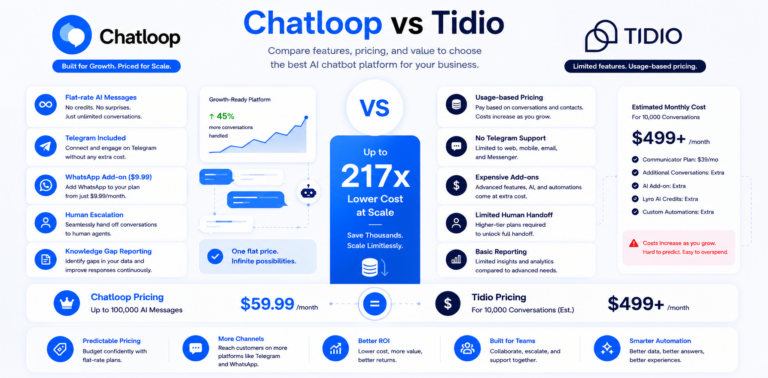
Q: How does Chatloop compare to tools like Tidio or traditional live chat?
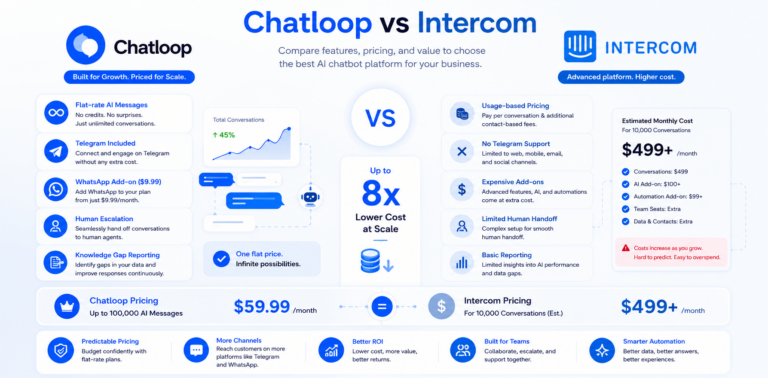
Traditional live chat tools are built for synchronous human conversation. They require an agent online to be useful, and they don't provide genuine AI resolution — just routing and notification. Chatloop is built around AI-first resolution with human escalation as the exception. See our detailed Chatloop vs Tidio Comparison and Chatloop vs Traditional Live Chat Tools for a full breakdown.
Q: Can Chatloop handle multi-language support?
Yes. Chatloop detects the language of the incoming message and responds in kind, drawing from a multilingual knowledge base. This is particularly valuable for ecommerce brands with international customer bases who currently manage language-based support routing manually.
Q: What's the realistic payback period?
For most SMBs, the payback period on Chatloop's subscription cost is 30–60 days when measured against staff time saved alone. When high-intent conversion improvement is factored in, payback is frequently immediate in month one. The AI Help Desk Automation for Remote Teams article walks through a detailed payback model for distributed team scenarios.
What to Do Next
If you recognise your business in the challenges described above — repetitive support volume consuming disproportionate time, delayed responses to high-intent conversations, inconsistent customer experience — the path forward is straightforward.
Three things worth doing this week:
-
Audit your support volume: Tag 30 days of conversations by L1/L2/L3 complexity. Most SMBs find 60–70% is immediately deflectable. That number is your ROI starting point.
-
Calculate your current support cost: Fully-loaded — staff, tools, opportunity cost. Compare it against what 60% fewer human-handled conversations would look like. The delta is your automation opportunity.
-
See Chatloop in your stack: Book a 30-minute demo with a product specialist who can map Chatloop's specific capabilities to your vertical, your channels, and your existing tools. There's no enterprise sales process — it's a practical working session with real data.
The SMBs generating the clearest ROI from AI automation aren't the ones with the most sophisticated tech stacks. They're the ones who moved quickly, started narrow, measured rigorously, and expanded from a position of evidence. That process can start this week.


Comments are closed.