Governance First: 5 Points to Evaluate AI Agents for Support
Governance First: 5 Points to Evaluate AI Agents for Support
A governance first playbook for AI agents for support: five vendor evaluation points, a shadow mode rollout path, and how to test fit with a Chatloop trial.
The right answer for most support organizations is an enterprise-grade agentic platform run with human-in-loop governance, not a bare chatbot and not full autonomy on day one. Start narrower than you think you need to: pick one queue, score vendors against a governance-first checklist, and pilot in shadow mode before any customer sees an autonomous reply.
TL;DR:
Support organizations should prioritize governance-first platforms with human-in-loop oversight rather than fully autonomous systems to minimize customer risk.
Pilot AI agents in shadow mode on low-stakes, high-volume queues for two to four weeks, setting clear success metrics before enabling auto-replies.
Evaluate vendors based on capability fit, integration depth, governance controls, operational tooling, and flexible exit options to ensure reliable deployment.
Automate low-risk, high-volume tasks first, such as order status and password resets, gradually expanding to medium and high-risk actions with strict entitlement and safety controls.
Incorporate a staged rollout with escalation triggers and continuous governance review to prevent failures and protect customer relationships.
Chatloop
Make Support More Responsive
Chatloop helps businesses provide personalized, multilingual customer support through intelligent chatbots and seamless multichannel messaging.
An AI agent for support does something a scripted chatbot cannot: it takes action. A traditional chatbot matches a question to a canned answer or a decision tree. An agent reasons across a conversation, pulls context from your CRM or order system, decides what step comes next, and can execute that step, like issuing a refund, updating a shipping address, or rebooking an appointment, without a human typing the command.
That distinction matters more than the marketing copy suggests. Support AI agents built on large language models can hold multi-turn context, recognize when a request needs a policy check, and hand off cleanly when they hit the edge of their authority. Simple chatbots, by contrast, tend to loop or dead-end the moment a question falls outside their scripted paths. This is the core split behind “ai agents vs chatbots” debates: one automates conversation, the other automates outcomes.
Gartner predicts agentic AI will autonomously resolve a large share of common customer service issues in the coming years, and the firm points to fast enterprise adoption of autonomous agents as the driver. That forecast is the reason procurement teams are suddenly fielding a dozen vendor pitches. It is also exactly why governance has to lead the rollout, not follow it: a botched autonomous action costs you a customer, not just a bad review.
Who Should Adopt AI Agents for Support Now?
Not every support team is ready to hand an agent the keys, and pretending otherwise is how pilots turn into cautionary tales. The organizations getting real value share a profile: moderate-to-high ticket volume (typically thousands per month), a handful of repeatable request types, and at least one channel where response speed directly affects revenue or retention.
Multilingual support desks and multichannel operations (chat, email, and messaging apps running simultaneously) tend to see the fastest payback, because that is exactly where human agents are stretched thinnest and inconsistency is most visible to customers.
Before you evaluate a single vendor, rank your own use cases by risk and volume. A good starting shortlist looks like this:
Triage and routing — classifying and directing tickets, the lowest-risk, highest-volume win.
Status and account lookups — order tracking, appointment confirmations, subscription details.
Multilingual first response — real-time translation so no queue backs up waiting for a bilingual agent.
Voice-to-text intake — capturing and summarizing calls for faster human follow-up.
The pilot pattern that works in practice is narrow, deliberate, and boring on purpose. Pick a single queue, ideally one with high volume but low emotional stakes (billing questions beat cancellation requests). Run the agent in shadow mode, where it drafts responses that a human reviews and sends, for two to four weeks. Define success metrics before you start (deflection rate, draft acceptance rate, time saved per ticket), not after you like the results. Only then move that queue to partial auto-reply, and only for the specific intents that scored well in review.
Pro Tip:Resist the urge to pilot your hardest queue first because it has the biggest cost problem. A messy pilot on a high-stakes queue kills executive confidence in the whole program before the technology gets a fair shot.
How Do You Evaluate AI Agent Vendors and Platforms?
Every vendor demo looks impressive. The differences show up six months into production, when edge cases pile up and someone asks who is accountable for a wrong refund. Score platforms against five categories before you sign anything.
Capability fit. Does the platform handle triage, autonomous actions, and multilingual conversations natively, or are these bolted-on features? Check whether channel behavior is consistent, an agent that performs well in chat but falls apart on voice or WhatsApp will fragment your customer experience.
Integration depth. Confirm real, tested connections to your ticketing system and CRM, not just a generic API. Marketplace listings for enterprise integrations are a reasonable proxy for how mature a vendor’s connector ecosystem actually is.
Governance and safety controls. This is where most vendor comparisons fall short, because it is the least demo-friendly category. You need entitlement checks (who can the agent act on behalf of, and for what dollar amount), confidence gating (does the agent know when it does not know), and PII redaction before data ever reaches a model.
Operational tooling. Ask what observability looks like day to day. Can your QA team score agent responses at scale, or are you manually spot-checking transcripts? What SLA does the vendor commit to for uptime and response latency?
Commercial terms. Pricing shape matters less than exit flexibility. Ask directly what it costs to leave, migrate your knowledge base, and switch platforms if the relationship sours.
Run each finalist through this checklist:
Does it support autonomous actions like billing updates or refunds only behind policy and entitlement checks?
Can you configure confidence thresholds per intent, not just globally?
Does every agent action generate an audit log a compliance officer could review without your help?
Does the platform expose channel-by-channel performance data, or just an aggregate dashboard?
What is the actual implementation cost beyond the subscription, including data prep and integration work?
Enterprise vendor guidance is consistent on one point: autonomous actions should only fire when governance, entitlements, and audit trails are already in place. Billing changes, account updates, and appointment rescheduling are common autonomous use cases specifically because they are policy-checkable. Treat any vendor who cannot explain their entitlement model in plain language as a red flag, not a technicality.
What Can AI Agents Actually Do in Support Today?
Vendor capability names vary, but the functional categories are consistent across the market. Smart triage classifies incoming requests and routes them, often correcting for mislabeled categories a customer chose themselves. Context enrichment pulls order history, prior tickets, and account tier before a human or an agent ever responds, cutting the back-and-forth that used to eat the first two minutes of every interaction. Guided playbooks walk an agent (human or AI) through a scripted resolution path for known issue types. Confidence-gated auto-response lets the agent answer directly only when it is statistically sure, and hands off everything else.
Vendor feature pages describe these capabilities consistently: smart triage, enrichment, guided playbooks, and confidence gating paired with helpdesk and CRM integration. That consistency across vendors is a useful signal, it tells you these are now baseline expectations, not differentiators.
Mapping capability to risk level helps you sequence a rollout sensibly:
Low risk, high volume: FAQ answers, order status, appointment confirmations, password resets. Automate these first.
Medium risk: plan changes, non-refund billing adjustments, multilingual first response. Automate after shadow mode validates accuracy.
High risk: refunds above a set threshold, cancellations, legal or regulatory questions, anything touching a VIP account. Keep a human in the loop indefinitely, or until entitlement checks are airtight.
Channel choice changes the math on ROI. Chat and messaging apps (WhatsApp, Facebook Messenger, SMS) tend to deliver the fastest payback because volume is high and interactions are short. Email automation helps more with backlog reduction than real-time deflection. Voice is the hardest channel technically, latency and interruption handling are real engineering problems, but it is also where labor cost per interaction is highest, so the ROI ceiling is the biggest once voice agents perform reliably.
How Do You Roll Out an AI Support Agent Safely?
The rollout sequence matters more than the model you pick. Practitioners consistently recommend starting in shadow or review mode, where the agent drafts every response and a human sends it, and only flipping to auto-reply once quality assurance scores clear a defined bar. That single practice does more to prevent public failures than any amount of prompt engineering.
Here is the sequence that holds up in production:
Scope the pilot. Pick one queue, define the intents in scope, and set a minimum sample size (at least a few hundred tickets) before you draw conclusions.
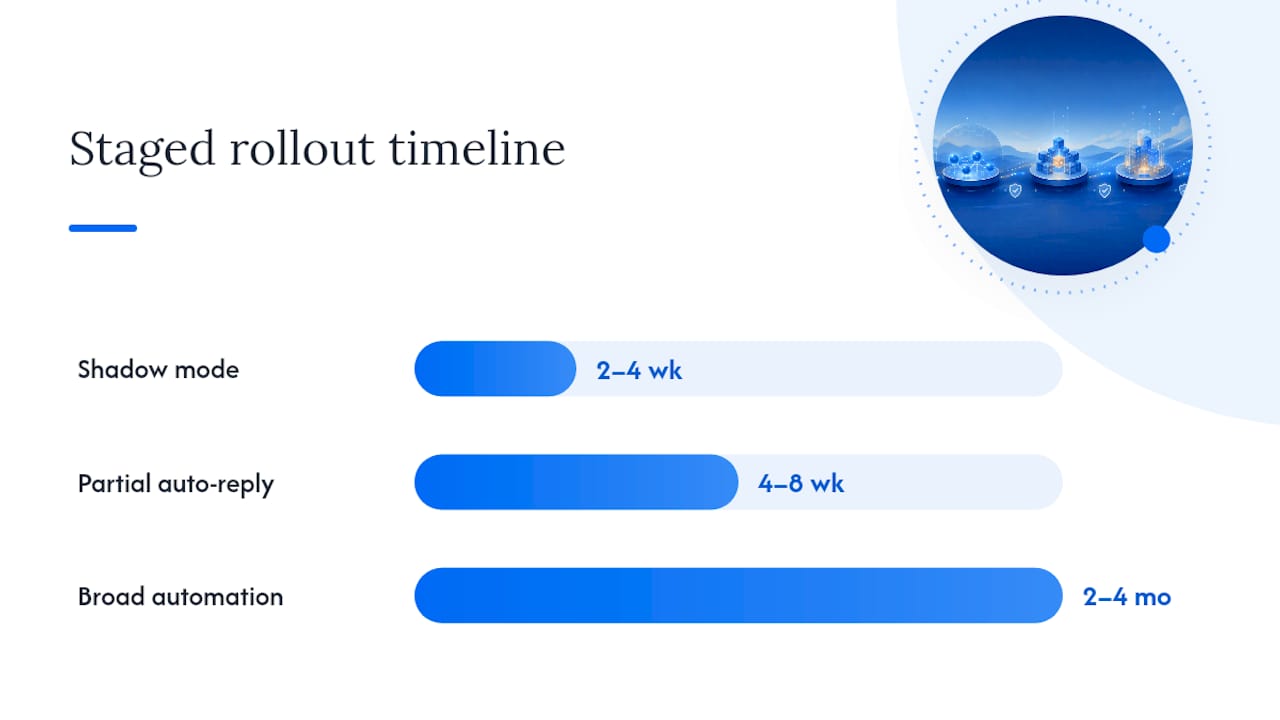
Run shadow mode. Let the agent draft responses for two to four weeks while humans review and send every one. Track draft acceptance rate, edit distance, and time saved per ticket.
Set a QA threshold to flip modes. A common bar is a draft acceptance rate above 85 to 90 percent with no safety-relevant errors, though your risk tolerance should set the exact number.
Enable partial auto-reply. Only for the specific intents that cleared review, not the whole queue. Keep a rollback switch that any team lead can flip without engineering support.
Expand gradually. Add intents and channels one at a time, rechecking QA scores at each expansion rather than assuming success in one queue transfers automatically.
Escalation rules deserve as much design attention as the automation itself. Build triggers around sentiment drops mid-conversation, entitlement failures (a customer asking for something outside their account’s permissions), and any VIP or high-value account, regardless of how routine the request looks. Vendor deployment patterns confirm the shadow-to-auto-reply staging approach as the industry-standard risk mitigation, and it is worth treating that consistency as a signal, not a coincidence.
Pro Tip:Write your escalation rules before you write your automation rules. Knowing exactly when the agent must hand off matters more than how smart it sounds when it doesn’t.
Timelines vary by organization size, but a reasonable expectation is two to four weeks for shadow mode, four to eight weeks of staged partial auto-reply, and two to four months before an organization reaches broad automation across multiple queues. Teams that skip shadow mode to hit a launch date almost always pay for it later in support escalations and trust repair. For a deeper walkthrough of QA gates and staging mechanics, see Chatloop’s implementation best practices.
How Much Do AI Agents for Support Cost?
Pricing in this market takes a few recognizable shapes: per-conversation fees, per-seat subscriptions, tiered plans based on ticket volume, or a platform fee plus usage overage. None of these is inherently better, but each changes your incentives. Per-conversation pricing rewards you for deflecting tickets; per-seat pricing does not scale with volume at all, which can be a problem if support demand spikes seasonally.
The sticker price is rarely the real cost. Budget separately for:
Integration work connecting the agent to your CRM, ticketing system, and knowledge base.
Data preparation, cleaning and structuring your help center content so the agent has something accurate to draw from.
Change management, training your human agents to work alongside the system rather than around it.
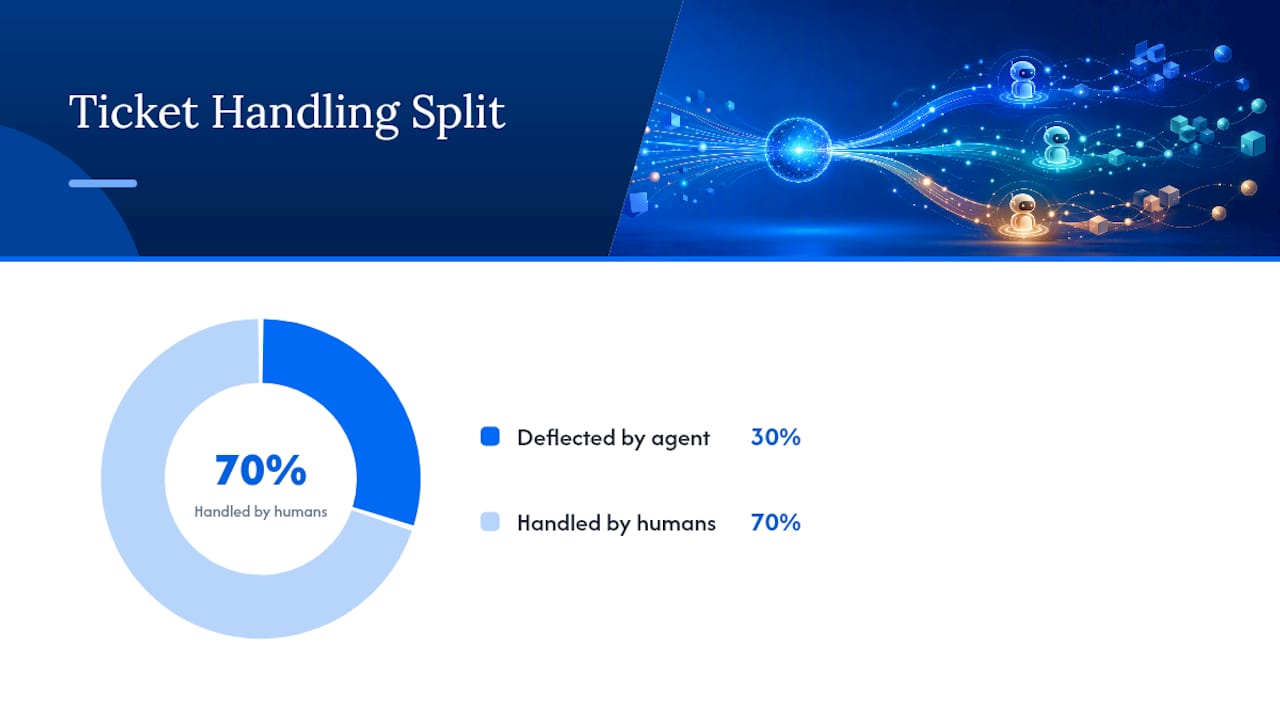
A rough ROI model: if an agent deflects 30 percent of a 10,000-ticket monthly volume at an average handling cost of $8 per ticket, that is roughly $24,000 in monthly savings before subtracting platform fees and review overhead. Break-even timing depends entirely on your integration cost and how fast shadow mode clears QA, but most organizations should model payback in months, not the first quarter.
Track four metrics religiously after launch: deflection rate (tickets resolved without human intervention), mean time to resolution, cost per ticket, and CSAT specifically on automated interactions, not blended with human-handled tickets. Blended CSAT hides exactly the problem you need to see early. SaaS-specific cost patterns and examples are broken down further in Chatloop’s strategy guide for SaaS support.
What Security and Compliance Controls Should You Require?
Treat this section as a floor, not a wish list. Any vendor unwilling to commit to these controls in writing should not touch customer data.
Encryption in transit and at rest, plus a defined data retention window you control, not the vendor’s default.
PII redaction before data reaches the model, ideally with a zero-retention option for the most sensitive fields.
Granular action entitlements, scoped permissions for refunds, account changes, and any action that touches money or identity, with dollar and category limits.
Full audit logging on every agent decision and action, reviewable by compliance without engineering help.
Human-review sampling built into the ongoing workflow, not just the initial pilot, to catch drift as the agent handles new edge cases.
Hallucination risk and missed escalations are the two failure modes that do real damage. Gartner’s research on chatbot reuse found that only a minority of customers will try a chatbot again after a bad experience, which means one governance failure can cost you a customer relationship, not just a single ticket. Confidence gating and clear entitlement boundaries are the two controls that most directly reduce that risk, and they cost far less to implement than the damage they prevent.
Chatloop’s Approach to Enterprise Support Automation
The platform is built around the same governance-first pattern this guide recommends: agents that handle multilingual support across chat, email, and messaging channels, with escalation rules and integration hooks into existing CRM and ticketing systems rather than a walled-off tool. It includes real-time translation as a built-in feature rather than as an add-on.
Multichannel deployment across website chat, CRM-integrated messaging, and third-party messaging tools.
Real-time translation for multilingual support desks.
Integration support for existing systems, aimed at reducing the setup friction that stalls most pilots.
Subscription pricing with a free trial, allowing evaluation without requiring a full procurement process before testing the product.
The specifics of any deployment (which queues to automate first, how aggressive the entitlement thresholds should be) still depend on your own ticket data. But the evaluation criteria in this guide apply whether or not you choose Chatloop, and that is deliberate: a governance-first rollout should outlast any single vendor relationship.
What Actually Trips Up AI Agent Rollouts?
The mistakes I see repeated across support organizations are rarely technical. They are sequencing errors. Teams skip shadow mode because a launch date is already on the calendar, then spend the next quarter doing damage control on a queue that should have stayed manual for another month. Teams also confuse “the agent answered” with “the agent answered correctly,” which is why draft acceptance rate matters more early on than raw deflection percentage.
The third mistake is treating governance as a one-time setup instead of a living system. Entitlement rules that made sense at launch stop fitting six months later when your product catalog or refund policy changes, and nobody revisits them until something breaks.
If you take one thing from this guide, make it this: define your escalation rules before you define your automation rules, and never let deflection rate outrank CSAT and audit completeness on your dashboard. Everything else in a successful rollout follows from getting that order right.
— Gaurav
Try Chatloop for Your Support Operation
If you have been comparing agentic platforms and shadow-mode playbooks, the next real decision is which one you run in your own environment, not which one looks best in a demo. Chatloop gives you multilingual, multichannel support automation with the same governance backbone this guide walks through: confidence-based handoffs, CRM integration, and escalation logic you configure rather than inherit.
What sets Chatloop apart for teams evaluating multiple vendors is the ability to test against your own ticket data during a free trial, rather than a generic sandbox. You can connect your existing helpdesk, run a shadow-mode pilot on a real queue, and see draft acceptance rates before committing to anything. For teams juggling multiple channels, the multichannel integration approach is worth reviewing directly against your current stack.
Common classifications include simple reflex agents, model-based agents, goal-based agents, utility-based agents, learning agents, hierarchical agents, and multi-agent systems, though vendors in the support space mostly build hybrid goal-based and learning agents tuned for conversation and action-taking.
What Are the Top AI Agents for Customer Support?
There is no single definitive ranking, since fit depends on channel mix, integration needs, and governance requirements, but platforms like Chatloop, along with enterprise players covering CRM-native and voice-first use cases, represent the main categories worth shortlisting against the evaluation checklist above.
How Do You Build an AI Agent for Customer Support?
Start by scoping one queue and running the agent in shadow mode so it drafts responses for human review, then define QA thresholds for accuracy before enabling partial auto-reply on validated intents, expanding gradually with entitlement checks and audit logging in place throughout.
How Much Do AI Agents Cost?
Pricing typically follows per-conversation, per-seat, or tiered subscription models, with real total cost driven more by integration work, data preparation, and governance setup than by the base subscription fee itself; most platforms, including Chatloop, offer a free trial to test fit before committing to a paid tier.
When Should a Support Team Keep a Human in the Loop?
Keep a human in the loop for any request involving refunds above a set threshold, account cancellations, legal or regulatory questions, or VIP accounts, and use confidence gating so the agent automatically escalates anything it is not statistically certain about.
Contains information related to marketing campaigns of the user. These are shared with Google AdWords / Google Ads when the Google Ads and Google Analytics accounts are linked together.
90 days
__utma
ID used to identify users and sessions
2 years after last activity
__utmt
Used to monitor number of Google Analytics server requests
10 minutes
__utmb
Used to distinguish new sessions and visits. This cookie is set when the GA.js javascript library is loaded and there is no existing __utmb cookie. The cookie is updated every time data is sent to the Google Analytics server.
30 minutes after last activity
__utmc
Used only with old Urchin versions of Google Analytics and not with GA.js. Was used to distinguish between new sessions and visits at the end of a session.
End of session (browser)
__utmz
Contains information about the traffic source or campaign that directed user to the website. The cookie is set when the GA.js javascript is loaded and updated when data is sent to the Google Anaytics server
6 months after last activity
__utmv
Contains custom information set by the web developer via the _setCustomVar method in Google Analytics. This cookie is updated every time new data is sent to the Google Analytics server.
2 years after last activity
__utmx
Used to determine whether a user is included in an A / B or Multivariate test.
18 months
_ga
ID used to identify users
2 years
_gali
Used by Google Analytics to determine which links on a page are being clicked
30 seconds
_ga_
ID used to identify users
2 years
_gid
ID used to identify users for 24 hours after last activity
24 hours
_gat
Used to monitor number of Google Analytics server requests when using Google Tag Manager