


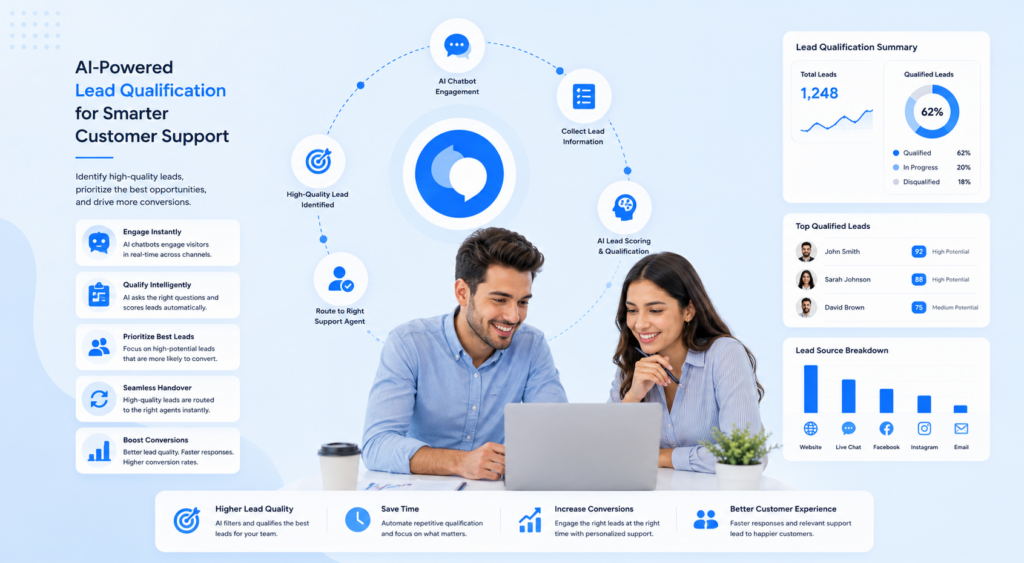
Modern support teams face a critical challenge: every conversation represents a potential sales opportunity, yet most teams lack the bandwidth to qualify and nurture every lead effectively. AI lead qualification for customer support transforms your customer support department into a revenue-generating engine. By automatically identifying buying signals, scoring conversational intent, and routing prospects to the right teams, businesses can convert support conversations into sales without expanding headcount.
This comprehensive guide explores how leading companies are implementing AI lead qualification, the specific metrics that drive ROI, and step-by-step strategies for integration into your existing support workflow.
The Business Case for AI Lead Qualification
Current Support Team Challenges
Traditional support teams operate in reactive mode. The average support agent handles 50-100 inquiries daily, with only 15-25% of conversations containing purchase intent. Manual lead identification takes 10-15 minutes per conversation, and the quality of qualification varies based on individual agent skills. Follow-up on qualified leads is often inconsistent, and many high-value opportunities slip through the cracks due to resource constraints.
The AI Qualification Advantage
When AI handles qualification, the results are transformational. Process speed improves dramatically—AI identifies intent in under 5 seconds versus 10-15 minutes of manual work. Consistency becomes algorithmic: the same criteria apply across 100% of conversations, eliminating agent bias. AI models trained on thousands of conversations achieve 85-92% accuracy rates, often exceeding human performance. Scalability becomes infinite—the same system qualifies unlimited conversations without team growth. Cost efficiency improves dramatically: $0.02-0.05 per qualified lead versus $2-5 manual qualification costs.
How AI Lead Qualification Works
The Technology Stack
AI lead qualification combines several technologies working in concert:
Natural Language Processing (NLP): Analyzes conversation language for buying signals, identifies contextual intent from sentence structure, and recognizes industry-specific terminology. Modern NLP models understand nuance, context, and implied meaning that humans might miss.
Intent Recognition Models: These classify conversations into intent categories (purchase, support, research) and detect urgency signals like "need ASAP" or "urgent issue." They identify decision-stage indicators and purchase readiness signals embedded in customer language.
Lead Scoring Algorithms: These score leads 0-100 based on multiple factors including budget mention, timeline, and authority indicators. The system continuously learns from human feedback, improving accuracy over time.
Real-Time Routing Engine: Routes qualified leads to sales team automatically, maintains conversation context during transfer, and logs all qualification data for analysis and model improvement.
The AI Qualification Workflow
Customer messages are analyzed through NLP engines that detect intent and buying signals. Intent detection happens in parallel with lead scoring. Once a score is calculated, the system makes a qualification decision. If qualified, the prospect is routed to sales with full context. Responses are generated or escalated based on the decision. CRM records are automatically updated with all relevant information.
Example Qualification Scenarios
Scenario 1: High-Intent Lead Customer: "We're looking to implement a support solution for our growing team. What are your pricing tiers?" AI Analysis: Purchase intent (95%), Decision-stage (high), Budget mentioned Action: Route to sales immediately with context
Scenario 2: Support-Only Inquiry Customer: "How do I reset my password?" AI Analysis: Technical support (99%), No purchase intent Action: Auto-respond with self-service solution
Scenario 3: Research-Stage Prospect Customer: "Can AI really reduce support costs? What's typical ROI?" AI Analysis: Interest (70%), Research-stage, Educational content needed Action: Provide educational resources, add to nurture sequence
Implementation Strategy: 5-Week Roadmap
Week 1: Assessment & Planning
Start with comprehensive audit. Review 500+ recent support conversations and identify common buying signal phrases. Define what constitutes a "qualified lead" for your specific business. Set target qualification accuracy (typically 85%+). Identify common objections and pain points mentioned across conversations. This foundation determines your system's effectiveness.
Week 2: Model Training & Configuration
Feed historical data into the AI model and train on known qualified/unqualified leads. Configure lead scoring criteria specific to your business. Test on holdout dataset to ensure performance meets benchmarks. Typical targets: Precision 85%+ (avoid false positives), Recall 80%+ (catch most real leads), F1 Score 0.82+.
Week 3: Integration & Testing
Connect AI to support channels (chat, email, ticketing), set up CRM integration, and configure sales team notifications. Conduct 50+ test conversations covering various scenarios. Validate: AI qualification appears in real time (less than 5 second lag), qualified leads automatically create CRM records, sales team receives instant notifications, lead context transfers correctly, and manual override capability works.
Week 4: Soft Launch
Launch to 25% of incoming conversations. Track qualification accuracy daily and gather sales team feedback. Monitor false positive/negative rates. Collect conversational examples for model improvement. Success targets: Qualification accuracy 85%+, Sales team adoption 80%+, No critical routing failures.
Week 5: Full Launch & Optimization
Roll out to 100% of conversations. Establish weekly review cadence. Create feedback loop for continuous improvement. Measure business impact against baseline metrics. Begin advanced feature development (predictive churn, next-best-action recommendations).
Performance Metrics That Matter
Qualification Metrics
Precision measures the percentage of predicted leads that are actual leads—target 85%+, which avoids sales team frustration. Recall measures the percentage of actual leads identified—target 80%+ to avoid missing opportunities. Qualification rate (percentage of conversations evaluated) should be 100%. Time to qualification should stay under 5 seconds.
Business Impact Metrics
Lead response time should improve from 120+ minutes to under 5 minutes average. Conversion rate from qualified leads should increase from 15% to 25%+. Sales productivity should increase from 25 to 40+ leads per rep per day. Revenue per conversation should shift from $0 (pure support) to $50-200.
ROI Calculation Example
Consider a company with 1,000 support conversations daily. If 15% naturally contain purchase intent (150 leads/day) and 20 sales team members currently spend 30% of time on lead triage, they're missing 40% of leads. Only 90 qualified leads reach sales daily.
With AI qualification handling 100% of triage instantly, the sales team is freed for selling. With 85%+ lead capture, that becomes 127 leads daily—an additional 1,110 leads monthly.
Assuming $50k average deal value and 15% conversion rate on AI-qualified leads: 1,110 leads × 15% × $50k = $8.3M additional annual revenue. System cost is $2,000-3,000/month = $36k annually. ROI: 230x.
Real-World Implementation Cases
Case Study 1: SaaS Support Team (50 agents)
Challenge: Support volume grew 300% year-over-year; sales team spending 40% on lead triage. Solution: Implemented AI lead qualification with custom model trained on 5,000 conversations.
Results after 60 days:
- Lead identification time: 15 min → <10 seconds
- Sales qualified leads per day: 45 → 82 (+82%)
- Sales team productivity: +35%
- Win rate on qualified leads: 12% → 19% (+58%)
- Revenue impact: +$4.2M annually
- System cost: $2,500/month
Case Study 2: E-Commerce Support (25 agents)
Challenge: High support volume during peak seasons; many conversations are actually sales inquiries. Solution: Deployed AI scoring integrated with Shopify backend to identify high-value customer inquiries.
Results after 45 days:
- Peak season conversations handled: 150% increase without hiring
- Qualified leads routed to specialists: 500+/month
- Additional upsell revenue: $85,000/month
- Support team satisfaction: +28%
- Implementation cost: $1,800/month
Case Study 3: Professional Services (30 agents)
Challenge: Long sales cycles require identifying enterprise opportunities early in support conversations. Solution: Implemented multi-factor scoring including company signals, budget mentions, timeline, and authority.
Results after 90 days:
- Enterprise-level qualified leads: 40+/month
- Average deal size of AI-identified leads: $150,000
- Average identification time: 6 weeks earlier
- Sales pipeline value added: $6M+ annualized
- Training investment payback: 3 months
Best Practices for Successful Implementation
Start with Clear Qualification Criteria
Define exactly what constitutes a qualified lead before implementing. Use frameworks like BANT:
- Budget: Mention of budget, pricing research, approval authority
- Authority: Language indicating decision-making power
- Need: Specific problem or pain point mentioned
- Timeline: Urgency signals, implementation timeline
Scoring example: Budget mention (+25 points), Authority indicators (+20 points), Specific need (+30 points), Near-term timeline (+25 points). Total 100 = Qualified.
Establish Human-in-the-Loop Review
Don't rely on AI alone. Have sales team manually review 10% of AI classifications weekly. Use feedback to update the model. Conduct monthly accuracy audits. Retrain the model quarterly.
Monitor and Continuously Improve
Review accuracy metrics weekly, analyze business impact monthly, and retrain the model quarterly. Incorporate sales team feedback in every iteration.
Comparison: AI Qualification vs. Manual Qualification
| Factor | AI | Manual |
|---|---|---|
| Speed | <5 seconds | 10-15 minutes |
| Consistency | 100% (algorithmic) | 40-80% (variable) |
| Scalability | Unlimited | Limited to team |
| Cost per lead | $0.02-0.05 | $2-5 |
| Accuracy | 85-92% | 60-75% |
| Learning | Continuous | Limited |
Conclusion
AI lead qualification transforms support from a cost center into a revenue driver. By automatically identifying and routing qualified leads in real-time, support teams increase sales output by 30-50% without expanding headcount. The combination of speed, consistency, and scalability makes AI qualification essential for modern support organizations.
Most organizations see positive ROI within 60 days and significant business impact by 90 days. The key is starting with clear criteria, implementing with rigor, and continuously improving through feedback loops.
Next Steps
- Define your qualification criteria using BANT framework
- Audit 500+ past conversations to establish baseline
- Request platform demos from leading providers
- Calculate ROI using your specific metrics
- Plan 4-week implementation timeline
Ready to transform your support team into a sales machine? Most AI platforms offer free trials. Start today and measure impact within 30 days.


6 Responses on this post
Comments are closed.